
Choosing a litter box location in a small apartment is rarely a matter of finding an empty corner. The box has to be accessible enough for the cat to use comfortably, separate enough from food and busy household activity, practical to clean and realistic within a floor plan where every square foot may already serve another purpose.
Those requirements can pull in different directions. A closet may hide the box from view but become inconvenient if the door closes. A bathroom may be easy to clean yet too busy or inaccessible at certain times. The far end of a laundry area may seem efficient until a noisy appliance starts beside the cat. Consequently, the most useful location is usually not the one that makes the litter box disappear; it is the place where several competing needs can coexist reasonably well.
The ASPCA recommends placing an indoor cat’s litter box in a quiet, accessible location and avoiding unnecessary moves once the cat is using it successfully. That provides a good starting principle, but applying it in a small rental requires looking more closely at circulation, household habits and the way the cat actually reaches the box.
Start with access, because every other advantage depends on it
A litter box can be discreet, attractive and easy to clean, yet still be poorly located if the cat cannot reach it whenever needed.
Accessibility includes more than leaving a door technically open. Consider the route from the cat’s normal resting areas to the box. Does that path remain available at night? Can another pet block it? Does the cat have to pass a noisy appliance, navigate an obstacle or wait for someone to leave a room?
These questions become more important in small apartments because one door can control access to an entire section of the home. A litter box in a bathroom, for example, may work perfectly in one household where the door remains open most of the day. In another, frequent door closures can make the same location unreliable.


Age and mobility can change what “accessible” means as well. A healthy young cat may have no difficulty stepping into a high-sided box tucked behind furniture, whereas a cat with reduced mobility may need an easier route and lower entry. The location should therefore be judged by the individual cat rather than by how efficiently the box fits into the room.
If the cat has already chosen a box location successfully, unnecessary relocation can create another problem. The ASPCA advises avoiding moving the litter box unless necessary and, when relocation is needed, shifting it gradually rather than abruptly. In a rental, that is a useful reminder not to move the box repeatedly every time furniture is rearranged or guests visit.
Quiet does not have to mean hidden
Renters often interpret “private” as “out of sight,” but cats do not necessarily need their litter box concealed behind a door or buried inside furniture.
What they generally need is a location where elimination is unlikely to be interrupted by sudden activity. A low-traffic corner of a bathroom, bedroom or hallway area may therefore function better than an enclosed cabinet placed beside a washing machine.
The distinction matters because some of the most visually convenient spots are acoustically unpredictable. Laundry equipment can start suddenly. A utility closet may contain mechanical sounds. An entryway can become busy whenever people arrive, while the space beside a front door may expose the cat to hallway noise from outside the apartment.
The ASPCA’s recommendation for a quiet location should be understood in that practical sense: the cat should be able to enter, use the box and leave without regularly being startled or cornered. citeturn713803search7
At the same time, complete isolation is not automatically better. If hiding the box requires the cat to squeeze through a difficult opening or enter an area that becomes inaccessible, the benefit of visual privacy is outweighed by the access problem.
This is why enclosed litter-box furniture deserves individual evaluation rather than automatic approval. It may work well for a cat comfortable entering it, provided ventilation, size and cleaning remain adequate. For another cat, the enclosure may reduce options and make the box less appealing.
Keep the litter area away from food preparation and feeding where practical
A small apartment can force resources closer together than they would be in a larger home, but the litter box should not share space unnecessarily with human food preparation.
The CDC currently recommends keeping litter boxes away from food preparation areas. That makes kitchen placement a poor default even when an unused cabinet or corner initially appears convenient.
The cat’s own feeding area also deserves separation. Cats differ in their tolerance for resources being close together, yet combining food, water and litter into one compact “cat station” prioritizes human organization over the animal’s ability to use different resources in different locations.
In a studio apartment, complete separation across multiple rooms may be impossible. The useful goal is therefore distance and functional distinction rather than an arbitrary number of feet. If the feeding station occupies one side of the living area, the litter box can usually be placed elsewhere rather than directly beside it.
This reflects a broader principle from living with a cat in an apartment: distributing key resources across the available space can make a small apartment function more effectively than concentrating everything in one corner simply because it looks organized.
A good location also has to be easy enough to maintain
Placement affects cleaning behavior.
A box squeezed behind furniture may be technically accessible to the cat but inconvenient enough that scooping becomes an annoying task. An enclosure that requires moving several objects before opening it can create the same problem. Over time, even small inconveniences matter because litter-box maintenance is frequent.
The CDC advises changing or scooping litter boxes daily and washing hands after handling the box. The agency also notes that cat feces can carry germs and specifically recommends daily litter-box cleaning as part of reducing exposure. citeturn713803search0turn713803search6
Therefore, when comparing two possible locations that are otherwise acceptable to the cat, favor the one you can clean consistently without dismantling part of the apartment.
Flooring influences the decision too. Litter can scatter beyond the box, and occasional accidents or tracking may occur. A location that allows an appropriate removable litter mat and straightforward surface cleaning can be easier to maintain than one where litter immediately spreads into hard-to-reach gaps.
That does not mean placing the box wherever the floor is most durable regardless of the cat’s needs. Maintenance and accessibility need to work together. A convenient tile floor beside a loud washer may still be worse than a quieter location that requires a little more cleanup.
For odor specifically, placement is only one part of the equation. The separate guide on controlling litter box odor in a rental apartment focuses on waste removal, cleaning and odor source control rather than trying to solve smell by hiding the box in a distant corner.
Multiple cats make the space problem harder, not optional
A single litter box occupies noticeable floor space in a small apartment. Multiple boxes can feel difficult to accommodate, which is why renters may be tempted to reduce the number simply because the home is compact.
Current CDC guidance states that each cat in a household should have its own litter box plus one additional box. For two cats, that recommendation means three boxes; for three cats, four.
The challenge in an apartment is not only finding physical room for them. Placing several boxes immediately beside one another may be easy for the renter but offers less spatial choice than distributing them when the layout permits.
This is an area where ideal guidance and the physical limits of the property can conflict. If the recommended arrangement is difficult to achieve, do not silently assume that a small apartment changes the cats’ needs. Instead, look critically at furniture placement, underused areas and whether the household’s current setup is contributing to litter-box avoidance or conflict.
A veterinarian can also help when multi-cat litter-box problems persist, particularly because inappropriate elimination can have behavioral or medical causes that cannot be diagnosed from floor-plan advice alone.
Common locations can work — but none is universally best
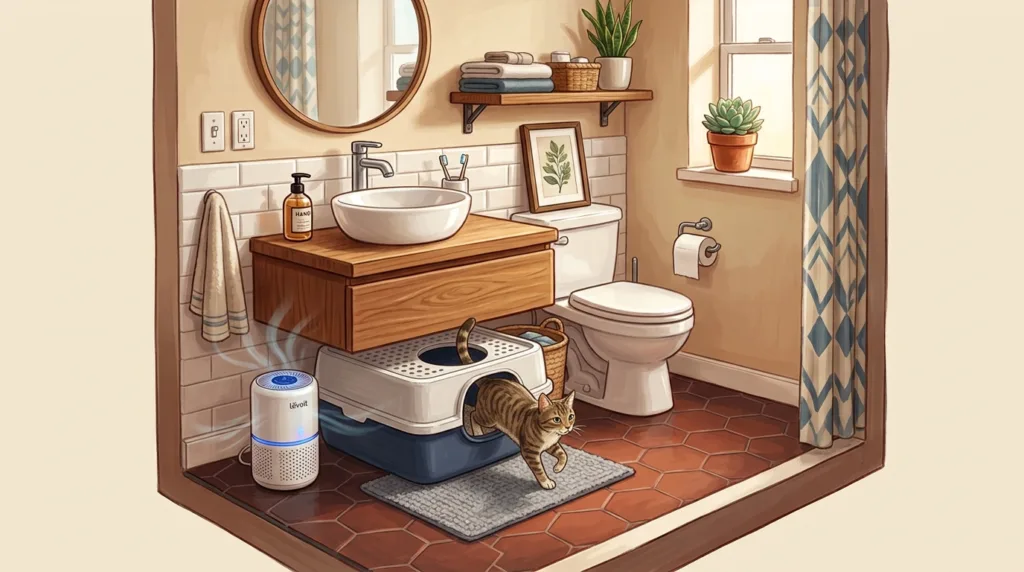
Rather than ranking rooms from best to worst, it is more useful to evaluate what each location solves and what new problem it might create.
Bathroom: often easy to clean and naturally separated from food preparation, but it works only if access remains reliable and household traffic is tolerable.
Bedroom: can be quieter and consistently accessible, although litter tracking and odor may be more noticeable to the renter.
Living-room corner: sometimes offers excellent accessibility in a studio or small apartment, but the location needs enough separation from feeding areas and heavy foot traffic.
Laundry area: may offer durable flooring and convenient cleanup, yet noise and vibration from appliances can make some placements unsuitable.
Hallway or transitional space: can use otherwise wasted floor area, provided the cat is not repeatedly interrupted by people moving through the same narrow route.
Closet: potentially discreet, but only when the door cannot accidentally block access and the space remains large enough, ventilated and practical to clean.
The value of looking at these tradeoffs is that it prevents a room label from substituting for observation. Two bathrooms can function completely differently. One may have a quiet corner with permanent access, while another has almost no usable floor space and a door that remains closed for long periods.
The same principle applies if you are touring a new rental. Instead of asking only whether a litter box “will fit,” look for at least one location that remains accessible, reasonably quiet and practical for daily maintenance once your furniture is in place.
Avoid solving a location problem by changing everything at once
When a cat begins avoiding the litter box, renters may respond by moving the box, changing the litter, replacing the box itself and introducing a new cleaning product simultaneously.
That makes it difficult to learn which factor mattered.
If the location is genuinely problematic, change it deliberately. When possible, preserve other familiar characteristics while testing the new placement. The ASPCA’s advice to move an established box gradually reflects the value of continuity, particularly when the cat has already been using the previous setup reliably. citeturn713803search7
More importantly, litter-box avoidance should not automatically be treated as a decorating problem. The ASPCA notes that a cat that stops using the litter box may have an underlying medical condition and recommends veterinary evaluation when litter-box problems develop.
That distinction protects the cat and also prevents a renter from redesigning the apartment repeatedly while overlooking a health issue.
Once medical concerns and box-management factors have been considered, location can be evaluated more meaningfully: Is the route blocked? Has a new appliance changed the noise level? Did another pet begin guarding the area? Has the box become difficult for an older cat to enter?
Those are specific problems with specific consequences. They are more useful than assuming the cat simply dislikes the apartment.
Choose the location you can keep working
A litter-box location does not have to be invisible, elegant or perfectly separated from every other household function. In a small rental, compromise is inevitable.
What matters is whether the compromise preserves the essentials: the cat can reach the box reliably, use it without regular disturbance, remain reasonably separated from food-related areas, and leave again without being trapped or challenged. The renter, meanwhile, needs enough access to scoop, clean the surrounding area and notice when something about the cat’s normal litter-box behavior changes.
Once those conditions are met, appearance becomes a secondary decision. A box that is slightly more visible but consistently used and easy to maintain is usually more functional than a beautifully concealed setup that creates access or cleaning problems.
In a small apartment, the best location is therefore not a particular room. It is the place where the cat’s access and the household’s maintenance routine can continue to work together day after day.

Alex is the content editor at PetzNews, covering pet care guidance and pet-friendly housing topics for renters and property owners across the United States