
A scratched sofa is inconvenient. Scratched carpet at the edge of a doorway or damaged trim in a rental can become a different kind of problem because the surface may belong to the landlord rather than the renter.
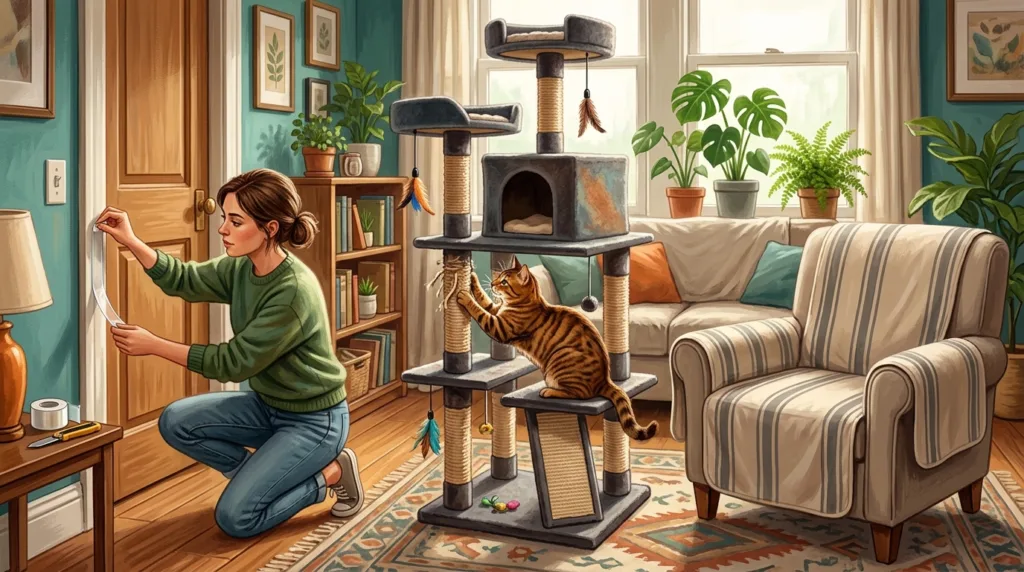
The most effective response, however, usually starts before any protective covering is installed. Cats scratch for normal reasons: the behavior helps maintain their claws, leaves visual and scent marks, stretches the body and becomes part of how they use familiar territory. The Feline Veterinary Medical Association explains that scratching is a normal feline behavior associated with claw maintenance and visual and scent marking. Consequently, protecting a rental is less about stopping scratching altogether and more about understanding which surfaces the cat is choosing and providing acceptable alternatives in places that make sense to the animal.
That distinction is especially useful in an apartment, where scratching may become concentrated around a small number of high-value locations. A cat may ignore a perfectly good post in one corner while repeatedly targeting carpet beside the bedroom door. Rather than interpreting that as stubbornness, the renter can use the pattern as information.
Read the scratching pattern before buying another post
When unwanted scratching keeps happening, three details are particularly revealing: what the cat scratches, how it scratches and where the scratching occurs.
The material gives one clue. Some cats repeatedly choose carpet, while others prefer upholstery, cardboard, rope, wood or another texture. Orientation gives another: one cat may stretch upward against a vertical surface, whereas another consistently scratches along the floor. The Feline Veterinary Medical Association notes that cats can have preferences for different scratching substrates as well as vertical, horizontal or angled orientations.
Location completes the picture. Scratching often happens in places that already matter to the cat rather than wherever humans would most like to place pet equipment. FelineVMA guidance notes that scratchers are particularly useful near sleeping areas, entryways, windows and other locations where cats naturally spend time or may mark territory. Cats commonly scratch after waking as well, which helps explain why a post beside a preferred resting area can attract more use than one hidden across the apartment.



These clues are more useful together than separately. If a cat repeatedly scratches the horizontal edge of carpet outside the bedroom, buying another tall sisal post may not address the preference that the cat has already demonstrated. A sturdy horizontal scratcher placed close to the target area is a much more direct experiment.
The same reasoning applies when the sofa is involved. First notice whether the cat uses the vertical side, the horizontal seat edge or one particular corner. Then match both the orientation and a reasonably appealing texture before deciding that the cat “doesn’t use scratching posts.”
This observation-first approach also fits the broader way cats use apartments. As discussed in our practical guide to living with a cat in an apartment, feline resources tend to work better when they are distributed according to the animal’s actual routes and resting areas rather than grouped wherever there is leftover space.
Put the alternative where the behavior is already happening
One of the easiest mistakes is choosing the scratcher for the room rather than for the cat.
A renter may put an attractive scratching post beside a bookcase because it looks organized there, yet the cat continues using the sofa twenty feet away. From the renter’s perspective, an alternative exists. From the cat’s perspective, the preferred location still offers the more useful scratching surface.
Both the ASPCA and FelineVMA recommend placing appropriate scratching surfaces near locations the cat already targets. The ASPCA specifically advises positioning a scratching post beside furniture or another object the cat has been scratching, while FelineVMA guidance similarly emphasizes placing scratchers where unwanted scratching is occurring.
Once the cat begins using the appropriate surface consistently, the renter can decide whether the scratcher needs to remain exactly there. Moving it several feet away over time may work in some homes; relocating it immediately to a more aesthetically convenient corner can simply recreate the original problem.
Stability matters as much as placement. A vertical post that wobbles when the cat stretches against it may be less appealing than a solid piece of furniture. The ASPCA recommends sturdy scratching posts that are tall enough for the cat to stretch fully. Horizontal scratchers likewise need to remain reasonably stable instead of sliding across the floor every time they are used.
For renters, this is good news because an effective scratching setup does not necessarily require permanent installation. A freestanding post with a stable base, a cardboard scratcher or another removable option can often provide the desired surface without drilling into the rental.
Protect the target while the new habit develops
Providing a better option and protecting the existing target can work together. The key is to use protection that is appropriate for the material underneath and compatible with the rental.
Suppose a cat has developed a habit of scratching one upholstered corner of a sofa. A renter-owned sofa can often be temporarily covered while an appropriate scratcher is placed beside it. If the target is landlord-owned carpet, trim or another fixed surface, the decision requires more caution because an adhesive, screw or protective film can cause its own damage.
This is where generic advice such as “just put tape on it” becomes less useful. Paint, finished wood, carpet, laminate and upholstery react differently to adhesives and coverings, particularly when something remains attached for weeks or months. A product advertised as removable is not automatically harmless on every finish.
The safer principle is to protect the surface without creating a second repair. Before attaching anything to landlord-owned material, review the product instructions and the lease, and avoid permanent alterations unless the property has approved them. Where possible, freestanding barriers, appropriately placed scratchers or coverings that interact with renter-owned furniture rather than the building itself reduce that risk.
FelineVMA’s current behavior guidance supports the broader strategy of using suitable furniture or carpet protectors while providing a preferred scratching surface at the problem location. Its emphasis is not merely on making the old surface unpleasant; the cat also needs an appropriate place for the normal behavior to continue.
That second part matters. Covering a target without offering another suitable scratching surface can remove one option while leaving the underlying need unchanged. The cat may simply choose the next available chair, carpet edge or piece of trim.
Reward the surface you want the cat to choose
A scratching post is more useful when the cat discovers that interacting with it leads to a good outcome.
For some cats, simply placing the right material in the right location is enough. Others may need additional encouragement, particularly when an existing surface has already become familiar.
FelineVMA recommends using positive reinforcement such as treats, toys or preferred attention to encourage use of appropriate scratching surfaces. The timing matters: the reward should follow the desired behavior rather than appear randomly near the post.
This approach is quite different from carrying the cat to the scratcher and physically moving its paws against the material. The ASPCA advises against forcing a cat’s claws onto a scratching post because the experience can frighten the cat and make the post less appealing.
Punishment creates a similar problem. A renter who discovers new damage may understandably become frustrated, but yelling or physically disciplining the cat does not teach which surface should replace the damaged one. FelineVMA specifically recommends avoiding punishment for unwanted scratching and instead redirecting the behavior toward appropriate resources.
The practical sequence is therefore straightforward even if changing an established habit takes time: make the desirable surface easy to find, match it reasonably well to the cat’s demonstrated preference and reinforce its use. Meanwhile, make the old target less available where that can be done safely.
Nail care can reduce damage, but it does not replace scratching
Regular nail trimming can make claws less sharp and may reduce the amount of damage caused when a cat scratches an unintended surface. The ASPCA’s general cat-care guidance recommends routine nail trimming and appropriate scratching posts as complementary parts of normal cat care.
Those measures perform different functions. Nail trimming changes the sharpness of the claw tip; scratching remains a normal behavior that cats use for several purposes. A cat with freshly trimmed nails may therefore continue using the same scratching locations.
If you are not comfortable trimming your cat’s nails, veterinary staff or a professional groomer can demonstrate an appropriate technique. Trying to rush through the process with a cat that is resisting strongly can make future handling more difficult and increases the chance of cutting the sensitive portion of the claw.
What should not become a rental-protection shortcut is declawing. The ASPCA states that declawing should not be used as a behavioral remedy or preventative measure for scratching and recommends nonsurgical alternatives such as appropriate scratchers, nail care and environmental management. FelineVMA likewise opposes declawing and recommends meeting the cat’s scratching needs through environmental and behavioral strategies.
That boundary is important in a rental article because concern about property damage can make permanent solutions sound superficially attractive. The better approach is to manage the behavior in a way that protects both the property and the cat.
A new scratching pattern can tell you something has changed
Once a scratching setup is working, a noticeable change deserves observation rather than an automatic assumption that the cat has become destructive.
The location may have changed because furniture was moved or a new cat entered the household. A new scratching area near a window or entrance can also coincide with increased territorial stimulation. FelineVMA notes that scratching may occur prominently near doors, windows and other locations where territorial or environmental pressures are relevant.
Age and physical comfort can alter preferences as well. Current FelineVMA guidance notes that a cat’s preferred scratching orientation or surface can change over time, including when mobility or chronic conditions affect how comfortably the cat can use a previous setup. A senior cat that once stretched against a tall post, for example, may begin preferring a lower or horizontal surface.
That does not mean every change in scratching indicates illness. It means an abrupt or substantial behavioral change should be considered in context, particularly if it appears alongside changes in movement, appetite, litter-box use, vocalization or other behavior. When health or pain may be involved, veterinary assessment is more useful than continually replacing scratching products.
For renters, this distinction can prevent a common cycle: new scratching appears, the surface is blocked, another surface becomes the target, and increasingly restrictive barriers are added without asking why the pattern changed.
Document the property separately from managing the cat
Behavior management and rental documentation solve different problems.
Even with appropriate scratching surfaces, a renter should know what condition the apartment was in at the beginning of the tenancy. Existing carpet fraying, scratched door trim or damaged surfaces are much easier to distinguish from new damage when they were documented before the cat moved in.
If that record was created at move-in, keep it with the rest of the tenancy documents. Our broader guide to what renters should document when pet-related damage becomes a concern explains how photographs, dates and communication can help preserve the sequence of events.
When new damage does occur, avoid immediately attempting a permanent repair simply to make the mark disappear. Lease terms may regulate painting, carpet repair, trim replacement or other alterations. Depending on the surface and the extent of the damage, notifying management or asking how repairs should be handled may be more appropriate than improvising.
The same separation is useful when thinking about the security deposit. Preventing scratching damage can reduce one potential source of deductions, but security-deposit questions involve broader rules about property condition, documentation and applicable law. Those issues are covered separately in our guide to protecting a security deposit when renting with a pet.
In everyday life, the renter’s best protection usually happens earlier. When the cat has suitable scratching options in the places where it naturally wants to use them, there is less pressure to solve a property problem after damage has already accumulated.
Make the scratching setup fit the cat and the rental
A useful scratching arrangement rarely consists of one post placed somewhere convenient and forgotten. It develops from watching how the cat uses the home.
If the cat prefers carpet, that preference matters. If it scratches vertically after waking, both orientation and location matter. If the main target is beside a window, moving the only scratcher to a distant hallway because it looks better there works against the information the cat is already providing.
For renters, the additional constraint is that solutions should not create their own property damage. That favors thoughtful placement, stable freestanding scratchers, surface-compatible protection and lease-aware decisions about anything attached permanently to walls, floors or trim.
Once those pieces work together, scratching becomes much easier to manage because the renter is no longer trying to eliminate the behavior. The cat has an acceptable place to perform it, while the parts of the rental that matter most are no longer competing for the same function.

Alex is the content editor at PetzNews, covering pet care guidance and pet-friendly housing topics for renters and property owners across the United States