
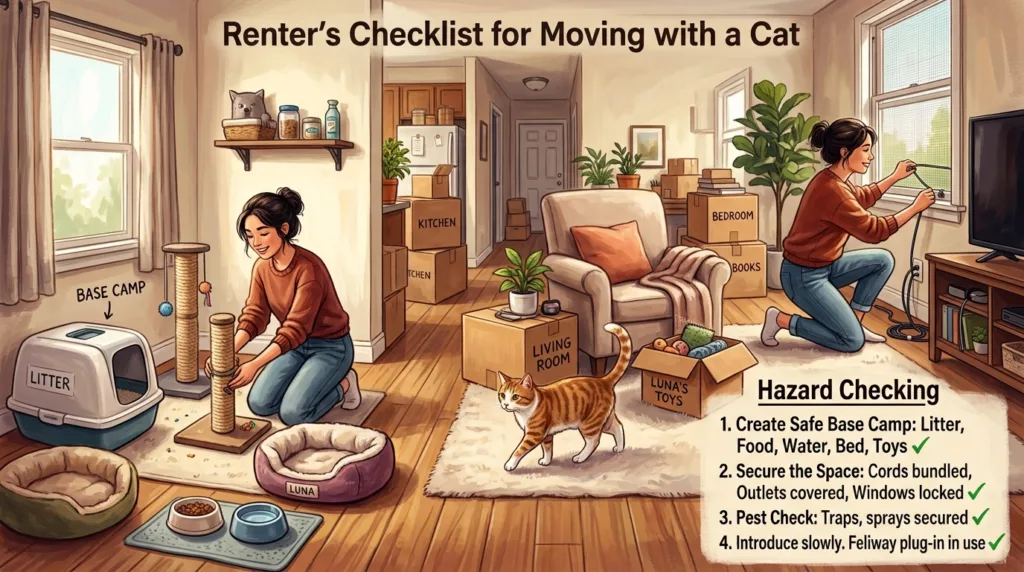
Moving day combines two situations that cats often handle poorly: their familiar territory is being dismantled while unfamiliar people, objects, sounds and doors appear around them. The practical challenge for a renter is therefore not simply getting the cat from the old address to the new one. It is reducing the number of changes the animal has to process at the same time.
The ASPCA recommends introducing moving boxes before the final packing rush, keeping cats in a familiar room that is packed later and maintaining their normal routine as much as possible. Once the move reaches the new apartment, the same principle still applies: familiar resources can remain stable even though the surrounding territory has changed.
A useful moving checklist should reflect that. Some tasks belong well before moving day, others need to happen before the carrier is opened at the new address, and several decisions are better postponed until the cat has had time to settle.
Checkpoint 1: Get the cat ready before moving day gets busy
Carrier preparation is worth doing early because the carrier will become one of the most important pieces of equipment on moving day. If it normally appears only before unpleasant trips, introducing it on the morning of the move adds another unfamiliar event to an already disrupted environment.
The ASPCA recommends acclimating pets gradually to their carriers before a move. For cats traveling by car, the Feline Veterinary Medical Association also recommends choosing an appropriate carrier, helping the cat become familiar with it in advance and transporting the carrier securely in the vehicle.
Keeping the carrier accessible for several days or weeks can make it part of the apartment rather than a sudden trap. Familiar bedding may be placed inside, and food, treats or play can be associated with the area when appropriate for the individual cat. The purpose is not to force long confinement sessions before the move; it is to reduce novelty.

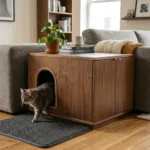

At the same time, separate the supplies you will need immediately from the general household packing. Food, medication, litter, scoop, bowls, familiar bedding and cleaning supplies should not disappear into boxes that may take several days to unpack.
Before moving day:
- Leave the carrier available early enough for the cat to investigate it before the trip.
- Keep familiar food, litter and essential supplies separate from the main moving boxes.
- Check that identification and microchip contact information, if applicable, are current.
- Confirm that the new rental’s pet paperwork, approvals or pet addendum have been completed when required.
- Decide where the cat will stay while movers are entering and leaving the old apartment.
- Preserve normal feeding and litter-box routines as much as the move allows.
If the move crosses a state or territorial boundary within the United States, paperwork should also be checked before travel. USDA APHIS explains that pet entry requirements for interstate moves are set by the destination state or territory and can include health certificates, vaccinations, tests or other requirements. Because those rules vary by destination, they are better verified early than discovered on the day of travel.
Checkpoint 2: Make the new apartment cat-ready before opening the carrier
There is an important moment in a cat move that is easy to overlook: the new apartment is yours, but the cat has not entered it yet.
Use that window of time.
Before the carrier opens, walk through the rental from the perspective of an animal that can fit behind furniture, jump onto a sill and investigate spaces you may not have noticed during the showing. The ASPCA recommends pet-proofing the new home by securing electrical cords, blocking spaces where a pet could become trapped, checking windows and screens, removing poisonous plants and looking for pest-control products left in the property.
For a renter, this inspection should happen alongside the ordinary move-in record. Photograph existing scratches, carpet damage, damaged screens, stains and other visible conditions before boxes and furniture cover them. The more detailed guide on documenting a rental before moving in with a pet explains that process separately.
Windows deserve particular attention before the cat has access to the room. A screen that is loose at one corner may not be obvious during a normal apartment tour, yet it matters considerably once the sill becomes part of the cat’s territory. The same applies to balconies and exterior openings; our guide to making apartment windows and balconies safer for cats covers those barriers in more detail.
The other priority is deciding which room will serve as the initial base. It does not need to be the room you ultimately consider the cat’s main area. It needs to be secure, relatively quiet and capable of holding the essentials while unloading continues elsewhere.
Before the carrier opens:
- Close and secure exterior doors, windows and other possible escape routes.
- Inspect window screens rather than assuming they are firmly attached.
- Check behind appliances, cabinets and furniture for spaces where the cat could become trapped.
- Remove accessible hazards, medications, unsafe plants and leftover pest-control products.
- Photograph the condition of rental surfaces before they are covered by belongings.
- Prepare one quiet room with litter, water, food, familiar bedding and a scratching option.
- Keep the litter box separated from food and water as the available room allows.
- Make sure movers do not need to use that room as a route through the apartment.
Setting up that room first also prevents a common moving-day conflict: trying to find the litter box, food and bedding while the cat is already loose in an unfamiliar property.
Checkpoint 3: Keep moving day smaller than the move itself
During loading and unloading, the main risk is not that the cat fails to “understand” what is happening. It is that the household becomes unusually difficult to control. Doors remain open, movers cross rooms repeatedly and familiar hiding places disappear as furniture leaves.
The ASPCA recommends keeping cats in a quiet closed room or with a trusted person during the busiest part of moving day. Either arrangement can work; what matters is that the cat is not relying on ordinary household boundaries during a period when those boundaries repeatedly disappear.
When travel begins, keep the cat contained rather than opening the carrier in parking areas, building entrances or other unsecured locations. For motor-vehicle transport, the Feline Veterinary Medical Association recommends securing the cat’s carrier in the vehicle and reducing visual stress when appropriate, for example by partially covering the carrier with a towel or blanket.
A cat that becomes highly distressed during travel may need an individualized plan discussed with a veterinarian before the move. The day of the trip is not the ideal moment to experiment independently with medication or unfamiliar calming products.
On moving day:
- Put the cat in the planned secure location before doors begin opening repeatedly.
- Confirm that everyone involved in the move knows where the cat is.
- Transport the cat in an appropriate secured carrier rather than loose in the vehicle.
- Keep necessary medication and essential supplies accessible during the trip.
- Do not open the carrier in an unsecured hallway, parking lot or loading area.
- At the new apartment, take the carrier directly to the prepared room before releasing the cat.
- Keep that room closed while unloading continues elsewhere.
The goal is to make the cat’s version of moving day much smaller than the human version. Movers may need access to every part of the property; the cat does not.
Checkpoint 4: Let one room become familiar before introducing the whole apartment
Once the front door finally closes and the boxes are inside, there can be a strong temptation to open the carrier and let the cat inspect the entire new home. For some confident cats that may appear to go smoothly, but there is no need to make full access the default.
The ASPCA recommends starting a pet in a single “home base” containing familiar toys, food, water and the litter box, then introducing additional rooms gradually as the animal becomes comfortable. This approach gives the cat a manageable territory from which the rest of the apartment can later be explored.
Familiar belongings are useful here because not everything needs to change with the address. The old bed, blanket, scratching surface or other regularly used items already carry familiar scents. Washing or replacing all of them immediately may make the new apartment aesthetically fresh for the renter while removing some of the continuity available to the cat.
The litter box deserves particular stability. If possible, begin with a litter and box the cat already uses rather than combining a new home, new box, new litter and new location in one experiment. When the temporary home-base location is different from the box’s eventual permanent position, the ASPCA recommends moving it gradually rather than making an abrupt change.
For the permanent setup, choosing a workable litter box location in a small apartment still requires balancing reliable access, quiet, hygiene and household circulation.
During the first days:
- Begin with the prepared room rather than automatically opening the entire apartment.
- Keep familiar bedding, scratching surfaces and other known resources available.
- Maintain familiar feeding times where practical.
- Avoid changing litter type and box style at the same time unless there is a reason to do so.
- Confirm that the cat is eating, drinking and using the litter box normally.
- Let exploration expand at the cat’s pace instead of carrying the animal from room to room.
- Open additional areas only after checking their windows, doors and hiding spaces.
- Position scratching options where the cat actually begins using the new territory.
That final point matters because the cat may establish different routes and resting locations in the new apartment. A scratching post that worked perfectly beside a bedroom door in the previous home may be less relevant if the cat now spends most of its time near another window. The principles in protecting a rental from cat scratching can then be applied to the behavior that actually appears in the new space.
Do not confuse slow adjustment with a failed move
Cats differ in how quickly they begin treating a new apartment as ordinary territory. One may begin exploring within hours, while another spends considerably more time in the initial room before showing interest in the rest of the property.
There is little value in forcing the timetable simply because the renter wants the move to feel finished. A cat that is eating, using the litter box and gradually becoming more willing to explore may simply need time. Conversely, significant changes in elimination, appetite or health should not automatically be written off as normal moving stress.
Cornell notes that environmental stressors, including a move to a new home and changes in routine, can be relevant in some feline urinary problems. This does not mean a move will cause urinary disease, but it is another reason to pay attention when a cat shows difficulty urinating, repeated litter-box changes or other concerning signs rather than simply waiting for the animal to “settle.”
Once the cat is moving comfortably through the apartment, the temporary safe-room arrangement can gradually become part of the permanent floor plan or disappear altogether. At that point, review the practical details that matter for the tenancy: the final litter location, protected scratching areas, secured windows, stored pet supplies and any property-specific pet rules.
A useful moving checklist does not end when the carrier reaches the new address. It ends when the temporary precautions are no longer doing essential work because the cat has a stable, safe setup that also functions for the rental household.

Alex is the content editor at PetzNews, covering pet care guidance and pet-friendly housing topics for renters and property owners across the United States