
A ball python can look like an ideal apartment pet: quiet, contained, and unlikely to bother a neighbor with barking. But “quiet” does not mean simple, cheap, or automatically allowed. For a renter who cannot afford to lose a security deposit or move again, the most important ball-python decision happens before bringing the snake home.
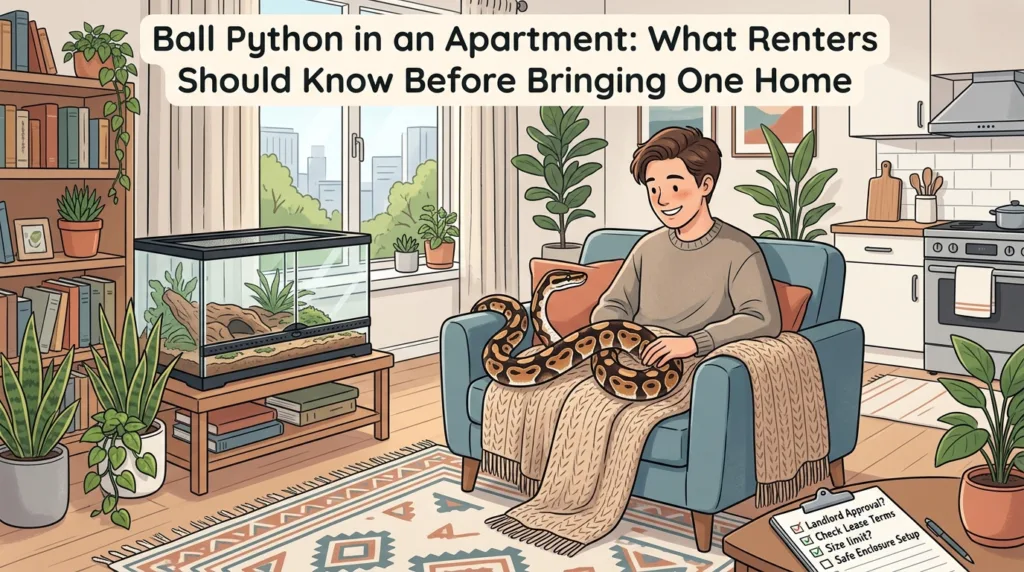
You need to know whether your lease allows a constricting snake, whether your city or state requires a permit, whether your apartment can support a secure heated enclosure, and whether you can reach a reptile veterinarian. You also need a plan for feeder rodents, power outages, maintenance access, and your next move. A ball python is a long-term animal, not a temporary decoration for a rental bedroom.
Ball python or “royal python”? Start with the exact animal
In the United States, ball python usually refers to Python regius, also called a royal python. It is a nonvenomous constricting snake, which matters because a landlord, city ordinance, insurance policy, or roommate may treat “snake,” “exotic animal,” “constrictor,” and “python” as different categories.
Do not assume that a small juvenile will remain a small pet. The enclosure, escape protection, heating equipment, electrical load, feeding routine, and handling plan must work for the adult animal too. Ask an exotic-animal veterinarian for species-appropriate husbandry guidance rather than relying on a seller’s minimum setup.
The lease is your first care requirement
A ball python can be legal to own and still prohibited by your lease. A pet addendum may list dogs and cats without mentioning reptiles. Another lease may prohibit “exotic,” “wild,” or “dangerous” animals without defining those terms. A third may require written approval, an additional deposit, proof of insurance, inspection of the enclosure, or a limit on the number of animals.
Get these answers in writing
Does the property allow a nonvenomous ball python? Is approval required before possession? Does the building prohibit constrictors or pythons by name? Is the terrarium considered a pet enclosure, an electrical appliance, or a safety risk? Can maintenance staff enter the unit when the snake is inside? What happens if the lease is renewed under a different pet policy?

Do not hide the snake because the terrarium is enclosed. An unauthorized animal can become a lease violation, and an undisclosed heat lamp or high-wattage equipment can create a separate concern. Save the written approval with your lease documents. If the property manager gives you a verbal “that should be fine,” ask for the exact approval in an email or signed addendum.
Legality changes at the city line
There is no safe national shortcut that says every U.S. renter may keep a ball python without checking local rules. Municipal ordinances can be stricter than state rules. For example, the City of Janesville, Wisconsin, says its ordinances do not allow wild, exotic, or vicious pets including constricting snakes such as pythons or boas, while distinguishing other nonconstricting snakes. That is a local example, not a rule for every Wisconsin renter or every U.S. city read Janesville’s animal ordinance guidance.
New Jersey illustrates a different problem: the Department of Environmental Protection directs residents to species-specific exotic and nongame wildlife rules, permit categories, exemptions, and renewal requirements. Albuquerque, New Mexico, also publishes local animal permit information, including an exotic or wild animal collection permit for certain numbers of animals. Neither page should be read as a universal ball-python requirement. They show why the correct search is your state wildlife agency plus your city or county animal code check New Jersey’s species and permit framework see Albuquerque’s local permit information.
Before purchase, search the official website for your state wildlife agency, city animal services department, and county code. Ask whether the rule applies to possession, sale, transport, breeding, or only certain species and sizes. A pet-store employee or social-media post is not a substitute for the current local rule.
The enclosure is part of the apartment’s infrastructure
A ball python needs a secure enclosure, controlled heat, appropriate humidity, hides, water, substrate, and a way to monitor conditions. The setup should prevent escape, protect the snake from burns and overheating, and keep the equipment stable when a renter is away.
Think about the apartment before choosing the terrarium. Is the floor strong and level? Can the enclosure be secured away from direct sunlight, drafts, radiators, and air-conditioning vents? Can you reach the thermostat and electrical connection without running cords across a walkway? Is there enough clearance for a maintenance worker to access the wall outlet without opening the enclosure?
| Rental question | Why it matters | What to verify |
|---|---|---|
| Where will the enclosure stand? | Uneven furniture or a busy walkway can create escape and tipping risks. | Stable surface, secure doors, no direct sun, safe clearance. |
| How will heat be controlled? | Heat equipment can fail, overheat, or draw attention during inspections. | Thermostat, monitoring, safe wiring, backup plan. |
| Where will food be stored? | Frozen feeder rodents must remain separate from human food. | Dedicated labeled container and freezer space. |
| Where will cleaning happen? | Reptile equipment can carry germs and wastewater. | Non-food preparation area, disinfecting plan, landlord rules. |
| What happens during an outage? | Apartment heating and terrarium heating may fail together. | Emergency contact, safe temporary transport, local reptile help. |
A specialist veterinary source such as Chicago Exotics Animal Hospital describes ball-python temperature and humidity requirements as part of routine husbandry. Exact ranges and equipment choices should be confirmed for your animal and enclosure with a reptile veterinarian, because a number on a care sheet does not replace measuring the actual habitat review a reptile veterinary ball-python care guide.
The true cost is more than the snake
A low purchase price can make a ball python look accessible to a renter on a tight budget. The larger financial question is whether you can pay for a safe setup before the animal arrives and maintain it month after month.
| Cost category | What the renter should budget for | Why it can surprise you |
|---|---|---|
| Enclosure | Secure, appropriately sized habitat with doors that lock. | A juvenile setup may need replacement as the snake grows. |
| Heat and monitoring | Thermostat, heat source, thermometers, hygrometer, safe wiring. | The cheapest heat source is not necessarily the safest. |
| Interior setup | Hides, water bowl, substrate, cleaning supplies and replacement parts. | Humidity, spills and wear create recurring purchases. |
| Food | Frozen feeder rodents stored separately from human food. | Small apartments may lack freezer space and safe thawing space. |
| Veterinary care | Exotic-pet examination, transport and emergency reserve. | Not every neighborhood clinic treats snakes. |
| Rental costs | Approved pet fee, deposit, insurance requirement or inspection. | “Pets allowed” may not include reptiles. |
Do not use a generic online estimate as proof that the animal fits your budget. Call a reptile veterinarian near the apartment, ask about an initial exam and emergency availability, price the required equipment, and confirm whether your lease adds a charge. If paying for the enclosure leaves no emergency reserve, wait. The snake’s low monthly food cost does not cancel the cost of veterinary care or a failed heating system.
Feeder rodents create a shared-housing responsibility
The CDC warns that reptiles and their environments can carry Salmonella even when the animal appears healthy. Its guidance also says to keep reptiles, equipment, and feeder rodents away from areas where food is prepared, stored, served, or eaten. That matters in a studio apartment where the kitchen, dining table, and pet storage may be only a few steps apart read the CDC’s reptile and amphibian safety guidance.
Use a dedicated labeled container for frozen feeder rodents. Do not thaw them in a microwave, kitchen sink, or on a food-preparation surface. Plan where cleaning will happen, how wastewater will be disposed of, and how you will disinfect the area afterward. Ask roommates or family members about allergies, pregnancy, age-related risk, and comfort with handling frozen feeders.
Never release a ball python outdoors if you can no longer keep it. Contact the breeder, a reptile rescue, an exotic-animal veterinarian, or local animal services for a responsible surrender plan. Abandonment can endanger the snake, native wildlife, neighbors, and your lease.
Safety for neighbors is part of being a good renter
A ball python is not venomous, but it is still a constricting snake. The relevant safety questions are not whether the animal barks. They are whether the enclosure can be opened by a child, whether the snake can escape during feeding or cleaning, whether maintenance staff could encounter it unexpectedly, and whether a roommate knows what to do if a door or thermostat fails.
Keep the animal in its enclosure unless handling is intentional and supervised. Do not handle it immediately after feeding or when it is showing signs of stress or shedding. Keep the enclosure locked, label it discreetly for emergency responders, and maintain a written care sheet with the species, feeding schedule, veterinarian contact, and emergency instructions.
Apartment life in Phoenix is not apartment life in Chicago
Phoenix
Cooling costs, direct sun, and power outages can affect both the apartment and the enclosure. Keep the habitat away from windows and ask how the building handles prolonged outages or HVAC failures.
Houston
Humidity and storm-related outages can complicate ventilation, cleaning, transport, and temporary housing. Keep a sealed transport container and identify an exotic veterinarian before an emergency.
Chicago
Winter temperatures make transport and move-in timing important. Do not carry the snake through freezing conditions without a species-appropriate plan, and confirm whether the building’s heat and electrical access are reliable.
New York City or another dense market
Space, elevator access, roommates, delivery storage, and building rules can matter more than the purchase price. A terrarium that blocks a fire exit or cannot be moved safely is not a workable setup.
These city examples are planning contexts, not legal conclusions. Check the current local code and ask your property manager. The same ball python may be allowed in one nearby municipality, restricted in another, and prohibited by a particular building’s insurance policy.
Plan the next move before the first feeding
Renters move more often than homeowners, and a snake enclosure is not an easy item to improvise around on moving day. Ask a prospective landlord before applying, not after signing. Confirm how the snake will be transported, how the enclosure will be secured, whether the new property accepts the animal, and how temperature will be managed during the trip.
Keep the current lease approval, permit documents, veterinary records, feeding notes, and equipment instructions together. If a landlord sells the building or a new property manager takes over, written records are more useful than “the previous manager said it was okay.”
When the responsible answer is not yet
Wait before getting a ball python if the lease does not clearly allow it, local legality is uncertain, you cannot afford a secure enclosure and emergency veterinary reserve, no reptile veterinarian is reasonably accessible, feeder rodents would be stored beside human food, or a roommate cannot safely live with the setup.
A ball python can fit some apartment households, but only when the animal’s needs fit the rental’s rules and the renter’s finances. The quietness of the snake is a benefit; it is not a waiver of legal checks, husbandry, sanitation, safety, or long-term planning.
For related apartment planning, see PetzNewz’s pet emergency plan for renters, hidden rental costs guide, and questions to ask before touring an apartment. The most renter-friendly snake decision is the one made before money changes hands.

Alex is the content editor at PetzNews, covering pet care guidance and pet-friendly housing topics for renters and property owners across the United States