
Guinea pigs are physically small, but their housing can occupy a surprisingly large part of an apartment. A suitable enclosure needs horizontal floor space rather than height, and that footprint expands further once hay storage, bedding, hiding places, cleaning access and an exercise area are considered. In a rental, the practical question is therefore not simply where a cage will fit. It is whether the whole setup can function in that location every day without creating persistent mess, moisture or damage around it.
This makes guinea pig planning quite different from arranging a home for a rabbit. Rabbits may use a larger bunny-proofed territory outside a primary pen, whereas guinea pigs generally depend much more heavily on a defined enclosure as the center of daily life. The renter consequently has to make that enclosure large and functional enough while also considering what happens immediately outside it: scattered hay, bedding, water drips, cleaning supplies and supervised exercise all require space of their own.
Before planning the physical setup, confirm that guinea pigs are permitted by the property. Rental policies do not always treat every small mammal alike, so the lease or pet policy should identify whether your particular species and number of animals are allowed. Once that question is settled, measuring the apartment becomes much more useful.
Start with the enclosure footprint, then plan the room around it[
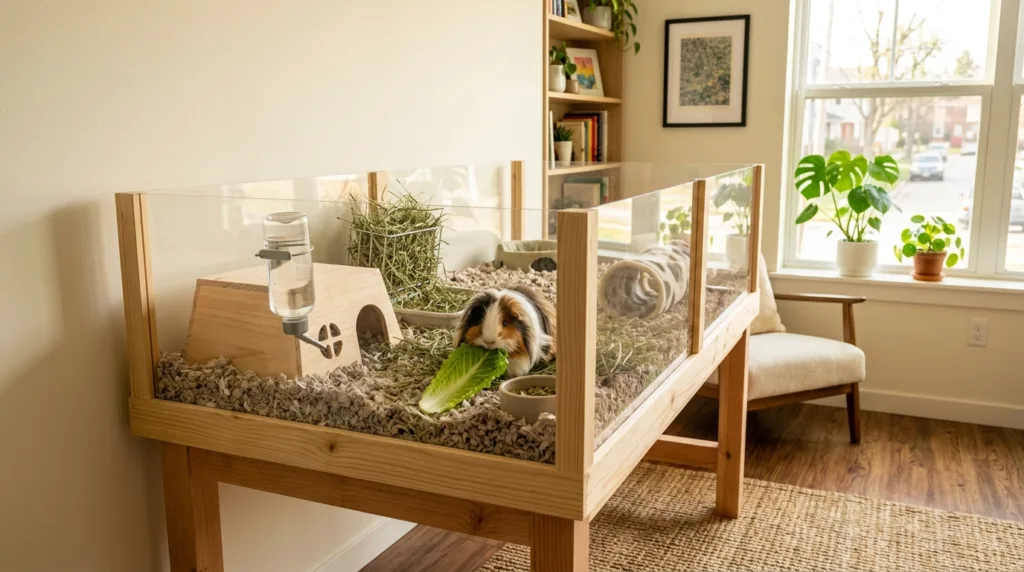
Commercial packaging can make guinea pig housing look more compact than current veterinary guidance suggests. The Merck Veterinary Manual recommends at least 7.5 square feet of enclosure space for one guinea pig, with roughly another 2 to 4 square feet for each additional animal. It also recommends a solid floor rather than wire mesh, which can contribute to foot and limb injuries.
Those measurements change how a renter should evaluate available space. A narrow gap beside a dresser may technically hold a commercial cage, but it may not accommodate an enclosure with an appropriate footprint. More importantly, the enclosure still needs enough clearance around it for opening panels, changing bedding and reaching every corner during cleaning.
That surrounding access often gets overlooked during apartment planning. An enclosure pressed tightly between a wall and heavy furniture may look space-efficient until the first full cleaning, when reaching the back becomes difficult. If daily maintenance requires moving a bookcase or climbing over another piece of furniture, the location is unlikely to remain convenient for long.

Guinea pigs primarily use horizontal space, so stacking equipment upward does not compensate for reducing the floor area they can actually move through. Merck notes that they rarely climb or jump and recommends multiple hiding areas within the enclosure, ideally providing more hiding options than there are guinea pigs. The layout therefore needs to accommodate movement between resting places, food, water and open areas rather than simply fitting the maximum number of accessories into a small footprint.
For renters with more than one guinea pig, companionship and enclosure size need to be considered together. Merck describes guinea pigs as social animals that often do well in pairs or small groups, while also noting that sex and compatibility matter because inappropriate pairings can lead to fighting or breeding. The decision to keep more than one animal consequently increases both the social planning and the amount of floor space required.
A useful way to evaluate a possible location is to account for everything that will routinely occupy that part of the room:
| Space to account for | Why it matters |
|---|---|
| Main enclosure | Permanent usable floor area for the guinea pigs |
| Cleaning clearance | Access to corners, bedding and removable components |
| Hay and supply storage | Keeps bulk supplies available without crowding the enclosure |
| Floor protection zone | Accounts for bedding, hay and water that move beyond the enclosure |
| Exercise area | Provides supervised activity outside the main housing when appropriate |
Adding these pieces together gives a much more realistic footprint than measuring the cage alone.
Choose a location that works for the animals and for daily maintenance
Once you know how much space the setup actually needs, location becomes a question of environmental stability rather than appearance.
Merck recommends good ventilation and specifically advises against glass aquariums for guinea pigs because airflow is inadequate compared with an appropriately ventilated enclosure. The same guidance places a comfortable environmental range around 65–79°F (18–26°C) and recommends keeping housing away from conditions that create excessive heat or humidity. citeturn657922search0turn657922search4
In an apartment, that means a sunny window is not automatically an ideal location simply because it provides natural light. Direct afternoon sun can warm a small area considerably, particularly near glass. Similarly, placing the enclosure directly against a heating vent, air-conditioning outlet or drafty exterior door can create environmental changes that the rest of the room does not experience.
Noise deserves attention for a different reason. Guinea pigs are prey animals and may startle easily, so a location beside a frequently slammed apartment door or directly against a loud entertainment system may create unnecessary disturbance. At the same time, putting the enclosure in a remote room that receives almost no household interaction can create another tradeoff for social animals.
The most workable location is often part of an ordinary living area without being in its busiest traffic path. The guinea pigs remain part of household activity, but people are not stepping around the enclosure every few minutes. That balance also makes observation easier because changes in eating, activity or behavior are more likely to be noticed during the normal day.
Other pets change the calculation. Merck advises caution with dogs, cats and other animals because guinea pigs can be injured or stressed by them. If another pet shares the apartment, the enclosure needs to remain protected even when the renter is not standing beside it. A dog that appears merely curious while supervised should not automatically be assumed safe with unrestricted access to the enclosure when nobody is watching.
Location should also make feeding and water maintenance straightforward. Guinea pigs require continuous access to appropriate hay, and water bottles need regular checking because sipper tubes can become dirty or blocked. Merck notes that guinea pigs commonly soil their living areas, including food and water zones, so easy access to those resources is part of keeping the enclosure functional rather than an aesthetic detail. citeturn657922search0
Plan for hay, bedding and moisture to leave the enclosure
A guinea pig enclosure has an unofficial perimeter outside its walls.
Hay gets pulled outward. Bedding can be kicked or carried beyond the edge. Water bottles may drip. During cleaning, material that was contained inside the enclosure temporarily moves through the apartment. None of those things is necessarily a serious problem, but together they explain why the floor underneath and immediately around the setup deserves planning.
The first layer is the enclosure floor itself. Current Merck guidance recommends a solid base and identifies recycled paper products, fleece and other suitable materials as possible bedding options, while cautioning against materials containing loose fibers or strings. It also warns against aromatic wood shavings because of potential respiratory irritation. citeturn657922search0
Whichever appropriate bedding system is used, the important rental question is what happens when it becomes wet. An absorbent layer that remains damp against laminate, hardwood or another landlord-owned surface can create a different property concern from loose dry bedding that simply needs sweeping.
For that reason, a removable, waterproof or otherwise surface-appropriate protective layer under the enclosure can be useful when it is compatible with both the housing setup and the floor. The protector should extend far enough to cover realistic spill areas without introducing edges that the guinea pigs can reach and chew if that material is unsafe for ingestion.
Hay requires its own strategy because it does not stay neatly where it is stored. Keeping the main supply in a container near the enclosure reduces the distance loose pieces travel through the apartment, while routine sweeping or vacuuming around the area prevents accumulation along walls and furniture.
Cleaning frequency then determines how much odor and moisture can build up. Merck states that guinea pigs soil sleeping areas and produce feces throughout the enclosure, making regular, frequent cleaning necessary. Its pet-owner guidance recommends daily spot cleaning and a more thorough cage cleaning on a regular schedule. citeturn657922search0turn657922search8
UC Davis similarly notes that guinea pigs produce substantial fecal waste and recommends changing soiled bedding frequently to prevent urine-related ammonia from accumulating. It also stresses good ventilation and solid flooring. citeturn657922search1
This is where odor management in a rental becomes less about fragrance and more about material turnover. Removing wet bedding, refreshing heavily used areas and keeping the floor around the enclosure dry generally addresses the mechanism creating odor. Adding scented products without improving cleaning does not perform the same function and may introduce substances unnecessarily into an animal’s environment.
Water deserves a quick check during that routine as well. A bottle that leaks slowly can keep one section of bedding damp for hours before the renter notices it. Checking both the nozzle and the material directly underneath makes it easier to distinguish normal soiling from an equipment problem.
If moisture or staining begins reaching landlord-owned flooring, photograph the affected area and address the source rather than repeatedly covering it. The broader guide on documenting pet-related changes to a rental is relevant once an issue begins affecting the property rather than remaining within normal enclosure maintenance.
Exercise outside the enclosure needs a different safety plan
A well-sized enclosure does not eliminate the value of additional movement. Merck recommends daily supervised exercise in a guinea pig-proofed area, and UC Davis similarly describes supervised activity outside the cage while warning that guinea pigs readily chew wires, outlets and baseboards. citeturn657922search2turn657922search1
The important word for apartment planning is supervised.
Guinea pigs are small enough to disappear behind furniture and can reach hazards that were irrelevant while they were inside the enclosure. Electrical cords become chew targets, gaps beneath cabinets can become hiding places, and a person walking through the room may not immediately see an animal close to the floor.
Instead of trying to guinea-pig-proof the entire apartment, a renter can create a temporary exercise zone. A portable pen or another safe barrier can define the space while keeping cords, toxic plants, furniture gaps and landlord-owned surfaces outside it. Because the area does not have to remain assembled permanently, this approach can work particularly well where floor space serves several purposes throughout the day.
The surface underneath should provide secure footing and be easy to monitor for urine or waste. UC Davis notes that tile, linoleum and wood surfaces free from exposed wires can be practical for supervised exercise because they are easier to clean, although the individual flooring and the animal’s traction still need to be considered. citeturn657922search1 A removable layer may be useful when the existing floor is slippery or needs additional protection.
Exercise equipment needs species-specific judgment as well. Merck specifically advises against exercise wheels for guinea pigs because they can cause injury. Tunnels, hiding places and an open area for normal movement are more appropriate than borrowing equipment designed for other small pets. citeturn657922search2
This difference is easy to miss in a household where several kinds of small-animal products are sold together. “Small pet” is a retail category, not a husbandry standard; what is suitable for a hamster or rabbit cannot automatically be transferred to guinea pigs.
The exercise period also gives the renter a useful opportunity to inspect the enclosure itself. While the animals are safely elsewhere, it is easier to reach under bedding, check corners, examine the floor protector and notice water or residue that daily spot cleaning may not reveal.
Build the setup around repetition rather than special cleaning days
The most successful apartment arrangement is usually the one that makes ordinary maintenance easy enough to repeat.
If hay is stored at the opposite end of the home, fresh bedding requires moving several boxes and the enclosure cannot be cleaned properly without shifting furniture, even a carefully designed setup can become frustrating. By contrast, keeping supplies nearby and leaving enough working room around the enclosure reduces the effort attached to tasks that occur every day or every week.
That practical ease matters because guinea pigs continuously generate the materials that need managing. Hay is replenished, bedding becomes soiled, water is changed and waste is removed. Unlike an occasional pet accident elsewhere in the apartment, these are predictable parts of the housing system.
A useful final review therefore looks at the full routine rather than at the enclosure in isolation. Is there enough horizontal space for the number of guinea pigs living there? Can every part of the enclosure be reached for cleaning? Does wet bedding remain separated from rental flooring? Are hay and supplies stored without blocking household circulation? Can the animals receive supervised exercise without gaining access to cords and other hazards?
If several of those answers depend on moving heavy furniture, ignoring repeated spills or reducing the animals’ usable space, the problem is probably the layout rather than the guinea pigs themselves. Rearranging the setup before those inconveniences become permanent usually costs less effort than trying to manage around them every day.
For a renter, that is the central planning difference with guinea pigs: their housing is not simply an object placed in the apartment. The enclosure, its maintenance perimeter and the temporary exercise area operate together as one small living system, and the rental works better when enough space has been reserved for all three.

Alex is the content editor at PetzNews, covering pet care guidance and pet-friendly housing topics for renters and property owners across the United States