

A rabbit may occupy one corner of a room when resting, yet the part of the rental that needs planning extends well beyond that corner. Exercise changes how much floor the animal can reach, chewing brings cords and baseboards into the picture, litter habits affect nearby surfaces, and even ordinary furniture can determine which areas remain protected once the rabbit is outside its primary enclosure.
That is why the useful unit of planning is not simply the cage, pen or enclosure. It is the rabbit’s entire usable territory. In a rental apartment, that territory has to provide enough room for normal movement and daily activity while remaining compatible with surfaces and building components the renter does not own.
Before solving any of those practical questions, confirm that the animal itself is permitted. As discussed in our guide to small-pet rental rules, rabbits should not be assumed to qualify automatically under phrases such as “small pets” or “caged animals.” Once permission is clear, the next challenge is making the physical setup work.
Plan a living area, not just a place to put the rabbit
The amount of space occupied by rabbit supplies can be deceptive. A litter box, hay, water and resting area may all fit inside a fairly compact footprint, but fitting the equipment does not establish that the rabbit has enough room to move comfortably.
Rabbit.org describes exercise pens and larger bunny-proofed spaces as modern indoor housing options and explains that a cage should function as part of a broader living arrangement rather than as the rabbit’s entire play space. Exercise areas can be incorporated into the rabbit’s primary territory or provided through access to additional bunny-proofed indoor space.
That distinction is particularly useful for renters. A permanent rabbit room is not necessary in every apartment, nor does free access to the entire home have to be the goal. A renter can define a safe base area with an exercise pen and then decide which additional parts of the apartment can be used without exposing the rabbit or the property to avoidable hazards.

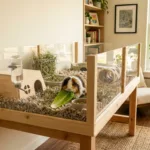

Think about the usable floor rather than the room’s advertised square footage. A living room may look large on a floor plan but offer little rabbit-safe movement once a sofa, television stand, exposed wiring and other furniture are accounted for. Conversely, an appropriately arranged portion of a smaller room can provide a more coherent exercise area if routes are open and hazardous sections are blocked.
Floor traction also deserves attention. UC Davis School of Veterinary Medicine advises avoiding housing arrangements based entirely on wire flooring and providing solid surfaces that can be cleaned or replaced. The same guidance emphasizes that rabbit housing should have enough space to separate resting, activity, litter and food or water functions.
In a rental, removable rugs or mats may help create usable footing on smooth floors, provided the rabbit is not chewing and ingesting the material. The goal is not to carpet the apartment in rabbit products; it is to make the area the rabbit actually uses functional without permanently altering the property.
Bunny-proofing begins where the pen ends
A rabbit that spends exercise time outside its primary area changes the risk map of the apartment immediately. The electrical cord beside a desk, the unfinished edge behind a sofa and the baseboard along the wall can all become accessible even though none of them is near the rabbit’s litter box or bed.
Chewing is normal rabbit behavior, which is why property protection works better when it combines blocking what is unsafe with providing things the rabbit is allowed to chew. Rabbit.org recommends moving electrical cords out of reach or enclosing them in protective tubing and blocking access to household items that should not be chewed. Its training guidance also recommends redirecting unwanted chewing toward appropriate alternatives rather than relying only on interruption.
For renters, the important distinction is between protecting access and modifying the building. Drilling protective panels into trim or tacking sacrificial wood onto landlord-owned baseboards may be appropriate in an owned home but can create a separate problem in a rental. Freestanding barriers, cord management and removable arrangements are usually easier to reconcile with a lease.
Cords need protection for the rabbit, not only for the apartment
Electrical cables deserve priority because the consequence of chewing them is much more serious than cosmetic damage. Rabbit.org identifies exposed electrical cords as a major indoor hazard and recommends making them inaccessible rather than relying on supervision alone.
Start by tracing cables at rabbit height. Television cords, chargers, power strips, lamps and cables running behind a desk can be easy for a person to overlook because they are normally hidden from view. A rabbit moving behind furniture encounters a very different layout.
Whenever practical, raise cables completely out of reach. Where that is not possible, use an appropriate protective system and block access to vulnerable sections. The setup should also be inspected periodically because a barrier that worked when it was installed can move as furniture and electronics are rearranged.
Baseboards, carpet and furniture reveal where access needs to change
Property damage often develops repeatedly in the same places. A rabbit may begin working on one corner of baseboard, pull at a particular carpet edge or investigate the underside of the same chair.
Those patterns are useful information. Rabbit.org’s bunny-proofing guidance describes protecting problem flooring areas and blocking access to vulnerable household surfaces, while its behavior guidance recommends providing acceptable chewing or digging alternatives when a rabbit targets an inappropriate material.
In a rental, observation should determine how much protection is necessary. If one doorway is repeatedly targeted, controlling that location is more practical than surrounding every wall with barriers. If the rabbit digs at a particular carpet edge, restricting access and offering a suitable digging activity may make more sense than covering an entire room.
Be cautious with anything adhesive. A film, tape or temporary protector can still lift paint, leave residue or affect finished surfaces when removed. Before attaching products directly to landlord-owned flooring, walls or trim, check both the product instructions and the lease.
Litter habits can make odor manageable without pretending rabbits are maintenance-free
Rabbits can often learn consistent litter-box habits, but that does not mean the surrounding area will maintain itself. Hay moves, bedding scatters, dry fecal pellets may occasionally appear outside the box, and urine becomes noticeable when an absorbent area stays wet for too long.
UC Davis explains that rabbits naturally tend to eliminate in a particular part of their environment and recommends placing the litter box where the individual rabbit has already shown a preference for eliminating. That observation-based placement can be more effective than choosing the box location entirely according to where the renter would prefer not to see it.
Rabbit.org similarly recommends regular litter-box maintenance and appropriate rabbit-safe litter. Its guidance cautions against clumping litter, dusty clay and highly aromatic softwood shavings, because litter that works for a cat is not automatically suitable for a rabbit.
For odor control, frequency matters more than perfume. UC Davis recommends daily attention to spills, waste and the litter area as part of rabbit housing maintenance. Rabbit.org also notes that litter-box cleaning frequency depends partly on the substrate and setup, with less absorbent arrangements requiring more frequent replacement.
A renter can make this routine easier by treating the box and its immediate surroundings as one maintenance zone. Keep it accessible enough to clean without moving furniture, watch for urine reaching the exterior or floor, and remove wet material before odor becomes established. A removable mat or other appropriate protection may help where the rabbit regularly pushes litter or hay outside the box, provided the material itself is safe around that rabbit.
Strong fragrance is not a substitute for maintenance. If the apartment still develops persistent urine odor despite regular cleaning, inspect the surfaces around and beneath the box rather than simply adding another scented product. Moisture may have reached a mat, flooring edge or nearby material that now needs attention.
A sudden loss of previously reliable litter habits deserves a different response. UC Davis notes that illness, fear and environmental changes can disrupt litter-box use. When a rabbit’s elimination pattern changes noticeably—particularly alongside changes in appetite, fecal output or behavior—the issue should not automatically be treated as a housekeeping failure.
The safest setup is often deliberately limited
Giving a rabbit more room is useful only when the additional room is safe.
That principle helps resolve an apparent conflict in apartment living. A renter may want to provide as much freedom as possible, yet unrestricted access exposes more cords, plants, carpet, furniture and hidden spaces. Restricting the rabbit to an adequately sized, well-arranged area plus additional bunny-proofed exercise space can therefore be more practical than opening every room indiscriminately.
Rabbit.org explicitly notes that free-running rabbits do not need unrestricted access to an entire house and that rooms can remain off-limits depending on how much bunny-proofing has been completed. That approach translates particularly well to rentals because it concentrates protection where it provides the most benefit.
A renter might, for example, use an exercise pen as the rabbit’s stable base and allow access to one adjacent bunny-proofed room during active periods. The office containing multiple unprotected cables can remain closed. A bedroom with exposed carpet edges may become available later after those areas are addressed. The usable territory can expand because the environment becomes safer, not simply because the rabbit has been in the apartment longer.
This approach also makes property monitoring easier. When a rabbit suddenly develops an interest in one wall or begins digging at a new floor area, the problem is visible sooner within a defined territory. The renter can then adjust access before minor wear becomes significant damage.
That does not mean a rabbit should spend its life confined to a tiny pen for the sake of protecting a security deposit. Space and property protection are not opposite goals. The useful compromise is enough functional territory for the rabbit combined with deliberate boundaries around parts of the rental that have not been made safe.
A rental changes over time, so the rabbit-proofing has to change with it
The setup that works during the first month may not remain adequate after the apartment changes.
A new desk introduces cables. Moving the sofa exposes a section of baseboard. Replacing a rug changes the rabbit’s access to carpet beneath it. Even something as ordinary as adding a floor lamp can create a new cord at exactly the height the rabbit explores.
For that reason, bunny-proofing is better treated as a periodic inspection than as a one-time installation. After rearranging furniture or adding equipment, look again from the rabbit’s level and trace the areas it can now reach.
Behavior changes can alter the equation too. A rabbit that ignored a particular surface for months may begin chewing it later. Younger rabbits and newly adopted animals can also reveal preferences only after they become comfortable in the home. When that happens, expanding the protection around the new target is more useful than assuming the original setup has failed completely.
This is where documentation can help the renter as well. If chewing or digging does affect part of the property, record the location and extent rather than waiting until move-out to reconstruct what happened. The broader guide on documenting pet-related rental damage explains how photographs and dates can preserve the condition and sequence of events.
At the same time, do not improvise permanent repairs to landlord-owned surfaces merely because the rabbit caused the damage. Lease terms and property-management procedures may affect how carpet, trim, flooring or walls are supposed to be repaired.
Judge the setup by what happens during an ordinary week
A rabbit-friendly rental setup should not depend on constant emergency intervention. During an ordinary week, the rabbit should have a usable living area and opportunities for movement, while the renter should be able to maintain the litter area and protect vulnerable property without repeatedly rebuilding the apartment.
That provides a more useful test than asking whether the enclosure fits.
Can the rabbit move through its normal territory without reaching exposed electrical cords? Are appropriate chewing and digging options available where those behaviors tend to occur? Can the litter area be cleaned easily enough that wet material and odor do not accumulate? Have carpet edges, baseboards and other recurring targets been addressed in a way that does not create new damage to the rental?
If the answers reveal several weak points, the solution may involve changing the territory rather than adding more equipment. Shifting a pen, blocking one route or moving a cable can sometimes resolve more than purchasing another accessory.
Rabbits may be categorized as small pets in rental paperwork, but planning their home around that label can be misleading. What matters inside the apartment is the amount of safe, functional territory the rabbit can actually use and how well that territory has been reconciled with the surfaces, wiring and maintenance responsibilities of a rented home.

Alex is the content editor at PetzNews, covering pet care guidance and pet-friendly housing topics for renters and property owners across the United States