
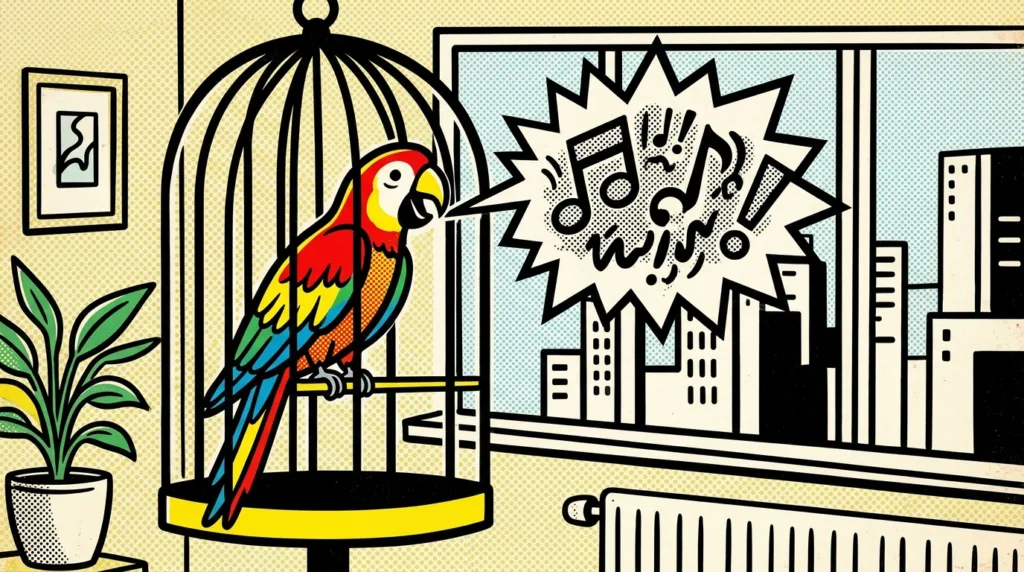
A bird can affect much more of an apartment than the area occupied by its cage. Food and feathers travel beyond the enclosure, out-of-cage exercise changes which windows, doors and household objects become relevant, airborne products used elsewhere in the home can matter to the bird, and vocalization can travel through walls that the animal never approaches.
For renters, this makes cage size only one part of the housing decision. A workable setup has to fit physically, remain safe within the household environment and coexist reasonably with neighbors and rental rules. Those three requirements overlap, but each reaches beyond the enclosure in a different way.
Think about the bird’s three footprints
The physical footprint is larger than the cage
Start with the space the bird actually needs rather than with the smallest enclosure that can fit beside a piece of furniture.
The Merck Veterinary Manual recommends a cage large enough for the bird to move comfortably and at least about one and a half times the bird’s wingspan in all directions. When more than one bird shares an enclosure, additional space is necessary, and compatibility between individual birds also has to be considered.
The cage itself is only the center of that footprint. Doors need enough clearance to open. Trays have to be removed for cleaning. Food and water containers need to be reached without shifting furniture, while toys and perches should not make normal movement through the enclosure impossible. Once supplies are included, the section of the apartment devoted to the birds may extend well beyond the cage base.
Placement changes whether that space works. Merck advises keeping bird housing away from temperature extremes, drafts and locations such as kitchens where smoke or cooking fumes may be present. The CDC similarly recommends a warm, draft-free enclosure location with adequate light and some connection to normal household activity.


That creates a more nuanced decision than simply choosing the quietest unused corner. A bird may benefit from being near ordinary household activity, yet a cage directly in the path between the kitchen and living room can expose it to constant traffic. Beside a window, the cage may receive interesting visual stimulation, but direct heat, cold or drafts can make the location unsuitable. The room has to work environmentally as well as spatially.
Exercise adds another layer. Merck states that birds should have opportunities for supervised activity outside the cage, which means the renter also needs to consider the room when the cage door is open. Open exterior doors, windows, ceiling fans, mirrors, cords and other household features become relevant in a way they were not while the bird remained enclosed.
A small cage in a large unsafe room is therefore not necessarily a better setup than a larger enclosure in a room whose layout has been planned around both contained and supervised out-of-cage activity.
The air footprint can extend through the entire apartment
Bird housing has an unusual feature compared with many other small-pet setups: what happens elsewhere in the apartment may reach the animal through the air.
The Merck Veterinary Manual notes that birds are particularly sensitive to a range of chemical fumes and household hazards, including pesticides, perfumes and sprays. It also identifies smoke and cooking fumes as reasons not to keep a bird’s cage in the kitchen.
In an apartment, that matters because rooms are not sealed environmental compartments. An aerosol used in the bathroom, a strong cleaning product applied nearby or fumes created during cooking can move beyond the place where they originated. Ventilation systems and compact floor plans can make that separation even less distinct.
As a result, choosing a cage location cannot solve every airborne risk by itself. Household routines may also need adjustment. Before bringing a bird into the rental, consider what sprays, cleaners, fragrances or other airborne products are normally used and where. If painting, pest treatment or other maintenance work is scheduled, ask what products will be used and discuss bird safety with an avian veterinarian when exposure is uncertain.
This is also one reason the kitchen deserves special caution. In addition to cooking fumes, it contains heat, open liquids and food-related hazards. Merck identifies open flames, hot cooking areas and fumes among household dangers for birds, while the CDC recommends keeping bird enclosures away from places where food or drinks are prepared or stored.
The implication for a studio apartment can be significant. When the kitchen and living space occupy essentially one room, there may be less ability to separate the bird from routine cooking and cleaning activities. That does not automatically make every studio unsuitable, but it means the air environment deserves deliberate evaluation rather than being treated as an invisible background condition.
The sound footprint may cross walls before anything else does
Bird vocalization is not equivalent across species or even across individual birds. Some produce relatively modest calls, whereas others can vocalize loudly enough that apartment construction and neighbor proximity become part of the ownership decision.
Merck explicitly notes that pet birds can be noisy and recommends that people living in apartments research the expected noise level of a species before bringing one home. This is more useful than asking whether birds in general are “good apartment pets,” because the answer depends heavily on what kind of bird is being considered.
Volume is only part of the issue. Timing matters too. Repeated vocalization early in the morning may affect neighbors differently from similar noise in the middle of the afternoon. The location of the cage can amplify the problem if it sits directly against a shared bedroom wall, while moving it to an interior wall may reduce transmission without isolating the bird from the household.
Before signing a lease or acquiring the bird, listen to recordings and speak with experienced avian professionals about the normal vocal behavior of the particular species. Marketing labels such as “small bird” do not provide enough information; a compact animal can still produce sound that carries easily through an apartment building.
The lease also becomes relevant at this point. A property can permit birds while separately enforcing nuisance or noise provisions. NYCHA, for example, currently permits reasonable quantities of certain small caged birds but also requires residents to control pet noise so that it does not interfere with other residents’ peaceful enjoyment of the property. That is a rule for NYCHA housing rather than a nationwide standard, but it demonstrates why species permission and noise obligations should be read as separate questions.
Choose the room by eliminating conflicts, not by finding leftover space
Once those three footprints are considered together, some seemingly convenient locations become easier to reject.
The kitchen may offer hard flooring and simple cleanup, yet both Merck and the CDC advise against housing birds in food-preparation areas because of contamination and environmental hazards. A sunny window corner may look ideal until temperature changes or drafts are considered. An unused closet or remote room may reduce visible mess but provide poor ventilation, inconvenient cleaning access or too little household interaction.
A better approach is to start with the conditions that cannot be compromised and work backward.
The enclosure needs enough room for the particular bird. The surrounding area needs to support cleaning. The environmental conditions should remain reasonably stable. Airborne household hazards need to be manageable, while the bird’s normal vocalization should not be positioned unnecessarily close to the most sensitive shared wall.
Then consider what happens when the bird leaves the enclosure.
Merck identifies open windows and doors, ceiling fans, mirrors or glass, electrical cords and open water among common household hazards for free-moving birds. A room that looks appropriate for a cage may need significant preparation before it becomes appropriate for supervised flight or exercise.
This creates a useful distinction between permanent and temporary bird space. The cage and its immediate maintenance area remain in place, but the larger exercise environment may be secured only when the bird is out. Doors can be closed, fans switched off and particular hazards made inaccessible before the cage door opens. The renter does not necessarily need to redesign the entire apartment permanently.
Cleaning deserves the same room-level planning. Birds can scatter food, feathers and material from the enclosure, so the floor beneath and around the cage should be practical to maintain without requiring permanent changes to the rental. A removable, surface-compatible protector may help in some homes, particularly where repeated moisture or debris could affect landlord-owned flooring.
The CDC advises keeping cages, perches and enclosures clean to prevent droppings from accumulating. It also recommends avoiding the kitchen sink when cleaning bird equipment because of cross-contamination; outside cleaning is preferred when possible, and a laundry sink or bathtub can be used indoors with appropriate cleaning afterward.
That recommendation has an apartment-specific consequence: before choosing a very large enclosure, think about how removable components will actually be cleaned. If trays cannot fit through a doorway or the only workable cleaning location is the kitchen sink, the setup may be less practical than it appeared on the showroom floor.
Cleaning technique can matter as well. CDC guidance for preventing psittacosis recommends wetting bird-cage surfaces before cleaning rather than dry sweeping or vacuuming contaminated material, which can put dust into the air. That advice is particularly relevant when droppings or contaminated debris are involved; routine household cleaning should still follow appropriate veterinary and product guidance for the bird and materials in question.
Read the lease against the life the bird will actually have
Rental permission should be established before equipment is purchased or the animal arrives. As the previous guide on small-pet lease rules explains, wording such as “small pets allowed” or “caged animals permitted” does not establish that every bird species or every setup is acceptable.
The CDC also recommends checking state, local and property rules before obtaining a pet bird because restrictions can involve factors such as noise, size or public-health concerns. The lease, pet addendum and incorporated community rules should therefore be read together rather than treating a listing’s “pet-friendly” label as the final answer.
Our broader guide to reviewing pet rules before signing a lease becomes especially relevant when the bird setup involves more than a standard cage. A large freestanding enclosure may require no alteration at all, whereas wall-mounted equipment, permanent barriers or structural changes can raise separate lease questions even when the bird itself is approved.
Ask management about the actual situation when the documents leave room for interpretation. A useful description includes the species, number of birds and general housing arrangement. “I have two budgies housed in an indoor enclosure” gives the property considerably more information than “I have a small pet.”
Noise should be discussed just as concretely when it could matter. The fact that a property allows birds does not necessarily prevent enforcement of general nuisance provisions, and the absence of a bird-specific noise rule does not automatically mean ordinary building-noise requirements disappear.
The same separation applies to cleaning and property condition. Permission to keep the animal does not authorize damage to flooring, walls or building fixtures. If cage debris, repeated moisture or another aspect of the setup begins affecting landlord-owned material, address the mechanism early rather than waiting until move-out.
Ultimately, the most useful apartment test is an ordinary weekday rather than the appearance of the cage on move-in day. Consider what happens when food is changed in the morning, when the bird vocalizes, when cooking begins, when the enclosure is cleaned and when the bird comes out for supervised exercise. Then consider where the neighbors, shared walls, vents, windows and lease rules intersect with those moments.
If that routine can be handled without continually improvising around noise, fumes, unsafe flight space or difficult cleaning, the setup is more likely to fit the apartment in practice. If it works only while the cage remains closed, the kitchen is never used and the neighbors never hear the bird, the floor plan is hiding problems rather than solving them.

Alex is the content editor at PetzNews, covering pet care guidance and pet-friendly housing topics for renters and property owners across the United States