
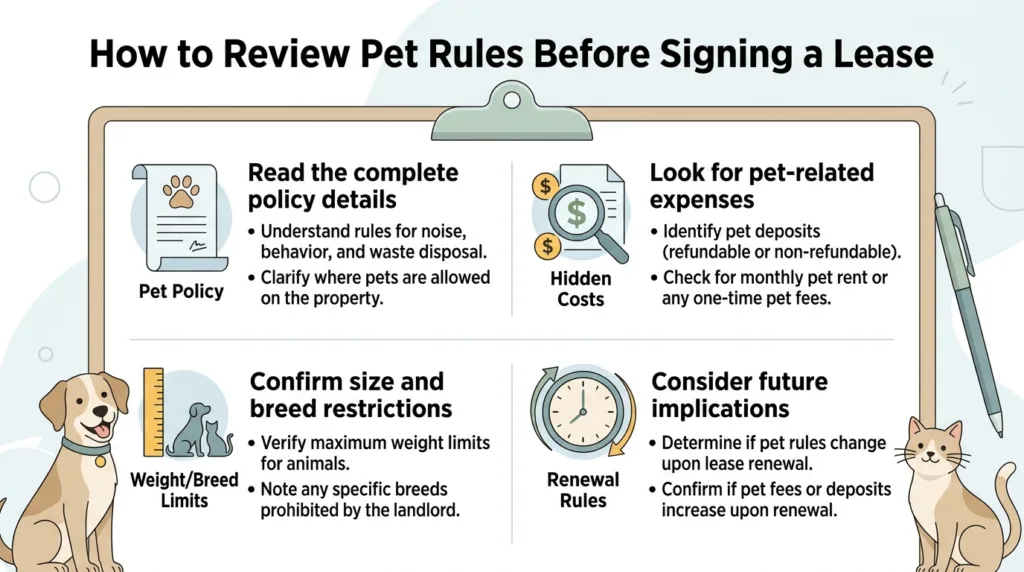
A rental listing can say “pets welcome” in two words. The lease may take several pages to explain what that actually means.
Before signing, a renter needs to know more than whether the property accepts dogs or cats. The documents may establish limits on the number of animals, monthly charges, deposits, weight restrictions, common-area rules, cleanup responsibilities and consequences for violating the policy.
Some of those conditions may appear in the main lease. Others may be buried in a separate pet policy, community rules or a pet addendum.
That is why reviewing pet rules is not a final administrative step after you have already chosen the apartment. It is part of deciding whether the rental works for you and your pet in the first place.
Start with every document referenced by the lease
Do not review only the page where you sign.
If the lease refers to another document—such as community rules, pet rules or an addendum—get that document before agreeing to the tenancy.

California’s official tenant guidance specifically advises renters that if a rental agreement refers to a separate document, they should obtain and read that document before signing.
That advice matters for pet owners because important restrictions are often separated from the basic rent and term information.
Collect the complete set:
- main lease;
- pet addendum;
- property pet policy;
- community or house rules;
- fee schedule;
- move-in requirements;
- any written approval specific to your pet.
Then read them as one package.
If one document says “pets allowed” while another says “dogs under 25 pounds only,” the second statement may significantly change what the first one means.
Before reaching this stage, it also helps to read the rental’s pet policy before you apply, since discovering a major restriction after paying an application fee can waste both time and money.
Confirm that your specific pet is actually permitted
“Pet-friendly” does not necessarily mean every animal is allowed.
A property may distinguish between dogs, cats, birds or other animals. In addition, policies can include limits involving:
- number of pets;
- weight;
- size;
- species;
- age;
- breed or type;
- individual approval.
Therefore, do not stop at a general sentence saying pets are permitted.
Compare the policy with the animal that will actually live with you.
If you have two dogs, for example, a property that allows “one pet per apartment” does not fit simply because dogs appear on the approved list.
Likewise, if the lease requires prior written approval, verbal permission from a leasing employee may not be enough to establish that your particular animal has been accepted.
When there is uncertainty, ask for clarification in writing before signing.
Identify every pet-related cost
Once you know that your animal is eligible, separate the financial rules from the rest of the policy.
Look for:
- pet deposits;
- one-time pet fees;
- monthly pet rent;
- charges per animal;
- registration fees;
- possible additional cleaning or damage obligations.
The words used for these charges matter, but they do not always have the same legal treatment across the country. For that reason, renters should understand the difference between pet deposits, pet fees and pet rent and then verify how the relevant state treats those payments.
California illustrates the issue clearly: state guidance explains that amounts labeled as a pet deposit can be treated as part of the security deposit under California law.
Consequently, a nationwide statement such as “pet deposits are always separate from security deposits” would be misleading.
For your own rental, record two totals:
Upfront pet cost: everything due before or at move-in.
Recurring pet cost: everything added each month.
A $40 monthly charge may look minor beside the rent, yet it becomes $480 over a one-year lease. If it applies to two pets, the effect doubles.
Read the pet addendum line by line
When the rental includes a separate addendum, do not treat it as duplicate paperwork.
A pet addendum can establish obligations that the main lease mentions only briefly.
It may identify the approved animal, define behavioral expectations, assign responsibility for damage, address common areas and describe what happens if a pet rule is violated.
If you are not familiar with this type of document, first understand what a pet addendum in a lease can contain.
Then compare it with the main lease.
The two documents should make sense together. If the lease says one thing and the addendum appears to say another, ask the property manager to explain the discrepancy before you sign.
This matters because the Texas Attorney General describes the rental agreement as the most important source of information about the landlord-tenant relationship and advises renters to read it carefully before signing.
A pet addendum that becomes part of that agreement deserves the same attention.
Pay attention to rules for common areas
A renter may focus almost entirely on what happens inside the apartment. However, many pet rules are really about what happens outside the unit.
Look for provisions covering:
- leashes;
- hallways;
- elevators;
- stairways;
- courtyards;
- lawns;
- dog parks;
- pet waste;
- restricted areas.
The practical importance of those rules depends on the property.
For someone renting a house, elevator rules are irrelevant. For someone living on the tenth floor of a large apartment building, they may affect daily life several times a day.
Therefore, ask a more useful question than “Is this rule reasonable in general?”
Ask:
How will this rule affect my normal routine in this particular property?
That perspective helps distinguish a minor clause from one that could make the rental inconvenient every day.
Look closely at noise and nuisance language
Pet policies often contain broad terms such as nuisance, disturbance, excessive noise or interference with other residents.
Do not ignore those provisions simply because your pet is normally well behaved.
Apartment living creates conditions that may not exist in a detached home. Neighbors share walls, ceilings, corridors and entrances. As a result, barking or other repeated noise can become a lease issue as well as a behavior issue.
For dog owners, thinking ahead about how to reduce barking problems in an apartment may help prevent a routine behavior from becoming a conflict with neighbors or management.
Still, pay attention to the actual wording.
A lease provision describing repeated nuisance behavior is different from a vague assumption that “any bark violates the lease.” The written policy tells you what the property has chosen to regulate.
Understand damage responsibilities before move-in
Pet rules often contain language making renters responsible for animal-related damage.
That can include damage to:
- flooring;
- doors;
- walls;
- trim;
- landscaping;
- common areas.
However, determining what damage occurred during your tenancy is easier when the starting condition of the property is well documented.
Before you move in, document the rental’s condition before your pet enters the property.
Photograph existing scratches, stains, worn flooring or damaged surfaces, and follow any inspection procedure provided by management.
This is not merely a pet-specific precaution. California’s official tenant guide, for example, discusses rental-condition documentation and security deposits as part of protecting both sides from later disagreements.
Moreover, documentation creates a useful distinction between:
existing wear or damage
and
a condition that appeared during your tenancy.
That distinction can become particularly important when pets live in the property.
Check what happens when a pet rule is violated
Many renters read what they are supposed to do but skip what happens if they do not do it.
Do not stop halfway.
Look for provisions dealing with:
- warnings;
- notices;
- corrective periods;
- fees where permitted;
- removal of an unauthorized pet;
- repeated violations;
- serious nuisance or safety concerns;
- potential lease consequences.
The consequences should be understood in context rather than generalized nationwide.
That is New York guidance, not a universal description of eviction law in every state.
Nevertheless, it illustrates why pet rules deserve attention: when they are incorporated into a lease, violating an important pet provision can become more than a disagreement over building etiquette.
If a clause appears unusually severe or you do not understand its legal effect, consider getting local legal guidance before signing rather than guessing.
Compare verbal promises with the written agreement
Imagine the leasing agent tells you:
“Two dogs are fine.”
The documents say:
Maximum: one pet per unit.
Do not sign first and assume the verbal conversation will resolve the conflict later.
Instead, ask for the documents to reflect the arrangement management actually intends to approve.
The same principle applies to:
- promised fee waivers;
- pet weight exceptions;
- permission for a second animal;
- access to certain common areas;
- additional deposits;
- special approval conditions.
The Texas Attorney General advises that when landlord and tenant agree to change part of a lease, the agreed change should be written into the agreement rather than left as an informal understanding.
Although lease law varies by state, the practical lesson is broadly useful: important rental terms are safer when the signed documents accurately describe the deal you think you are making.
Do not confuse ordinary pet rules with assistance-animal rules
An ordinary pet policy is not always the correct framework for an assistance animal.
Federal fair housing rules can require a different analysis when an individual with a disability seeks a reasonable accommodation involving an assistance animal.
HUD guidance explains that housing providers must not simply apply ordinary house pet rules to assistance animals and their owners.
Therefore, a renter with an assistance-animal issue should not assume that every provision labeled “pet policy” automatically determines the outcome.
At the same time, simply calling an animal an assistance animal does not transform an ordinary pet into one. The fair housing framework has its own requirements.
Because the legal distinction matters, PetzNewz treats assistance animals separately from ordinary pet policies.
Watch for terms that depend on another rule
Some lease provisions make little sense until you follow the cross-reference.
You might encounter wording such as:
Pets must comply with all Community Rules.
or:
Animal approval is subject to Management’s Pet Policy.
In that situation, the referenced document is part of your review.
Do not assume you already know what it says.
California’s tenant guidance expressly recommends obtaining referenced rules and regulations before signing a rental agreement. That principle is particularly useful here because a short lease clause may point to several pages of additional pet requirements.
Likewise, look for phrases such as:
- “as amended from time to time”;
- “subject to community rules”;
- “with management approval”;
- “according to property policy”;
- “unless otherwise authorized in writing.”
Each phrase tells you that another document, decision or condition may affect the rule.
Consider how the policy fits your actual daily life
Legal and financial review is important, but a technically acceptable lease can still be a poor practical match.
Suppose the property permits your dog but requires animals to use one distant exit. That may be manageable for some renters and inconvenient for others.
Perhaps the apartment accepts cats, yet window or balcony conditions require extra planning.
Maybe the building permits two pets but has no convenient outdoor area.
Those details are not necessarily reasons to reject a rental. However, they belong in the decision.
Before signing, consider:
- how often you will need to use common areas;
- how your pet reacts to elevators or stairs;
- whether outdoor access is practical;
- whether the unit offers enough usable space;
- whether cleaning and waste rules fit your routine;
- whether the total pet costs fit your budget.
This is why asking detailed questions before renting an apartment with a pet can reveal issues that the lease alone does not answer.
Finish with a consistency check
After reading the documents, do one final pass with a different objective.
Do not ask, “Did I read everything?”
Ask, “Does everything agree?”
Compare:
Listing → leasing conversation → pet policy → pet addendum → main lease
The permitted number of pets should not change unexpectedly between documents. Charges should match. Exceptions should be written down. Your approved animal should satisfy the policy you are signing.
If something conflicts, resolve it before the lease becomes effective.
A careful review does not require memorizing landlord-tenant law across fifty states. Rather, it requires knowing which questions the documents answer, which rules are specific to your property, and which legal questions need to be checked locally.
The best time to discover an incompatible pet rule is while you still have the choice not to sign.

Alex is the content editor at PetzNews, covering pet care guidance and pet-friendly housing topics for renters and property owners across the United States