
You find an apartment that accepts pets, the monthly rent fits your budget, and the property seems like a good match. Then you reach the pet policy and discover a pet deposit, a pet fee, pet rent—or a combination of them.
Those charges may sound interchangeable, but they affect a renter’s budget in different ways.
A pet deposit is generally an upfront amount associated with keeping an approved pet in the property and may be refundable depending on the applicable terms. A pet fee is commonly a one-time, nonrefundable charge. Pet rent is normally a recurring amount paid along with the monthly rent.
Those are useful general distinctions, not nationwide legal definitions. State rules, local requirements, housing programs and the language of the lease can change how a particular charge is treated.
Before deciding whether a rental actually fits your budget, read the rental’s pet policy carefully instead of relying only on the listing.
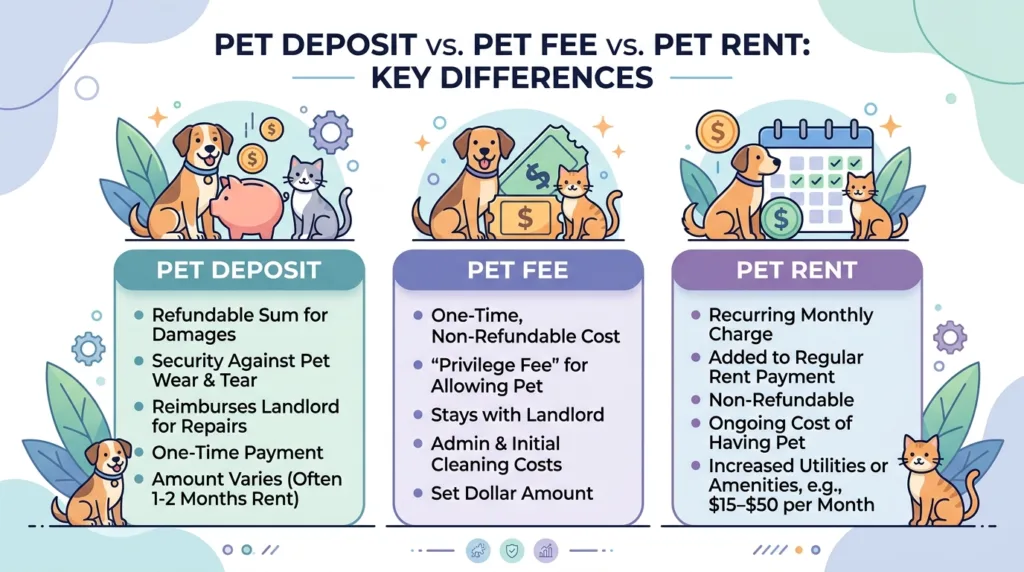
Pet deposit, pet fee and pet rent at a glance
| Charge | Typical timing | Usually recurring? | Common treatment |
|---|---|---|---|
| Pet deposit | Before or at move-in | No | May be refundable |
| Pet fee | Before or at move-in | No | Commonly nonrefundable |
| Pet rent | Monthly | Yes | Recurring housing expense |
The wording matters, but the written rental agreement matters more.



In some states, a payment described as a pet deposit can legally fall under broader security-deposit rules. California is one example: official state tenant guidance explains that amounts called pet deposits can be treated as part of the security deposit rather than as an entirely separate category of money.
That is a state-specific example, not a rule for every renter in the United States.
What is a pet deposit?
A pet deposit is generally an amount collected at or before move-in because an approved pet will live in the rental.
Its financial effect is different from monthly pet rent because it is normally paid upfront rather than every month.
Suppose a rental requires:
- $1,850 for the first month’s rent
- a regular security deposit
- a $350 pet deposit
The $350 increases the cash required at move-in, but it does not automatically become another $350 monthly expense.
Before paying a pet deposit, check the written documents for details such as:
- whether the amount is refundable;
- when deductions may be made;
- whether it applies per pet or per rental unit;
- how it interacts with the regular security deposit;
- how and when any remaining refundable amount is returned.
Do not assume that a payment works a certain way simply because the property calls it a deposit.
California illustrates why this matters. The California Department of Real Estate’s current landlord-tenant guidance states that payments called a pet deposit, key fee or similar name may still be considered part of the security deposit under California law.
A renter elsewhere should therefore check the rules that actually apply to the property rather than applying California’s rules nationwide.
What is a pet fee?
A pet fee is commonly a one-time charge associated with allowing an approved pet to live in the rental.
Unlike a deposit, it is often presented as nonrefundable.
A property might state:
Pet fee: $300 per pet
That wording matters.
One approved pet could mean a $300 charge. Two could mean $600. Another property might instead charge one amount for the entire household.
The renter should confirm the calculation before signing rather than assuming the advertised number represents the total.
A pet fee also should not automatically be interpreted as payment for any future damage caused by the animal.
If a dog damages a door or a cat damages flooring, responsibility for that damage may be addressed separately by the lease and applicable law.
Paying a fee therefore does not necessarily mean:
“Any pet-related damage is already covered.”
The written agreement should answer that question.
What is pet rent?
Pet rent is generally a recurring charge associated with having an approved pet in the rental.
Suppose the property charges:
- Base rent: $1,800 per month
- Pet rent: $40 per month
Over a 12-month lease, that recurring pet charge adds:
$40 × 12 = $480
If the property charges $40 per pet and the household has two animals:
$40 × 2 × 12 = $960
A relatively small monthly amount can therefore become meaningful over the full term of a lease.
That is one reason renters should compare pet-friendly apartments beyond the advertised monthly rent.
A rental can have more than one pet-related charge
Pet deposit, pet fee and pet rent are not necessarily three mutually exclusive options.
Depending on the property and the rules that apply, a rental may use more than one.
For example:
Rental A
- $250 one-time pet fee
- $35 monthly pet rent
Rental B
- $400 pet deposit
- no monthly pet rent
Rental C
- $300 pet deposit
- $25 monthly pet rent
This is why seeing pet-friendly in a listing tells you very little about the total financial impact of the pet policy.
If the rental uses a separate document for its pet rules, understanding what a pet addendum is and what it may contain can help you identify conditions that are not obvious from the advertisement.
Compare the full cost of the lease
Consider two apartments offered on 12-month leases.
Apartment A
Base rent: $1,750 per month
Pet fee: $300
Pet rent: $50 per month
Pet-specific payments during the first year:
$300 + ($50 × 12) = $900
Apartment B
Base rent: $1,790 per month
Pet deposit: $350
No monthly pet rent
At first glance, Apartment A appears cheaper because its base rent is $40 lower.
The pet policy changes the picture.
Apartment A adds $900 in pet-specific payments during the year. Apartment B requires $350 upfront as a deposit, although whether that money may later be returned depends on the terms and rules that apply.
This does not automatically make Apartment B the better rental. Location, utilities, amenities, lease conditions and pet restrictions can all influence the decision.
The comparison becomes clearer if you separate the costs into two groups.
Move-in costs
Calculate everything required before or around the time you receive the keys.
That may include:
- first month’s rent;
- security deposit;
- pet deposit;
- pet fee;
- other legitimate move-in charges.
Recurring costs
Then calculate expenses that continue during the lease.
These may include:
- base rent;
- pet rent;
- other required recurring property charges.
Looking at both numbers makes it easier to compare properties with different pricing structures.
Check whether the price is per pet
The words per pet can substantially change the total.
A $250 fee may mean $250 for one pet and $500 for two.
A $30 monthly pet rent becomes:
$360 per year for one pet
but:
$720 per year for two pets
when the charge applies individually.
When reading a pet policy, look for language covering:
- per-pet pricing;
- household pricing;
- additional-pet charges;
- maximum number of pets;
- species restrictions;
- weight or size limits;
- other approval requirements.
Before committing to a property, review the broader questions to ask before renting an apartment with a pet, not just the amount shown next to “pet fee.”
The pet policy and lease should agree
A low pet charge does not automatically make a rental suitable.
The property could have restrictions that matter much more than the fee itself.
Before signing, determine whether there is a separate pet addendum and compare it with the lease and any written pet policy.
Questions worth resolving include:
- What pet-related amount is due before move-in?
- Which charges repeat every month?
- Is each amount calculated per pet or per household?
- Is any deposit refundable under the applicable terms?
- How many pets are permitted?
- Are there restrictions involving species, size or other characteristics?
- Is there a separate pet addendum?
- What does the lease say about pet-related property damage?
- Are pet registrations or records required?
- Do the written documents match what the listing or leasing staff represented?
An important promise made verbally is much easier to rely on when it also appears in the documents governing the tenancy.
Document the property before your pet moves in
Rental costs are only part of the financial risk involved in living with a pet.
The physical condition of the property at move-in can become important later.
Before settling in, document the condition of the rental before moving in with your pet.
Record existing scratches, stains, worn flooring, damaged trim, marks on doors and other visible conditions. Follow the landlord or property manager’s move-in inspection procedure and retain your own records when appropriate.
California’s official tenant guidance, for example, discusses move-in inspections and security-deposit deductions as part of documenting the condition of a rental.
The legal procedures differ by state, but the practical value of establishing what was already present before your tenancy is much broader.
Pet-charge rules are not identical across the United States
One of the biggest mistakes a renter can make is finding a rule online and assuming it applies nationwide.
Pet-related charges can be affected by:
- state law;
- local rules;
- the type of housing;
- specific subsidized-housing programs;
- the rental agreement itself.
Official guidance from Oregon Housing and Community Services provides a useful example.
For Low-Income Housing Tax Credit properties overseen by that agency, OHCS states that pet rent and nonrefundable pet fees are not allowed, while a reasonable refundable pet deposit may be permitted for non-service animals.
That does not mean that every private rental in Oregon follows the same rule.
It means the rule applies within the housing program addressed by that agency.
This distinction is important whenever you read statements such as:
“Landlords cannot charge pet rent.”
The next question should be:
Where, and under which housing rules?
Assistance animals require a separate analysis
An assistance animal that qualifies under applicable federal fair housing rules should not simply be treated as an ordinary pet.
HUD’s official guidance explains that assistance animals are not pets and that housing providers may not exclude or charge a fee or deposit for qualifying assistance animals simply under an ordinary pet policy.
This is a different framework from a renter simply owning a pet.
It involves disability-related protections and reasonable accommodation, so ordinary pet-fee rules should not be used as a shortcut for deciding how an assistance-animal situation works.
PetzNewz treats that subject separately because mixing ordinary pets and assistance animals can produce misleading conclusions.
The lowest pet charge may not mean the lowest-cost rental
A pet deposit, pet fee and pet rent influence your budget in different ways.
A deposit can increase the amount needed at move-in. A nonrefundable fee becomes a direct upfront expense. Pet rent continues month after month and can become substantial over a longer lease.
A property with a low advertised rent may therefore cost more than expected once its pet policy is included.
Before signing, identify five things clearly:
What must I pay before move-in?
What repeats every month?
What, if anything, may be refundable?
Does the amount change with the number of pets?
What restrictions and responsibilities come with the policy?
Once those answers are clear, two rentals with similar advertised prices may look very different.
The goal is not simply to find a property that says pets are allowed. It is to understand what living there with your pet will actually cost—and what you are agreeing to—before you commit.

Alex is the content editor at PetzNews, covering pet care guidance and pet-friendly housing topics for renters and property owners across the United States