
The apartment itself is rarely the whole problem.
A dog can have enough room to sleep, eat and move comfortably indoors and still struggle with apartment life because the daily routine does not work. Perhaps the elevator is stressful. Maybe bathroom breaks require a long trip downstairs. Noise travels easily through the walls, or the dog spends too many hours alone while the renter is away.
The opposite can also be true. A modest apartment may work surprisingly well when the dog’s activity level, temperament and routine fit the household.
That is why square footage should not be the only question.
The CDC recommends considering a dog’s temperament, size and activity level together with your home and the amount of time you can spend with the animal. For a renter, that idea becomes especially useful because apartment living adds neighbors, common areas, building rules and limited direct access to the outdoors.
A better way to plan is to imagine an ordinary weekday from beginning to end.



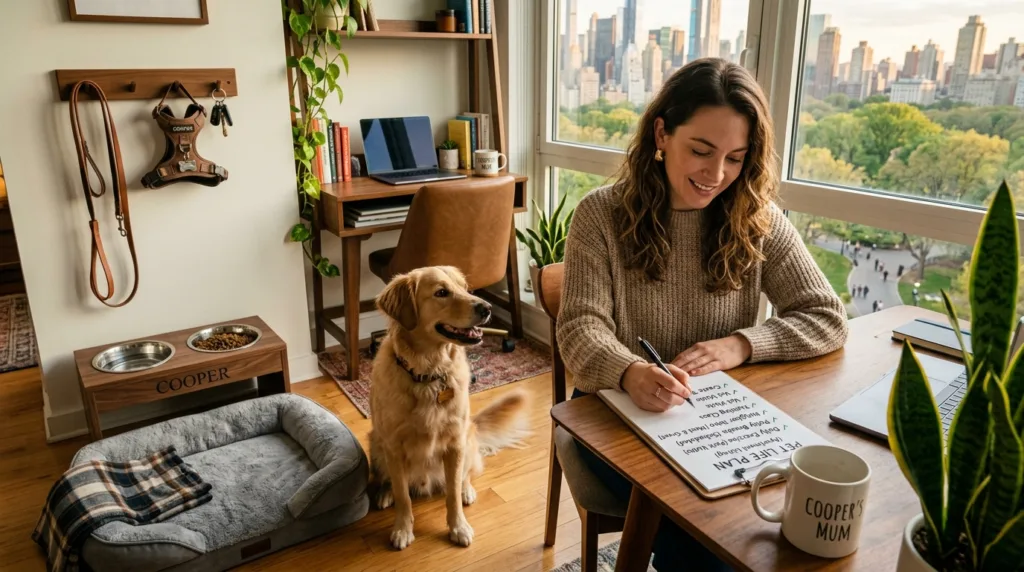
Run your weekday before you judge the apartment
Picture a Tuesday, not a perfect Saturday.
Your alarm goes off at 6:30 a.m. The dog needs to go outside. You are on the seventh floor. The elevator is busy with people leaving for work.
What happens next?
Can your dog wait calmly? Is there another route downstairs? How far do you have to walk before reaching an appropriate outdoor area? What happens when it rains, snows or you are running late?
Now move forward a few hours.
If you work outside the home, how long will the dog be alone? Is someone available for a midday break? Does the dog normally settle when left alone, or does departure trigger pacing, barking or destructive behavior?
Continue through the evening.
Where will exercise happen? Is the neighborhood comfortable for regular walks? Will you depend on a car to reach a suitable park? Does the building have stairs or an elevator that your dog can use comfortably several times each day?
This type of mental rehearsal often reveals more than the floor plan.
A dog does not experience an apartment only as a living room and bedroom. The dog experiences the routine required to enter, leave and live around that space.
If you are still deciding between property types, comparing an apartment with a rental house as a pet owner can help separate preferences from genuine daily needs.
Exercise has to exist outside the floor plan
A common assumption is that a small dog belongs in a small apartment and a large dog needs a house.
Real life is less tidy than that.
Size can matter, but activity level, age, health, temperament and routine matter too. A physically compact dog may need substantial activity, while another larger dog may be calmer indoors.
The CDC’s guidance for prospective dog owners reflects this broader view by recommending that people match the dog’s attitude, temperament, size and activity level with the household and living environment.
For apartment renters, the practical question is therefore not:
“Can my dog fit here?”
It is:
“Can I reliably provide what this dog needs while living here?”
That may mean morning and evening walks, additional bathroom trips, play, training and mental stimulation.
The amount and type of activity should fit the individual dog rather than a generic apartment rule. Your veterinarian can help when age, health or physical limitations affect appropriate exercise.
PetzNewz will look more closely at building a practical exercise routine for an apartment dog, because this is one area where a workable schedule matters more than a vague promise to “walk more.”
Indoor enrichment can also complement outdoor activity.
An official New York City guide developed specifically around pet-inclusive housing recommends daily enrichment for dogs through activities such as toys, puzzle feeders and sniffing games, alongside consistent routines.
That guidance comes from New York City, not a nationwide apartment rule. Still, the principle is useful anywhere: indoor space should give a dog something to do, not merely somewhere to wait for the next walk.
The walls change the meaning of ordinary dog behavior
A dog barking in a detached house and a dog barking beside a shared apartment wall can create very different consequences.
Dogs bark. They move around. They react to doors, people, other animals and sounds outside.
Apartment living compresses those ordinary behaviors into a space shared acoustically with other households.
That does not mean a renter should expect complete silence. It does mean that recurring barking deserves attention earlier than it might in a detached property.
Think about what the apartment exposes your dog to.
A unit beside an elevator may produce footsteps, voices and doors throughout the day. A ground-floor window may place dogs and pedestrians directly in view. A hallway can amplify sounds that never existed in the previous home.
Sometimes the apartment is not creating a new behavior; it is supplying new triggers for an old one.
If barking becomes persistent, the useful response is to understand the trigger rather than simply trying to suppress the sound. We cover that separately in How to Reduce Dog Barking Problems in an Apartment.
Noise is also one reason alone-time behavior matters.
A dog that appears calm when the renter is home may behave differently after the door closes. Planning for leaving a dog home alone in an apartment is therefore part of the housing decision, not merely a training topic to think about later.
Your apartment includes the spaces between your door and the street
Hallways, stairs, elevators, lobbies and shared pet areas are easy to ignore while evaluating a unit.
Once you live there, they can become part of every walk.
A dog that is uncomfortable in a crowded elevator may face that situation several times a day. Another may become highly excited when meeting dogs in narrow hallways. An older dog could find long stair routes more difficult than a younger animal.
Even small details affect the routine.
Where do you wait while another dog leaves the elevator?
Can you create distance in the lobby?
Does the building have a practical route outside late at night?
Where are pets allowed to relieve themselves?
These are not abstract questions once they happen four or five times a day.
Rules can matter as well. For example, NYCHA’s current policy requires dogs to remain on a leash no more than six feet long in public areas inside and outside its buildings. That is a rule for NYCHA properties, not a standard for every apartment in the United States, but it shows how housing providers can regulate dog movement through common areas.
Your own building may have different requirements.
Before signing, read the actual property policy and review pet rules in the lease. Once you know the rules, walk through the building mentally from your front door to the street.
For dogs that find these transitions difficult, our article on elevators, stairs and hallways with a dog will focus on the routine in more detail.
Give the dog a home inside the home
An apartment does not need to be filled with pet equipment to be dog-friendly.
It does need to make sense from the dog’s perspective.
Where will the dog rest when the household is active?
Where are food and water located?
Where will leashes, waste bags and walking supplies stay?
Can the dog relax away from the front door if hallway activity causes excitement?
Where will wet paws be dealt with after a rainy walk?
A small amount of planning can prevent the dog from having to improvise every part of the environment.
For example, placing the resting area directly beside a highly active hallway-facing door might be convenient for the furniture layout but difficult for a dog that reacts to every sound outside.
Likewise, slippery flooring can affect how comfortably some dogs move through the unit. Rugs or other rental-appropriate solutions may help in selected areas, provided they are safe for both the dog and the property.
The goal is not to redesign the apartment around the pet.
It is to create a few predictable places and routines.
Our guide to creating a dog-friendly space in a small apartment goes further into layout and organization.
Rental property changes what “dog-proofing” means
Owning a home and renting one create different constraints.
A homeowner can decide to replace a door, alter flooring or install permanent fixtures. A renter may need permission before making comparable changes.
Preventing damage therefore matters not only financially but operationally.
Watch the areas where your dog’s normal behavior intersects with the property:
doors scratched during departures;
floors affected by nails or repeated running;
trim or corners that become chewing targets;
windows where the dog reacts to passing animals;
carpeted areas where accidents become harder to manage.
This does not require assuming your dog will destroy the apartment.
It means noticing predictable friction before it becomes expensive.
If a problem develops, check the lease before making permanent modifications. The renter may be responsible for damage while still lacking permission to alter the property however they choose.
Our article on protecting rental floors and doors from dog damage will focus specifically on prevention without turning the rental into a construction project.
The lease still matters after the dog is approved
Approval is not the end of the pet policy.
A dog can be fully authorized and still be subject to rules involving:
- common areas;
- noise;
- waste;
- registration;
- damage;
- number of pets;
- restricted locations within the property.
Some properties also impose breed or weight limits. Those rules vary, which is why renters should examine breed and weight restrictions in the particular rental rather than assume a list found online applies everywhere.
Likewise, adding another animal later may require new approval even when the first dog was accepted.
The practical advantage of understanding these rules early is not merely avoiding violations.
It lets you judge whether the property fits your routine before you are committed to it.
A dog owner who hates using elevators may be perfectly happy in a first-floor unit. Someone with a dog that reacts strongly to other animals may prefer a building with quieter access. A renter working long shifts may value nearby walking support more than an on-site dog wash.
The better property is not necessarily the one with the longest list of pet amenities.
It is the one whose ordinary day actually works.
Apartment living is a routine before it is a floor plan
A renter can measure a bedroom.
It is harder to measure six daily elevator trips, three walks in bad weather, a neighbor’s door slamming beside the unit or a dog becoming restless at 3 p.m.
Those are the pieces that often decide whether apartment life feels easy or exhausting.
Before choosing a rental, imagine the boring days—not just move-in day.
Where will your dog go first thing in the morning?
What happens while you work?
Where does exercise fit?
How will the dog move through shared spaces?
What happens when noise, weather or your schedule changes?
If those answers are workable, a smaller home does not automatically mean a poorer life for the dog.
The apartment is only the physical container.
The routine is what makes it livable.

Alex is the content editor at PetzNews, covering pet care guidance and pet-friendly housing topics for renters and property owners across the United States