
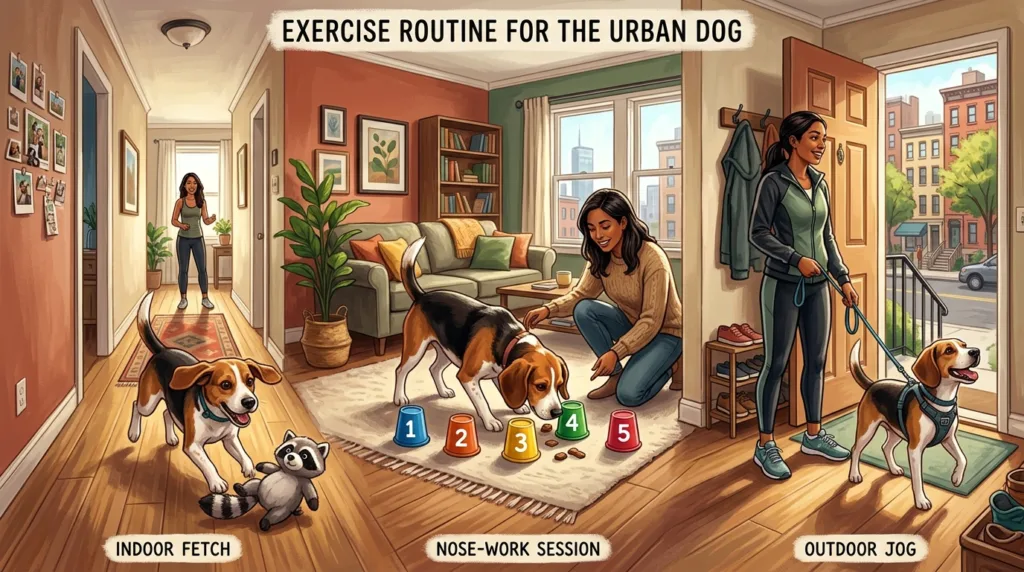
A good exercise routine is not the most ambitious schedule you can design.
It is the one you can repeat on a rainy Tuesday, during a busy workweek and three months from now.
That matters even more in an apartment. A dog living in a house may have easier access to a yard or outdoor space. Apartment renters often have to plan every bathroom break, walk and activity around elevators, stairs, weather, work schedules and shared areas.
The routine has to work for both sides of the leash.
There is also no single number of minutes that fits every dog. Exercise needs vary with factors such as age, breed, health and energy level, which is why copying another owner’s schedule is less useful than building one around the dog actually living with you.
Start with the dog you have, not the routine you saw online
It is easy to find confident claims about how long every dog should walk.

Real dogs are less standardized.
A young, energetic adult may need considerably more activity than an older dog. A puppy has different physical limits from a mature dog. Some breeds and individual dogs are naturally more active, while others are satisfied with a calmer pace.
Even size can be misleading.
A small dog is not automatically low-energy, and a larger dog is not automatically incompatible with apartment living. The AKC notes that some larger dogs can live successfully in apartments when their exercise needs are met, while certain small, high-energy dogs may be a poor match for a sedentary routine.
Health changes the equation as well.
If a dog is recovering from an injury, has orthopedic problems, is significantly overweight or has age-related limitations, increasing activity aggressively can be inappropriate. Exercise plans should be adjusted to a dog’s age and physical condition, and veterinary guidance is particularly important when health or mobility issues are involved.
For a healthy adult dog, you can begin by observing what the current routine produces.
Does the dog settle comfortably after walks?
Is there restless pacing every evening?
Does the dog still seem eager to move after a short outing, or does the dog lag behind?
Those observations are more useful than choosing a number first and forcing the dog to match it.
Build the routine around anchors you can actually keep
An apartment routine becomes easier when activity is attached to parts of the day that already happen.
Instead of planning:
“I need to exercise the dog for a lot of time today.”
you might create three reliable anchors:
Morning: bathroom break plus a purposeful walk.
Middle of the day: another outing, play session or help from someone else if needed.
Evening: a longer walk, play or another activity matched to the dog’s energy.
The exact structure will vary.
Someone working from home may use several shorter outings. A commuter may need a longer morning walk and outside help during the day. A renter with an older dog might prefer more frequent but gentler movement.
What matters is repeatability.
A plan built around a two-hour morning hike is not particularly useful if you can follow it only on Sundays.
Apartment living rewards consistency because the dog cannot simply be let into a private yard whenever the schedule falls apart.
Walking should do more than move the dog’s legs
Distance is easy to measure.
Quality is harder.
A walk can provide physical movement, but it can also give a dog opportunities to sniff, investigate the environment and engage mentally with the world outside the apartment.
Dog walks can provide mental stimulation in addition to physical exercise, so not every outing has to become a speed-focused workout.
A fifteen-minute walk where the dog is allowed appropriate time to sniff can serve a different purpose from a brisk thirty-minute fitness walk.
Both may belong in the same week.
That gives apartment renters more flexibility.
Perhaps the morning outing is efficient because work starts early. The evening walk can be slower and more exploratory. A weekend outing can be longer.
A routine becomes easier to sustain when every walk does not have to accomplish every goal.
Think in layers rather than one giant exercise session
An apartment dog can receive activity in several forms throughout the day.
For example:
Physical movement
- walking;
- age-appropriate running;
- play;
- suitable dog sports or activities.
Mental work
- training;
- food puzzles;
- scent games;
- problem-solving activities.
Exploration
- sniffing during walks;
- visiting appropriate new environments;
- changing walking routes occasionally.
Social interaction
- time with the renter;
- appropriate interaction with familiar people;
- carefully managed interaction with other dogs when suitable for the individual animal.
These activities are not identical, nor should mental enrichment be treated as a complete substitute for physical movement.
However, combining them can produce a more balanced routine than trying to solve everything with an increasingly long walk.
The AKC emphasizes that mental stimulation complements physical exercise and activities such as training, puzzle games and scent work can contribute to a dog’s overall activity routine.
New York City’s pet-inclusive housing guidance similarly encourages daily enrichment through activities such as toys, puzzle feeders and sniffing games for dogs living in rental housing.
This is particularly useful on days when the weather or your schedule makes one long outdoor session impractical.
Your apartment can support activity without becoming a dog gym
Indoor activity can help, but the space has limits.
A narrow hallway may not be an appropriate place for high-speed fetch. Repeated jumping on slippery floors may not suit every dog. Loud games late at night may create a neighbor problem even if the dog enjoys them.
The solution is not to eliminate indoor activity.
Choose activities that fit the room.
Short training sessions require little space. Food puzzles can occupy a dog without encouraging frantic movement. Hide-and-seek or simple scent games can turn part of the apartment into a low-impact activity area.
If the layout itself makes activity awkward, creating a dog-friendly space in a small apartment can help separate rest, feeding and activity zones without permanently modifying the rental.
Your flooring matters too.
If the dog repeatedly launches into turns on smooth floors, think about traction and property protection. The upcoming guide on protecting rental floors and doors from dog damage addresses that part separately.
Weather is not a scheduling failure
Apartment routines are exposed to weather in a way that backyard routines often are not.
Rain, heat, cold or snow can change how pleasant and safe a normal walk feels.
The answer is not necessarily to abandon the routine whenever conditions are poor. It is to have alternatives.
On a day when a long outdoor outing is unsuitable, a renter might combine shorter necessary trips with training and indoor enrichment.
On another day, mild weather may make a longer walk practical.
This flexibility is important because an exercise routine should survive ordinary disruptions.
It should also remain safe.
Extreme temperatures, poor air quality, icy surfaces and other conditions can require genuine changes rather than determination to complete a planned distance at all costs.
When environmental conditions or the dog’s health create uncertainty, use current veterinary or official guidance appropriate to the situation instead of treating a normal schedule as mandatory.
The building itself adds hidden exercise costs
A thirty-minute walk may require more than thirty minutes.
Put on the leash.
Wait for the elevator.
Navigate the lobby.
Reach the outdoor area.
Return, clean wet paws, take the elevator again and settle back into the apartment.
For someone living on an upper floor, those transitions become part of every outing.
They may also affect the dog.
A dog uncomfortable with elevators can turn each walk into a stressful event. An older dog relying on stairs may need a slower routine. A reactive dog may require extra time to avoid crowded hallways.
That is why elevators, stairs and hallways should be considered part of apartment life with a dog, not merely the route between the unit and the real exercise outside.
When estimating how much time a routine requires, count the entire process.
Five minutes of building logistics on each side of three walks adds up.
Do not wait for destructive behavior to prove the routine is insufficient
A dog does not need to destroy a sofa before you reconsider the day.
Restlessness, persistent attention-seeking, difficulty settling or repeated attempts to create activity may suggest that the current routine deserves another look.
At the same time, those behaviors do not prove that lack of exercise is the only cause.
This is where renters can make a common mistake:
Dog behaves poorly → dog must need more exercise → add more intense exercise.
Sometimes that helps.
Sometimes the behavior is connected to anxiety, training, environmental triggers, medical issues or something else entirely.
For instance, persistent barking may require identifying the actual trigger rather than simply extending every walk. That is why reducing dog barking problems in an apartment starts with observation rather than assuming the dog is under-exercised.
Exercise is one part of the system.
It should not become the explanation for every behavior.
Adjust the routine as the dog changes
The schedule that works today may not be the right one two years from now.
Puppies mature.
Adult dogs settle into different patterns.
Older dogs may still benefit from daily movement but need gentler activities or shorter sessions.
The AKC notes that senior dogs continue to benefit from regular activity, although exercise should be adapted to their physical abilities.
Seasonal changes can matter too.
A dog may be comfortable taking longer walks during cooler months and need shorter or differently timed outings during hot weather.
The renter’s life changes as well.
A new job, commute or work-from-home schedule can alter when activity is possible.
A practical routine is therefore not a permanent timetable.
It is a structure you can revise without losing the dog’s basic consistency.
Judge the routine by what happens between activities
The obvious way to evaluate exercise is to count walks.
A more revealing measure is what the dog does when nothing is happening.
Can the dog rest?
Does the animal settle after activity?
Is the dog constantly looking for another outlet, or does the day have a reasonable rhythm between movement and downtime?
Apartment dogs spend a meaningful amount of their lives indoors. The purpose of an exercise routine is not to keep them in continuous motion.
It is to make movement, enrichment and rest fit together.
If the dog receives appropriate activity and can comfortably settle into the quieter parts of the day, the routine is doing something useful.
That is a better standard than chasing a universal number of minutes that was never designed for your dog in the first place.

Alex is the content editor at PetzNews, covering pet care guidance and pet-friendly housing topics for renters and property owners across the United States