
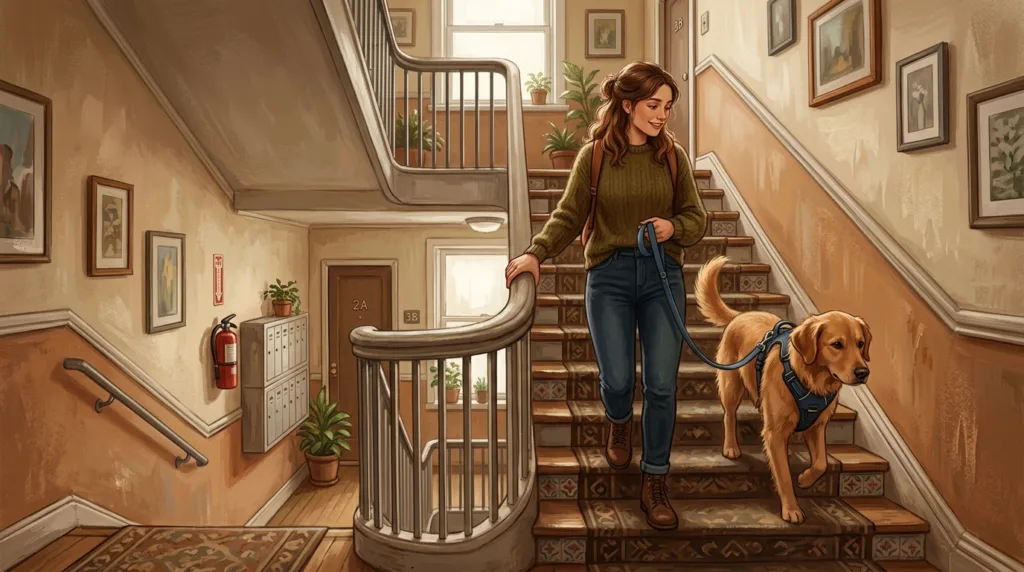
The walk may be only fifty feet.
Front door. Hallway. Elevator. Lobby. Outside.
Yet for some dogs, that short stretch contains more stimulation than the walk that comes afterward.
A neighbor steps out unexpectedly. Another dog appears around the corner. The elevator opens with three people inside. The floor changes from carpet to polished tile. A cart rolls through the lobby. Then the street door opens and the entire outside world arrives at once.
For apartment renters, these transition spaces deserve more attention than they usually get.
They are not simply the path to the walk. They are part of the dog’s daily environment.


The hallway is a shared space, not an extension of your apartment
Inside the unit, a dog may have room to move away from something uncomfortable.
A hallway offers fewer options.
Two dogs approaching each other may have nowhere convenient to create distance. A neighbor carrying groceries cannot always step aside. Someone who is afraid of dogs may suddenly find themselves sharing a narrow passage with one.
That changes what good handling looks like.
Keeping the dog reasonably close gives you more control over how much space the animal occupies and makes it easier to react before a greeting becomes chaotic. The American Kennel Club’s guidance for urban dog owners similarly recommends keeping dogs under control in public areas and paying particular attention to manners in hallways, lobbies and elevators.
The goal is not military precision.
A dog does not need to walk in a perfect heel every second between the apartment and the street.
But a leash stretched from one wall to the other can effectively turn a common hallway into private space.
That matters even when the dog is friendly.
Not every neighbor wants contact, and not every other dog wants a greeting.
The elevator compresses the problem
An elevator removes distance almost instantly.
The doors open, and whatever is inside is suddenly a few feet away.
A person.
A stroller.
A maintenance cart.
Another dog.
Sometimes all of them.
One useful habit is simply not treating every open elevator as an obligation to enter.
If the car is crowded, another dog is already inside, or your own dog is visibly struggling, waiting for the next one may be the easier choice.
The AKC specifically notes that elevators place dogs and other passengers in close quarters and recommends considering whether existing passengers are comfortable before entering with a dog.
That extra twenty seconds can prevent a much more complicated interaction.
Where should the dog stand?
There is no universal mark on the elevator floor.
What matters is that you know where the dog is.
A position beside you is generally easier to manage than allowing the dog to wander toward the doors, investigate bags or move behind other passengers.
The doors deserve attention too.
Do not allow the leash to trail through closing elevator doors or leave the dog on one side of the threshold while you are on the other.
Enter together.
Exit together.
If the dog rushes through the doors every time they open, practicing calmer entrances when the elevator is quiet can make everyday trips easier.
The AKC’s Urban Canine Good Citizen program treats entering, exiting and riding an elevator under control as practical urban-dog skills.
You do not need to participate in that program for the underlying idea to be useful.
The elevator is easier when the dog has practiced it before the busiest ride of the day.
Not every dog experiences the elevator as neutral
Some dogs hesitate at the threshold.
Others enter but become uncomfortable when the floor moves.
The sounds can be unfamiliar: mechanical vibration, bells, closing doors, voices suddenly appearing.
Forcing a frightened dog into the car can make the next ride harder.
Instead, the introduction can be broken into smaller experiences when practical.
Approach the elevator.
Wait nearby.
Watch the doors open.
Enter during a quieter period.
Ride a short distance.
The exact progression depends on the dog and the building, but the principle is gradual exposure rather than turning every necessary bathroom break into a confrontation.
The AKC notes that dogs can be uncertain about unfamiliar surfaces and that gradual exposure to different surfaces, stairs and elevators can make these experiences less stressful.
In a high-rise, this matters because avoiding the elevator may not be realistic.
The objective is therefore not to convince the dog that elevators are exciting.
Neutral is enough.
Stairs create a different set of questions
Stairs may look simpler because nothing closes around the dog.
They are not automatically easier.
A young, healthy dog may handle several flights without difficulty. An older dog, a dog recovering from injury or one with mobility problems can have a very different experience.
The American Veterinary Medical Association notes that senior pets may begin avoiding activities such as climbing stairs and may benefit from environmental changes when mobility declines.
That is not a reason to conclude that stairs are inherently harmful to dogs.
It is a reason to notice changes.
If a dog that previously used the stairs comfortably begins hesitating, moving stiffly or refusing them, the answer should not automatically be “the dog is being stubborn.”
Health or mobility may have changed.
A veterinarian can help evaluate that change.
Stairs also matter when the elevator is unavailable
Apartment renters often build their entire routine around the elevator.
Then it stops working.
Or there is an emergency.
The AKC advises apartment residents to make sure their dogs are comfortable using fire exits or stairs because elevators should not be used during a building fire.
That makes occasional familiarity with the stair route useful even for dogs that normally ride the elevator.
You do not need to turn twelve flights into a daily workout.
You do want to know whether the dog can use the emergency route at all.
Check your building’s own emergency procedures as well, because evacuation arrangements vary by property.
A blind corner can change the whole interaction
Hallway problems often begin before either handler sees the other.
You hear tags.
A leash appears around a corner.
Then the second dog follows.
If your dog becomes highly excited or uncomfortable around other dogs, blind corners and elevator doors reduce the time available to respond.
One practical adjustment is pace.
Approaching a blind corner slightly more slowly gives you a moment to see what is ahead.
Listening helps too.
So does avoiding distractions such as looking at your phone while moving through a tight common area.
This becomes especially important for dogs that already have difficulty with close encounters.
The objective is not to scan the building nervously.
It is simply to preserve enough attention to react before two dogs end up nose-to-nose because neither person noticed the other.
If hallway encounters repeatedly trigger barking, the underlying pattern matters more than simply trying to silence the dog. The same trigger-management principles apply even though the setting is outside the unit.
Sometimes the best greeting is no greeting
Apartment living creates repeated exposure to the same neighbors and dogs.
That can make social interaction feel mandatory.
It is not.
Two dogs living in the same building do not need to become friends.
A brief pass in the lobby can remain a brief pass.
Likewise, a dog does not have to greet every person who says hello.
If your dog enjoys appropriate social contact and everyone involved is comfortable, that is one situation.
If the dog is nervous, overexcited or simply trying to get outside, moving along may be better.
This is one place where natural human politeness can work against the dog.
You may feel awkward declining a greeting.
The dog does not understand that social pressure. It only experiences another close interaction.
Creating a little space can be more considerate than forcing one.
The building’s rules still set the boundaries
Different rental properties regulate common areas differently.
Some specify leash requirements.
Others designate pet-free locations or restrict where animals may relieve themselves.
NYCHA, for example, currently requires dogs in its public and common areas to remain on a leash six feet long or less. Its pet policy also says animals must not create unsafe conditions, excessive noise or damage to elevators and other NYCHA property.
Those are NYCHA-specific rules, not a nationwide standard.
Your building may have a different leash provision, or the applicable rule may also come from local law.
That is why the relevant documents are the ones governing your actual rental.
If you have not reviewed them recently, the lease and pet rules should be the starting point, particularly before assuming that another building’s policy applies to yours.
The newer NYC pet-inclusive housing guide also illustrates how shared spaces can be designed around pet routines: it suggests small infrastructure measures such as placing waste-bag dispensers near exits or elevators.
Again, that is guidance rather than a universal requirement.
It does show something important, though: a pet-friendly building is not only an apartment where dogs are permitted. The common spaces influence everyday life too.
Shared spaces expose the weakest part of the routine
Inside your apartment, you control much of the environment.
Outside the front door, that control drops quickly.
You cannot decide when another resident comes home.
You cannot guarantee an empty elevator.
You cannot move the staircase.
You cannot prevent every unfamiliar dog from appearing in the lobby.
What you can change is preparation.
A dog that can pause briefly at the door gives you time to look into the hallway.
A dog accustomed to the elevator does not have to learn during rush hour.
A renter who knows the building’s pet rules is less likely to discover a restriction during a complaint.
And if your dog needs more distance from certain situations, recognizing that need early is more useful than hoping every trip downstairs goes perfectly.
Apartment life with a dog is often discussed in terms of what happens inside the unit.
Yet several of the most demanding moments happen after the front door closes behind you and before the walk has even begun.

Alex is the content editor at PetzNews, covering pet care guidance and pet-friendly housing topics for renters and property owners across the United States