
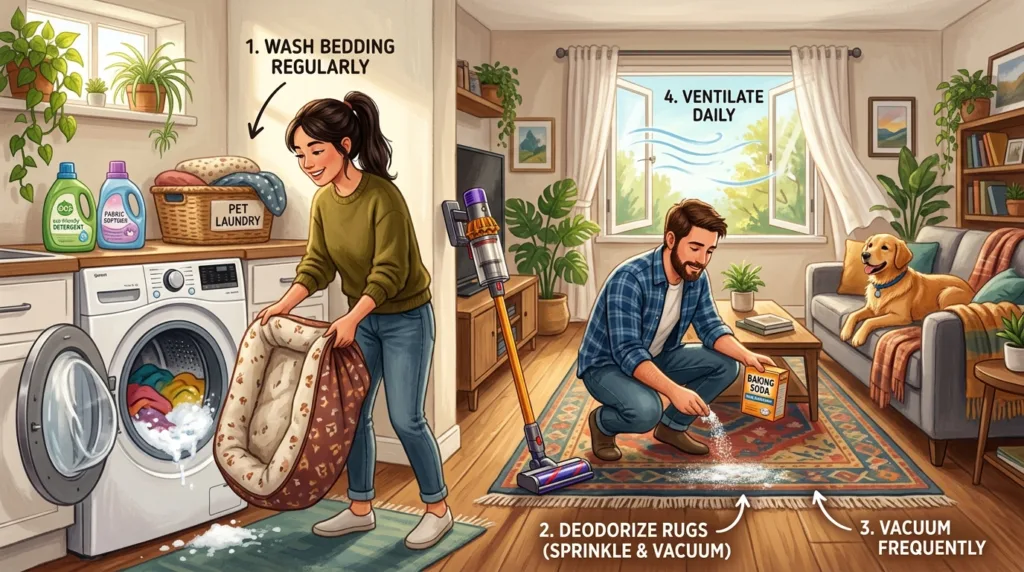
A room can smell like a dog even when the dog is not in it.
That usually tells you something useful.
Odor may be sitting in bedding, a rug, carpet, an upholstered chair, a damp entry mat or the place where the dog repeatedly rests. Sometimes the source is an accident that was cleaned on the surface but reached deeper material. In other cases, the smell is coming mainly from the dog itself.
Those situations should not be treated as one problem.
Spraying fragrance into the air may make the apartment smell different for an hour. It does not tell you what is producing the odor, and in a rental, experimenting with strong cleaners can create another concern: discoloration, damaged finishes or residue on surfaces you do not own.
A better approach is to follow the smell backward.



First decide whether the odor is in the dog, the belongings or the apartment
Before cleaning the entire rental, narrow the source.
Move through the space deliberately.
Does the smell become stronger near the dog’s bed?
What happens when you pick up a blanket?
Does one section of carpet smell different from the rest?
Is the entryway the problem after several wet walks?
Or does the odor follow the dog from room to room?
The answer changes what you should do next.
A washable dog bed does not need the same response as urine that reached carpet padding. Neither should be handled like a persistent odor coming from the dog’s skin or ears.
This distinction also keeps renters from over-cleaning.
If the main source is a blanket, repeatedly treating the carpet wastes time and exposes the rental material to chemicals unnecessarily.
Likewise, deodorizing the apartment every evening will not solve a dog-health issue.
Work from the smallest likely source outward.
Soft items quietly collect a large part of everyday dog odor
Dogs spend hours in contact with fabric.
Beds, blankets, washable covers and certain toys collect hair, saliva, outdoor dirt and normal body oils. Because those items remain in the apartment day after day, they can gradually become part of what people perceive as “the apartment smells like a dog.”
This is one of the easier sources to manage because many pet belongings can be removed and cleaned without touching the rental itself.
The CDC currently recommends cleaning pet beds and blankets regularly and following the item’s own cleaning instructions. It also distinguishes ordinary cleaning from disinfecting: for most pet items, routine cleaning is generally sufficient, while disinfection becomes more relevant in specific situations such as contamination with urine or feces or illness in the household.
That distinction matters.
“Clean” does not automatically mean “use the strongest disinfectant available.”
For washable bedding, follow the care label. Allow the item to dry thoroughly before returning it to the dog’s resting area. If a removable cover is doing most of the work, cleaning that cover consistently may be easier than waiting until the entire bed has absorbed months of odor.
The same principle applies to throws or blankets placed on renter-owned furniture.
Contain the most washable layer.
Then maintain that layer.
A small system is usually easier to sustain than deep-cleaning the entire living room whenever the smell becomes noticeable.
Carpet and rugs need a different kind of restraint
Carpet creates uncertainty because a smell can remain after the visible evidence has disappeared.
An accident may reach below the surface fibers. A damp area can stay wet longer than expected. Repeated contact in one location can gradually make that part of the room smell different from the rest.
The temptation is to keep adding product until the odor disappears.
That can be risky in a rental.
Carpet fibers, backing, padding and dyes are not all the same. A homemade mixture or aggressive cleaner that worked in someone else’s house may discolor your carpet, leave residue or conflict with care instructions for the material.
Start with what you know about the surface.
If the property provided carpet-care instructions, use them. If the material or cleaning method is unclear, asking management what is approved may be safer than improvising on a large visible area.
The EPA’s Safer Choice program can also help renters identify cleaning products whose ingredients have been evaluated against the agency’s health and environmental criteria, including categories such as carpet cleaners, floor cleaners and odor removers.
That label does not mean every product is appropriate for every rental surface.
The product still has to be used according to its instructions, and material compatibility still matters.
In other words:
safer chemistry and surface safety are related, but they are not the same question.
Do not turn a small stain into a large wet area
More liquid is not always more cleaning.
Soaking a carpet can push moisture deeper into the material and make drying harder. Scrubbing aggressively can also change the appearance of the fibers.
For a fresh accident, respond promptly, remove what can reasonably be removed, and follow an appropriate cleaning method for that carpet.
If the odor returns after the area appears dry, the problem may be deeper than the visible surface.
At that point, repeatedly saturating the same spot may be less useful than finding out whether professional cleaning or another property-approved response is needed.
If an incident could later matter at move-out, preserve a reasonable record. Our guide to what renters should document when pet damage occurs explains when photographs and communications are worth keeping.
Hard floors can hold odor around the places you overlook
A hard floor looks easier.
Often it is.
Still, odor can persist along seams, baseboards, edges of rugs and locations where moisture repeatedly sits.
The area around a water bowl is a good example. So is an entryway where wet paws arrive several times a day.
Cleaning the visible center of the floor while ignoring the mat underneath it may leave the actual source in place.
Work outward from the highest-contact areas:
the bowl;
the feeding mat;
the edge of the rug;
the baseboard;
the place where the dog lies down after coming inside.
Use a product and method appropriate for the specific flooring.
Wood, laminate, vinyl and tile do not necessarily tolerate the same amount of moisture or the same chemistry.
This is where rental care overlaps with prevention. As discussed in our guide to protecting rental floors and doors from dog damage, repeated moisture in one small area can matter more than one isolated spill.
The best odor-control measure may therefore happen before cleaning.
Move the water bowl onto a suitable removable mat.
Keep a towel near the entrance during wet weather.
Deal with an accident when it happens rather than discovering it later by smell.
None of those actions is dramatic.
That is precisely why they work well as routine.
The air can carry odor, but it is rarely the best place to begin
Opening a window can make a room feel fresher.
Ventilation may help remove stale air when weather, building conditions and safety allow it.
However, airflow is not a substitute for source removal.
If the dog’s bedding smells, fresh air does not clean the bedding.
If urine remains in carpet, a scented spray does not remove what is in the carpet.
If wet towels stay in a closed basket by the door, an air freshener simply adds another smell to the room.
Think of air as the final layer, not the first one.
Once obvious sources have been cleaned and damp items have dried, ordinary ventilation can help the apartment return to a more neutral baseline.
Fragrance is optional.
Heavy fragrance, however, can make it harder to tell whether the original odor has actually disappeared.
It can also create a false sense of progress immediately before a move-out inspection.
A room that smells strongly of perfume is not necessarily a clean room.
Be careful when “natural” turns into “safe for everything”
Rental cleaning advice online is full of homemade formulas.
Vinegar.
Baking soda.
Bleach.
Ammonia.
Various combinations of them.
The fact that an ingredient is familiar does not mean it belongs on every surface or can be mixed safely with other products.
The EPA specifically warns that homemade cleaning ingredients vary in their hazards and that some combinations, including bleach and ammonia, can generate toxic gas.
There is another problem for renters: chemistry is only half of the issue.
Even a mixture that is not highly hazardous could still affect a floor finish, carpet dye, painted surface or sealant.
Do not invent a stronger recipe because the first cleaning attempt was disappointing.
Read product labels.
Follow material-care instructions.
Keep incompatible chemicals apart.
And avoid treating a viral cleaning trick as evidence that a method is appropriate for your particular rental.
When cleaning products are used around pet items, the CDC likewise advises following label directions and keeping pets away when a disinfectant’s instructions require the treated area to remain inaccessible until dry.
The goal is to remove the odor without creating a surface problem or an exposure problem.
Sometimes the apartment is not the source
You wash the bedding.
You clean the floor.
The apartment smells fine for a while.
Then the dog returns to the room, and the odor returns too.
That deserves a different kind of attention.
Routine grooming can address normal dirt and coat odor. The ASPCA recommends using grooming products formulated for dogs and notes that regular bathing and brushing can help keep the coat and skin clean.
But a persistent or unusually strong smell should not automatically trigger more bathing.
The same ASPCA guidance notes that ongoing odor can originate from areas such as the ears or mouth and recommends veterinary evaluation when grooming does not resolve a persistent smell.
That boundary matters because excessive cleaning of the apartment will not treat an underlying issue in the dog.
Nor should renters diagnose a skin or ear condition from smell alone.
If odor appears together with symptoms such as frequent scratching, irritated skin, discharge, repeated ear scratching or another noticeable change, veterinary guidance is more appropriate than escalating the household cleaning routine.
Build odor control into things that already happen
The easiest odor routine is one that does not feel like an emergency cleaning project.
After a rainy walk, paws are already being dealt with.
That is a natural moment to dry the dog and hang the towel somewhere it can dry too.
When bedding is visibly dirty or beginning to smell, it enters the laundry cycle rather than waiting for the entire room to become noticeable.
Water splashes are handled when the bowl area is cleaned.
Accidents are addressed when they happen.
The dog’s preferred resting place gets more attention than a corner the dog never uses.
This approach is less about cleaning more and more about cleaning the right things at the right time.
It also fits a rental better because repeated light maintenance is generally easier to control than a last-minute attempt to remove months of accumulated odor from several materials at once.
For renters already thinking ahead to the end of the tenancy, move-out inspection preparation with pets should include checking odor after the apartment is mostly empty. Furniture and pet belongings can hide both stains and smells while the home is still fully occupied.
Neutral is a better target than “smells cleaned”
The most successful odor control is often difficult to notice.
There is no heavy perfume.
No wet carpet from an aggressive treatment.
No scent trying to prove that cleaning happened.
The room simply smells like the room.
Getting there usually requires separating several things that are easy to mix together:
the dog;
the dog’s belongings;
the rental’s surfaces;
the air.
Find which one is holding the odor first.
Then use the least complicated response that actually addresses that source.
That approach is easier on the apartment, easier to repeat and much more useful than trying to make every room smell like a cleaning product.

Alex is the content editor at PetzNews, covering pet care guidance and pet-friendly housing topics for renters and property owners across the United States