
A renter can sign a lease that says “no pets” and still encounter a completely different set of questions when an animal is connected to a disability. The reason is not that every animal receives an automatic exception from rental rules. It is that federal fair-housing law can require a housing provider to make a reasonable accommodation when a person with a disability needs an animal in order to have an equal opportunity to use and enjoy the home.

That distinction changes the conversation. Instead of asking only whether the property allows pets, the relevant questions become whether the animal is being requested because of a disability, whether there is a disability-related need for the accommodation and whether the particular request meets the requirements that apply in housing. Those questions are different from ordinary decisions about pet deposits, breed policies or a property’s preferred list of animals.
The U.S. Department of Housing and Urban Development, or HUD, explains that an assistance animal is an animal that works, provides assistance, performs tasks for a person with a disability, or provides emotional support that alleviates one or more identified effects of a disability. HUD also makes an important point at the outset: under this housing framework, an assistance animal is not treated as a pet.
Start with the housing rule, because “service animal” does not mean the same thing everywhere
One of the easiest ways to become confused about assistance animals is to begin with terminology from public places and assume that the same definition controls residential housing.
It does not always work that way.
The Fair Housing Act uses a broader housing framework
Under the Fair Housing Act, a person with a disability may request an exception or adjustment to a housing rule when that accommodation may be necessary to provide an equal opportunity to use and enjoy a dwelling. HUD describes assistance animals broadly enough to include animals that perform work or tasks as well as animals that provide disability-related emotional support.
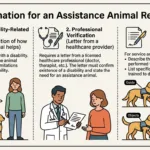


HUD’s current assistance-animal guidance explains that requests can involve service animals as well as other trained or untrained animals that provide assistance or therapeutic emotional support related to a disability.
That broader housing framework is why a renter should be cautious with statements such as “emotional support animals are not service animals, so housing does not have to allow them.” The first part may be correct under the ADA definition of a service animal; the housing conclusion does not automatically follow.
Our separate guide on service animals versus emotional support animals in housing goes deeper into that distinction, because the terms become much easier to understand once the applicable law is identified first.
The ADA answers a different access question
The Americans with Disabilities Act has its own definition of a service animal. The U.S. Department of Justice explains that under the ADA, a service animal generally means a dog individually trained to perform work or tasks directly related to a person’s disability. Emotional support or comfort by itself does not make an animal a service animal under that ADA definition.
The ADA is particularly important for access to businesses, government services and other public settings. It also applies in certain housing-related environments, including some public housing programs and university housing, but residential housing can simultaneously be subject to the Fair Housing Act.
The Department of Justice specifically cautions that housing providers should not use the narrower ADA service-animal definition to reduce obligations that may exist under the Fair Housing Act.
For a renter, the practical lesson is simple: do not resolve a housing question solely by searching “Is my animal a service animal under the ADA?” The housing analysis may require a different framework.
A reasonable accommodation changes a rule; it does not erase the entire lease
Assistance-animal questions often begin with an existing rental rule.
The property may have a no-pets policy. It may charge pet rent. It may restrict certain animals or impose other rules on ordinary pets. A reasonable accommodation request asks the housing provider to change, waive or make an exception to a rule, policy, practice or service when that change may be necessary because of a disability.
HUD and the Department of Justice describe a reasonable accommodation under the Fair Housing Act as a change, exception or adjustment to a rule, policy, practice or service that may be necessary for a person with a disability to have an equal opportunity to use and enjoy a dwelling.
That concept is broader than assistance animals, but animals provide an easy example. HUD identifies both of the following as possible assistance-animal accommodation requests:
- allowing an assistance animal at a property with a no-pets policy; and
- waiving a pet deposit, pet fee or another rule that ordinarily applies to pets.
The key word is request. The existence of a disability-related animal does not mean every rental rule disappears automatically. Rather, the renter is asking for a particular accommodation connected to a disability-related need, and the housing provider evaluates that request under the applicable fair-housing framework.
This is also why the wording “my lease says no pets” does not answer the entire question. Our article on what renters should review when a lease says “no pets” explains the ordinary lease side; assistance animals require the additional fair-housing analysis described here.
The same separation applies to costs. An ordinary pet deposit or monthly pet rent and a disability-related assistance-animal accommodation are not simply interchangeable categories. The specific issue of pet fees and assistance animals deserves its own analysis because the reasoning depends on why the charge exists and how the animal is being treated under the housing rules.
The request is about a disability-related need, not about proving that the animal is a good pet
A housing provider evaluating an assistance-animal request is not supposed to conduct the same screening exercise used for an ordinary pet application.
HUD’s current public guidance states that a Fair Housing Act accommodation involving an assistance animal can depend on whether a request was made by or for a person with a disability and, when the disability and the disability-related need for the animal are not apparent, whether the request is supported by reliable disability-related information.
That framework creates an important distinction between what is obvious and what is not.
A person using an animal for a readily apparent disability-related function may present a different documentation question from someone whose disability or need for the animal cannot be observed. HUD’s 2020 Assistance Animals Notice was issued partly to explain what kinds of information housing providers may consider when the disability or the disability-related need for an animal is non-obvious or not already known.
This does not mean that every request requires the same document, letter or form. It also does not mean that a renter can avoid the underlying disability-related requirements simply by purchasing a certificate or registration online.
HUD’s guidance focuses instead on reliable information relevant to the disability and the need for the accommodation when such information can appropriately be requested. Because documentation questions are easy to oversimplify, they are covered separately in what information may be relevant to an assistance-animal request.
There is another useful practical distinction here: a request for reasonable accommodation does not have to sound like a legal filing. HUD and DOJ explain more generally that a person does not necessarily need to use the words “reasonable accommodation” for a request to raise the issue, provided the housing provider is made aware that an exception or change is being sought because of a disability-related need.
A written request can nevertheless be useful because it creates a clearer record of what was asked for, when it was submitted and which rule the renter is asking to have adjusted.
Assistance-animal status does not make every concern irrelevant
Treating an assistance animal differently from an ordinary pet does not mean a housing provider must ignore every safety or property concern.
HUD’s current assistance-animal page identifies several circumstances that may be relevant when evaluating a request. A housing provider may consider, for example, whether granting the accommodation would impose an undue financial and administrative burden or fundamentally alter the essential nature of the provider’s operations.
HUD also identifies concerns involving the specific animal in question. A request may present a different problem if that particular animal poses a direct threat to the health or safety of others that cannot be eliminated or reduced through another reasonable accommodation, or if it would cause significant physical damage to the property of others that similarly cannot be sufficiently reduced.
The emphasis on the particular animal matters. General assumptions about a species, breed or category are not the same thing as evidence about the behavior or circumstances of the animal actually involved.
That issue becomes important later when discussing breed and weight restrictions for assistance animals, because an ordinary property rule and an individualized assistance-animal assessment are not necessarily the same analysis.
Residents also remain responsible for ordinary conduct associated with the animal. An accommodation is not a license to allow uncontrolled behavior, persistent property damage or conditions that would create legitimate health or safety concerns. The accommodation changes the relevant housing rule; it does not remove every responsibility associated with living in the property.
Federal fair-housing protection is broad, but coverage still has boundaries
The Fair Housing Act covers most housing in the United States, including much private and public housing, and disability is one of the characteristics protected by the federal law. HUD also notes, however, that the Act contains exemptions for certain housing situations.
For example, federal law contains limited exemptions involving some owner-occupied buildings with no more than four units and certain single-family housing rented or sold by an owner under specified conditions. Those exemptions have technical requirements, and state or local fair-housing laws may provide additional protections even where a federal exemption is relevant.
That makes it risky to decide that a landlord “is exempt” based on one visible fact, such as the size of a building. The underlying ownership, occupancy, use of brokers and other details can matter depending on the provision involved.
HUD summarizes the broader rule by explaining that the Fair Housing Act applies to most housing while recognizing limited statutory exemptions.
Other disability laws can also apply in particular settings. Housing receiving federal financial assistance, for example, may be subject to Section 504 of the Rehabilitation Act, while certain government-operated housing programs may also have ADA obligations.
A beginner does not need to memorize every overlap before making a housing request. What matters is recognizing when the simple pet-policy analysis is no longer enough. If the situation involves an animal connected to a disability, the appropriate starting point is the housing accommodation framework rather than the property’s ordinary pet rules.
Use the framework in the right order
Assistance-animal disputes become much harder to understand when all the questions are collapsed into one argument about whether an animal is “legitimate.”
A more useful sequence is to identify the housing rule first. Is the issue a no-pets policy, a fee, an animal restriction or another requirement? Then identify the requested accommodation and the disability-related reason it is being sought. If documentation is appropriately needed because the disability or need is not apparent, that becomes a separate part of the process. Finally, concerns involving the particular animal can be considered on their own facts rather than through general assumptions about pets.
That sequence also explains the structure of the rest of this series. The next articles separate service animals from emotional support animals, explain reasonable accommodations in more detail, examine what information may be relevant to a request and address specific issues such as fees, no-pet policies, breed restrictions and denials.
For a renter encountering the subject for the first time, the most important shift is conceptual: an assistance-animal request in housing is not simply a request to make an exception because someone wants to keep a pet. It is a disability-related housing accommodation question, and the answer depends on the housing law and the facts that apply to that request.

Alex is the content editor at PetzNews, covering pet care guidance and pet-friendly housing topics for renters and property owners across the United States