
“No pets.”
Two words can look final.
Sometimes they are straightforward: the lease prohibits ordinary pets, and the renter is expected to follow that restriction. In other situations, however, the full answer depends on the exact wording of the lease, other property documents, state or local law, the history of the tenancy, or whether an assistance-animal accommodation is involved.
The mistake is jumping too quickly to either conclusion:
“The clause means there is absolutely nothing else to review.”
or:

“A no-pets rule probably does not matter.”
Neither is a safe assumption.
The better starting point is to identify what the clause actually says, what other documents are incorporated into the lease, and whether your situation involves an ordinary pet or a different housing framework.
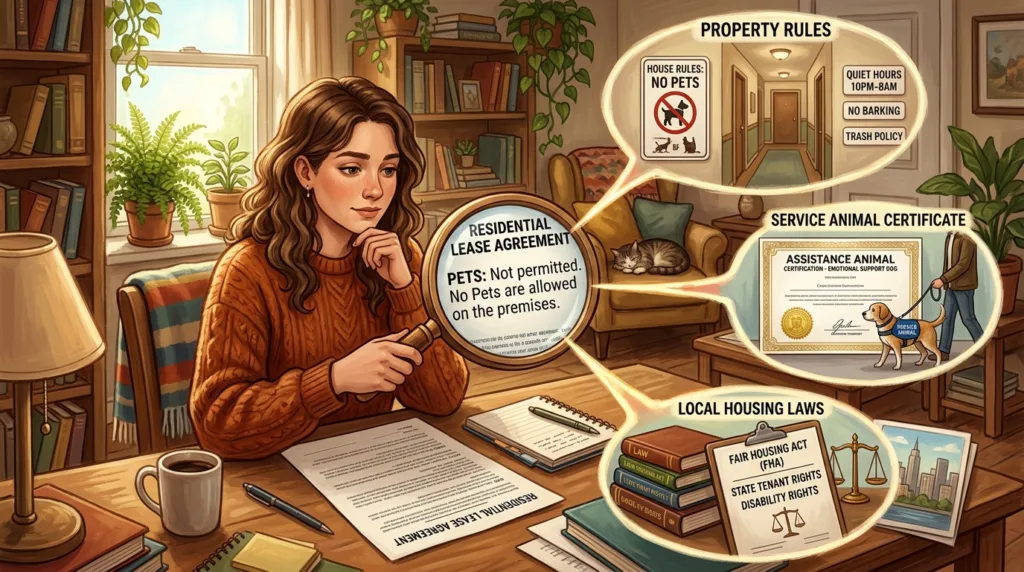
Read the exact language, not just the heading
A lease may contain a bold heading that says NO PETS, but the wording underneath matters.
Compare these hypothetical provisions:
No pets are permitted on the premises.
and:
No pets are permitted without prior written approval from management.
Those are not the same rule.
The first appears to state a general prohibition. The second leaves room for approval.
Another lease might prohibit dogs and cats but say nothing about fish or small caged animals. A separate pet policy may then define what is or is not allowed.
That is why reviewing the complete pet rules before signing a lease matters more than relying on one phrase.
Look for cross-references such as:
- “subject to management approval”;
- “except as provided in the pet addendum”;
- “see community rules”;
- “unless otherwise authorized in writing”;
- “except as required by law.”
Those phrases can change the practical meaning of the clause.
Check whether another document modifies the rule
A no-pets sentence in the main lease may not be the only relevant document.
The property could also use:
- a pet addendum;
- community rules;
- written approval;
- a separate animal policy;
- a lease rider.
If the lease refers to another document, read that document too.
Texas provides a useful general contract example: the Texas Attorney General advises renters to read the lease carefully and explains that changes agreed to by landlord and tenant should be written into the agreement rather than left as informal understandings.
That principle matters when a landlord says:
“Normally we do not allow pets, but we approved yours.”
If that exception is real, ask how it will be documented.
A verbal “that’s fine” can create uncertainty later if the signed lease still says no pets and nothing else reflects the approval.
Do not assume an online listing overrides the lease
Rental advertising can create another mismatch.
Suppose the listing says:
Cats allowed
but the lease presented for signature says:
No pets permitted
That inconsistency should be resolved before signing.
The same is true in the opposite direction. A generic listing might say “no pets,” while the property manager later offers written approval for a particular animal.
The controlling answer depends on the actual agreement and applicable law, not on which version is more convenient.
If the property intends to permit your animal, the paperwork should reflect that intention clearly.
This is one reason asking specific questions before renting with a pet is useful before money, moving plans and lease commitments make the situation harder to unwind.
Bringing in a pet first can create a lease problem
Some renters discover a no-pets clause only after they already have an animal.
Others know the clause exists but assume management will not care.
That is risky.
New York offers a clear example of why local law and lease terms both matter. The New York Attorney General states that tenants may keep pets unless the lease specifically prohibits them, and landlords may be able to pursue eviction when a tenant violates a lease provision prohibiting pets.
That is a New York statement, not a nationwide rule about eviction procedure.
The broader lesson is simpler: an ordinary pet prohibition can have real contractual consequences.
Do not rely on the fact that another tenant appears to have a dog or cat. You may not know whether that household has written permission, an older lease, an assistance animal or another exception.
Your own agreement is the relevant starting point.
Some places have unusual local rules
A national article has to be careful here because local pet-law exceptions can be surprisingly specific.
New York City and Westchester County provide a good illustration. The New York Attorney General explains that in certain multiple dwellings, a no-pet lease clause may be considered waived when a tenant openly keeps a pet for at least three months and the owner or owner’s agent knows about it, subject to important exceptions.
That rule is highly local.
It should not be translated into advice such as:
“If your landlord sees the pet for three months, the no-pets clause disappears.”
That would be inaccurate for most of the United States and incomplete even within New York.
Local rules like this are a reminder to verify the law where the property is located when the consequences matter.
They are not shortcuts for ignoring a lease.
A “no pets” property can still have written exceptions
Some landlords use a general no-pets policy but approve animals in limited circumstances.
If management is willing to make an ordinary-pet exception, get the terms in writing.
That written approval may identify:
- the specific animal;
- pet-related fees or deposits where permitted;
- behavior requirements;
- property rules;
- whether another pet can later be added.
If a separate document is used, understand what a pet addendum may contain.
The key is consistency.
The lease should not say one thing while a side conversation says another.
Likewise, if the property offers an exception only for one specific dog, do not assume that approval automatically extends to a second animal or a future replacement pet.
Assistance animals are not ordinary pets
This is the most important boundary in the article.
A housing provider’s ordinary no-pets policy does not automatically resolve a disability-related assistance-animal request.
That can mean an exception to an ordinary no-pets rule when the requirements for a reasonable accommodation are met.
New York’s Attorney General gives a practical example as well: a reasonable accommodation can include allowing a guide dog or companion animal despite a building’s no-pets policy.
This does not mean a renter can simply relabel an ordinary pet.
HUD’s framework looks at disability-related need and the circumstances of the requested accommodation. In some cases, documentation may be relevant when the disability or need is not readily apparent.
PetzNewz treats assistance animals separately because the legal analysis is different from ordinary pet permission.
Do not assume that requesting an accommodation and getting one are the same thing
Another mistake is treating a request as automatically approved.
That point deserves care.
It does not mean every renter must provide the same documentation. Nor does it mean every assistance-animal request can be denied until paperwork is produced.
The relevant question is whether the disability and disability-related need are already apparent or whether reliable supporting information may reasonably be requested under the fair housing framework.
For someone dealing with an assistance-animal situation, ordinary pet advice is therefore not enough.
What if the lease changed at renewal?
A renter may have a pet under one lease and then receive renewal documents containing a stricter pet policy.
That creates a different question from violating an existing term.
For example, New York’s Attorney General explains that a lease is a contract and generally cannot be changed while it is in effect unless both parties agree.
What happens at renewal can be different because the old lease term is ending and a new agreement may be offered, subject to whatever state, local or regulated-housing protections apply.
Do not assume:
“They allowed my pet last year, so the rule can never change.”
But also do not assume:
“A website update automatically changes my existing fixed-term lease today.”
Those are separate legal questions.
If a policy change affects your housing materially, check the actual lease dates, renewal documents and local rules.
Unauthorized pets can create more than one problem
A renter may focus only on the possibility of a lease violation.
There can be other consequences too.
An unauthorized animal may create disputes about:
- pet fees or deposits;
- property damage;
- complaints from neighbors;
- registration requirements;
- insurance or property rules;
- future lease renewal.
Trying to hide the animal can make documentation worse because communications, approvals and responsibilities remain unclear.
The cleaner approach is to resolve the permission question before the pet moves in whenever possible.
If the issue arises during the tenancy, read the lease first and avoid inventing your own interpretation of what management “probably” allows.
The phrase “no pets” answers less than it appears to
A no-pets clause certainly matters.
It just does not answer every possible housing question by itself.
You still need to know:
What exactly does the lease prohibit?
Are other documents incorporated into that rule?
Has management granted a written exception?
Does state or local law change the analysis?
Is this an ordinary pet situation or a disability-related assistance-animal request?
For many renters, the answer will remain simple: the lease prohibits ordinary pets, so that property is not a fit for the household.
In other cases, another document or legal framework matters.
The important part is not trying to force every situation into the same answer.
Read the actual rule first. Then identify which set of rules applies.

Alex is the content editor at PetzNews, covering pet care guidance and pet-friendly housing topics for renters and property owners across the United States