
A reasonable accommodation becomes easier to understand when you stop treating it as a special status attached to an animal and start with the housing rule that is creating a barrier. A property may prohibit pets, charge an animal-related fee or apply another policy that would ordinarily affect a renter’s animal. When a person with a disability needs an assistance animal in connection with that disability, the renter may ask the housing provider to change, waive or make an exception to the relevant rule so that the person has an equal opportunity to use and enjoy the dwelling.
That requested change is the reasonable accommodation.
HUD and the U.S. Department of Justice describe a reasonable accommodation under the Fair Housing Act as a change, exception or adjustment to a rule, policy, practice or service that may be necessary for a person with a disability to have an equal opportunity to use and enjoy a dwelling. For assistance animals, HUD gives familiar examples: allowing an animal despite a no-pets policy or waiving a pet deposit, fee or another rule that would ordinarily apply to pets.
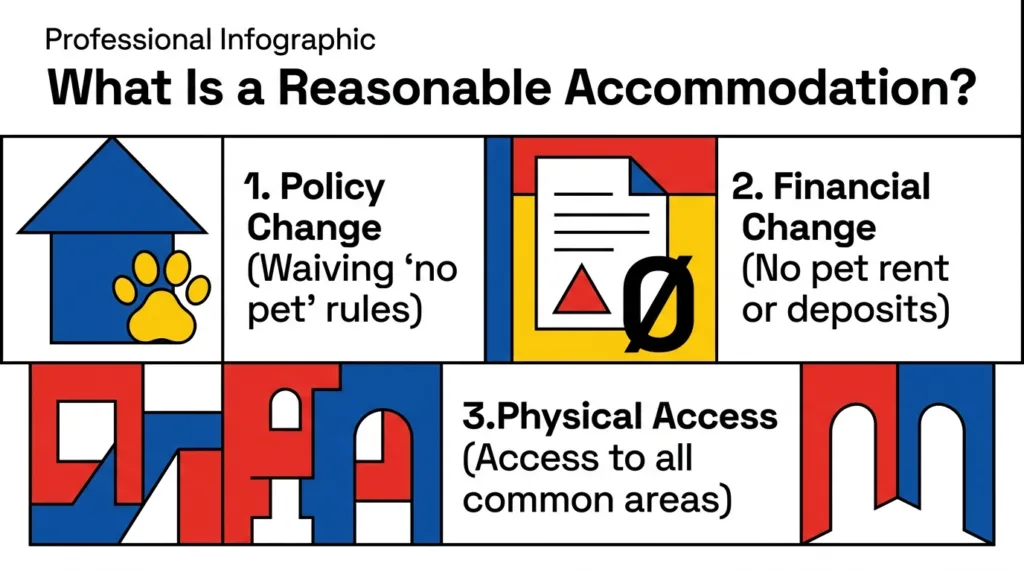
A useful request connects three things that belong together
Consider a property with a no-pets policy. The rule is clear, but knowing the rule does not tell you whether a reasonable accommodation is required in a particular situation.
The next part is the disability-related need. The renter is not merely asking management to overlook the rule as a personal favor; the requested change is connected to a disability and to the person’s ability to use and enjoy the housing. Finally, there is the accommodation itself: the specific exception or adjustment being requested.
Those three elements can be thought of together:



the housing barrier → the disability-related need → the requested change
For an assistance animal, that could mean a tenant with a disability asking to keep the animal even though the property ordinarily prohibits pets. HUD’s current assistance-animal guidance expressly identifies an exception to a no-pets policy as an example of a reasonable accommodation involving an assistance animal.
A different renter may already live in a pet-friendly property but face a pet-specific charge. The requested accommodation might then concern the charge rather than permission for the animal itself. That is why reasonable accommodation should not be understood as a single standardized benefit called “ESA approval” or “service-animal approval.” The relevant accommodation depends on the housing rule that needs to change.
This also explains why two people with assistance animals may ask for different things at the same property. One may need an exception to the no-pets provision, while another may already have permission for the animal and need an adjustment to a separate policy. The disability-accommodation framework focuses on the barrier affecting that individual rather than requiring every assistance-animal request to look identical.
The same distinction protects the boundaries between articles in this series. Why assistance animals are not treated the same as ordinary pets in housing explains why the pet-policy framework changes; reasonable accommodation is the mechanism through which a particular rule may then be adjusted.
The request does not need legal language, but it should communicate what is being sought
A renter does not have to draft a legal memorandum or quote the Fair Housing Act to make a reasonable-accommodation request.
HUD and DOJ explain that a request exists when a resident or applicant makes clear that an exception, change or adjustment to a rule, policy, practice or service is being requested because of a disability. The person does not have to use the words “reasonable accommodation,” and a request may be made orally or in writing.
Someone else may also make the request on behalf of the person with a disability, such as a family member or another authorized person acting for them.
Although a particular phrase is not required, clarity is useful. Compare these two statements:
“I want permission to keep my dog.”
and
“Because of my disability, I am requesting an exception to the property’s no-pets policy so that I can live with my assistance animal.”
The second statement makes the relationship between the rule and the requested accommodation much easier to recognize. It does not need to disclose unnecessary medical details to communicate that the request concerns disability rather than an ordinary pet application.
Written communication can also create a clearer record. The HUD/DOJ Joint Statement says that an accommodation may be requested orally, but notes that putting the request in writing can help both sides avoid misunderstandings about what was requested and whether a request was made.
A housing provider may have its own reasonable-accommodation form or preferred procedure. That can make administration easier, but the federal guidance states that a provider should not refuse to consider a request simply because the person did not use the provider’s preferred form or formal procedure.
Timing is similarly flexible. HUD’s assistance-animal guidance explains that a resident may request an accommodation before or after acquiring the assistance animal. It also explains that a request can still be made after the animal has been brought into the housing, although waiting until a lease-enforcement dispute has begun can make the circumstances more complicated.
As a practical matter, raising the issue before a conflict develops usually produces a clearer process. That is not the same as saying federal law imposes one universal deadline for every assistance-animal request.
Once the request is recognized, the information needed to evaluate it depends on what is already apparent or known. When disability or the disability-related need for the animal is not observable, reliable supporting information may become relevant. That issue deserves its own treatment in what information may be relevant to an assistance-animal request, because reasonable accommodation does not create a universal documentation checklist.
“Reasonable” is an evaluation, not a synonym for automatic
The Fair Housing Act does not require every accommodation exactly as requested under every circumstance.
HUD’s current assistance-animal page identifies several limits that may be relevant. A housing provider may demonstrate, for example, that a requested accommodation would impose an undue financial and administrative burden or fundamentally alter the essential nature of the provider’s operations. For assistance animals specifically, HUD also identifies circumstances involving a direct threat from the particular animal or significant physical damage that cannot be sufficiently eliminated or reduced through another reasonable accommodation.
These are not simply labels a provider can apply without analysis.
The HUD/DOJ Joint Statement explains that whether an accommodation creates an undue financial and administrative burden should be evaluated case by case. Relevant considerations can include the cost of the accommodation, the provider’s financial resources, the benefit to the requester and whether another accommodation could effectively meet the disability-related need.
A fundamental alteration is different. It concerns a change that would alter the essential nature of the housing provider’s operations. In many assistance-animal situations, the requested change is considerably narrower: an exception to a pet policy does not ordinarily ask a housing provider to become a fundamentally different type of operation.
The analysis should therefore focus on the actual request rather than on abstract discomfort with making exceptions.
There is another important possibility when the accommodation first proposed presents a legitimate problem: the discussion does not always have to end with a simple yes or no.
HUD and DOJ recommend discussing whether an alternative accommodation could effectively meet the person’s disability-related need when the accommodation requested cannot reasonably be provided. This kind of discussion is often described as an interactive process.
An alternative is meaningful only if it actually addresses the disability-related need. Federal guidance also recognizes that a person with a disability ordinarily has important knowledge about their own functional needs. If the person’s requested accommodation is itself reasonable, the provider cannot simply insist on a different alternative because it prefers that option.
That makes the interactive process different from bargaining over whether the renter deserves an accommodation. Its useful purpose is to identify an effective way to remove the disability-related housing barrier when the precise solution initially proposed presents a legitimate problem.
Housing providers are also expected to respond promptly. The HUD/DOJ Joint Statement warns that an undue delay in responding to a reasonable-accommodation request may itself amount to a failure to provide the accommodation. Federal guidance does not create one universal number of days for every private housing request, so renters should be cautious with online claims that every provider automatically has the same fixed response deadline.
The accommodation should be read against the particular rule it changes
Once an accommodation is granted, it is useful to identify exactly what has changed.
If the accommodation allows an assistance animal despite a no-pets policy, the animal is not suddenly exempt from every term governing the tenancy. If a pet-specific fee is waived, that does not automatically resolve unrelated questions involving actual property damage. Similarly, an accommodation involving one assistance animal does not rewrite every community rule that has no conflict with the disability-related need.
This targeted approach prevents two opposite mistakes.
The first is treating ordinary pet rules as though no exception can ever be made. That ignores the purpose of reasonable accommodation. The second is assuming that approval of an assistance animal eliminates every responsibility connected to living with the animal. That goes further than the accommodation itself.
Suppose, for example, that a renter receives an accommodation allowing an assistance dog at a property that otherwise prohibits animals. The accommodation addresses the presence of the dog. If the animal later creates a specific safety concern or causes actual damage, those facts may raise separate issues rather than automatically invalidating or expanding the original accommodation.
Likewise, if the dispute concerns a pet fee rather than permission, the useful question is whether that specific pet-related charge can be applied to the assistance animal under the Fair Housing framework. The details of pet fees and assistance animals in housing are easier to understand once the accommodation is viewed as a targeted adjustment to a particular rule.
This way of thinking also helps a renter organize a request. Instead of trying to establish that the animal is entitled to a vague package of special treatment, identify the obstacle that actually exists. Is the property refusing the animal because of a no-pets policy? Is management imposing a pet-specific charge? Is another animal restriction preventing the accommodation from working?
Then connect that obstacle to the disability-related need and state the change being requested.
If the provider grants the request, keep the written response and any related documentation with the lease records. If the request is denied or remains unresolved, preserve the request, supporting information and responses rather than reconstructing the sequence later. What renters can do when an assistance-animal request is denied addresses that later stage separately.
Reasonable accommodation is therefore less mysterious than the terminology can make it sound. It is a method for adjusting a housing rule when disability creates a need for that adjustment. The difficult questions usually concern the connection between the disability and the requested change, the information appropriately needed to evaluate it, or whether the particular accommodation is reasonable under the circumstances—not whether an ordinary pet policy exists in the first place.

Alex is the content editor at PetzNews, covering pet care guidance and pet-friendly housing topics for renters and property owners across the United States