
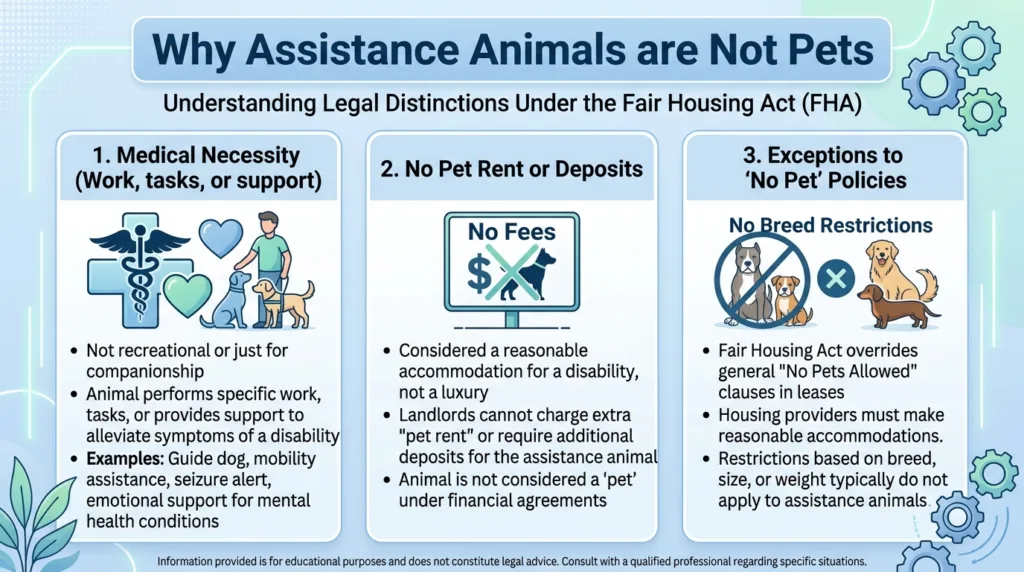
A rental property can have a perfectly valid pet policy and still need to handle an assistance-animal request differently.
That is because the two situations begin from different questions. With an ordinary pet, the housing provider is generally deciding whether animals are allowed under its lease and what conditions apply to them. With a qualifying assistance animal, the renter may instead be asking for a disability-related reasonable accommodation to a rule, policy or practice that would otherwise apply.
HUD’s Fair Housing guidance states the distinction directly: assistance animals are not pets for purposes of the Fair Housing accommodation analysis. The same guidance explains that an animal that does not qualify as a service animal or another type of assistance animal may be treated as a pet under the lease and the housing provider’s ordinary rules.
The practical effect is not that assistance animals exist outside the rental agreement. Rather, certain rules that make sense for voluntary pet ownership cannot simply be applied without considering the disability-related accommodation request.
A no-pet rule can answer one question without answering the other
Suppose a lease states that animals are prohibited.
For someone who simply wants to keep an ordinary pet, that provision is highly relevant. The renter should review the lease, any pet addendum and applicable law before assuming an exception exists. Our guide to what renters should review when a lease says “no pets” covers that ordinary rental-policy question separately.



An assistance-animal request changes the analysis because the renter may be asking the housing provider to make an exception to the no-pet rule because of a disability-related need.
The HUD and Department of Justice Joint Statement describes a reasonable accommodation as a change, exception or adjustment to a rule, policy, practice or service that may be necessary to give a person with a disability an equal opportunity to use and enjoy a dwelling. Its examples include making an exception to a no-pets policy for an assistance animal.
This does not make every request automatic. Disability, disability-related need, the accommodation being requested and the circumstances surrounding the request can all matter. What changes is the starting point: “our building does not allow pets” is no longer, by itself, a complete response to a disability-related accommodation request.
The distinction becomes easier to understand once the accommodation itself is isolated. A reasonable accommodation for an assistance animal concerns the specific housing barrier being adjusted; it is not a general declaration that all lease provisions cease to apply.
Pet rent and pet deposits belong to the ordinary pet framework
Money makes the difference between the two categories particularly visible.
A property that permits ordinary pets may charge pet rent, a pet fee or a pet deposit where those charges are otherwise lawful. Those amounts are tied to the property’s ordinary pet program.
HUD’s Assistance Animals Notice states that a housing provider may not charge a deposit, fee or surcharge for a service animal or other qualifying assistance animal. The HUD/DOJ Joint Statement similarly explains that a housing provider may not require an extra fee or deposit as a condition of granting a reasonable accommodation involving an assistance animal.
That rule should not be shortened to “an assistance animal can never cost the renter anything,” because actual property damage is a separate issue.
Federal guidance distinguishes a pet-specific charge imposed simply because the assistance animal lives at the property from responsibility for damage the animal actually causes. If the provider normally charges residents for damage they cause, it may charge for damage caused by an assistance animal under the same general approach. The provider may also use a standard security deposit that applies to tenants generally; the problem is adding a pet-specific charge as the price of receiving the accommodation.
The separate article on pet fees, pet deposits and assistance animals goes deeper into that distinction, because an advance animal charge and a later bill for actual damage solve completely different problems.
Ordinary breed or weight rules do not automatically decide the request
Pet policies often classify animals before management knows anything about the individual animal. A property might exclude particular dog breeds, impose a 25-pound weight limit or allow only certain species as ordinary pets.
HUD’s assistance-animal guidance says that pet rules do not apply to service animals and support animals in the same way and that a housing provider should not limit an assistance dog merely because of its breed or size.
A recent federal case illustrates why that distinction matters. In January 2026, the Department of Justice entered into a settlement in United States v. Nourse after alleging that housing providers had refused a reasonable accommodation because a tenant’s assistance dog exceeded a 15-pound limit and had charged the tenant a pet fee. The settlement required damages, fair-housing training and a new reasonable-accommodation policy. The allegations and settlement concerned that particular case; they do not convert every animal restriction into an automatic violation. (justice.gov)
What the example demonstrates is the danger of using an ordinary pet category as a substitute for an accommodation analysis.
That does not mean size, behavior or safety can never become relevant. The important difference is between rejecting an animal because it belongs to a prohibited category and evaluating facts involving the particular animal.
Our detailed guide to breed and weight restrictions for assistance animals focuses specifically on that boundary.
The individual animal can still create legitimate concerns
Once ordinary pet restrictions stop functioning as automatic answers, the opposite overcorrection is to assume that assistance-animal status makes the animal’s conduct irrelevant.
Federal guidance does not take that position.
The Fair Housing framework recognizes circumstances involving direct threats to the health or safety of others or substantial physical damage to the property of others. The HUD/DOJ Joint Statement emphasizes that direct-threat determinations cannot rest merely on fear, speculation or stereotypes; they require an individualized assessment based on reliable, objective evidence. (justice.gov)
HUD’s assistance-animal guidance applies a similar individualized principle to the animal involved in the accommodation request. A concern about what a particular animal has actually done is different from a prediction based only on breed, weight or another broad category.
That distinction produces a more balanced rule than either extreme.
A housing provider cannot necessarily take an ordinary pet restriction, apply it mechanically and consider the accommodation analysis finished. At the same time, a renter cannot reasonably treat the accommodation as permission for uncontrolled behavior, substantial property damage or legitimate safety problems to be ignored.
The animal still lives within a shared housing environment. Waste management, control in common areas, avoidable disturbances and care of the rental remain practical responsibilities even when a pet-specific restriction has been adjusted.
Pet screening and accommodation information serve different purposes
Ordinary pet applications often ask for details such as breed, weight, age, vaccination records or property registration because management is deciding whether the animal fits its pet program.
A reasonable-accommodation process has another purpose: determining whether an exception or adjustment may be needed because of disability.
HUD’s guidance therefore distinguishes situations in which the disability and disability-related need are readily apparent or already known from situations in which one or both are not observable. In the latter circumstances, reliable disability-related information may sometimes be relevant to evaluating the request.
The important point is not that every renter must produce the same document. It is that information should relate to what genuinely needs to be established in the accommodation process rather than simply reproducing an ordinary pet-screening form.
For the same reason, a housing provider’s pet-registration process should not automatically be assumed to answer the Fair Housing question. A form designed for ordinary pets may contain fees or eligibility criteria that do not fit the disability-accommodation framework.
The documentation issue is sufficiently nuanced that it has its own article: what information may be relevant to an assistance-animal request. Separating that question from ordinary pet screening reduces the risk of assuming either that no information can ever be requested or that extensive medical disclosure is always required.
The accommodation changes the relevant rule, not the entire tenancy
The phrase “assistance animals are not pets” is useful only when its limits remain visible.
If an accommodation allows an assistance animal despite a no-pets policy, the exception concerns that animal rule. The renter’s obligation to pay rent does not change. General requirements concerning property care do not disappear. A tenant is not excused from responsibility for actual damage merely because the animal was permitted as an accommodation.
Likewise, removing a pet-specific fee does not prevent the provider from enforcing unrelated lease provisions that apply equally and do not interfere with the disability-related accommodation.
Thinking about the issue in this targeted way also makes later disagreements easier to separate. A renter and housing provider might agree that an assistance animal can live in the unit but later disagree over a specific instance of property damage. The existence of the accommodation and responsibility for that damage are connected facts, yet they are not necessarily the same question.
The same principle works in reverse. If management objects to the animal because of an ordinary pet rule, the first step is to identify exactly which rule is creating the barrier. Is it a no-pets provision, a monthly pet charge, a weight limit or another condition? Once the rule is identified, the accommodation request can be evaluated against that specific obstacle instead of turning into an argument over whether the animal is a “real pet.”
That is the practical meaning of treating assistance animals differently in housing. The animal is not placed into a legal vacuum; rather, a disability-related housing need can require rules designed for ordinary pets to be reconsidered through the reasonable-accommodation framework, while responsibilities that legitimately remain part of the tenancy can continue to matter.

Alex is the content editor at PetzNews, covering pet care guidance and pet-friendly housing topics for renters and property owners across the United States