
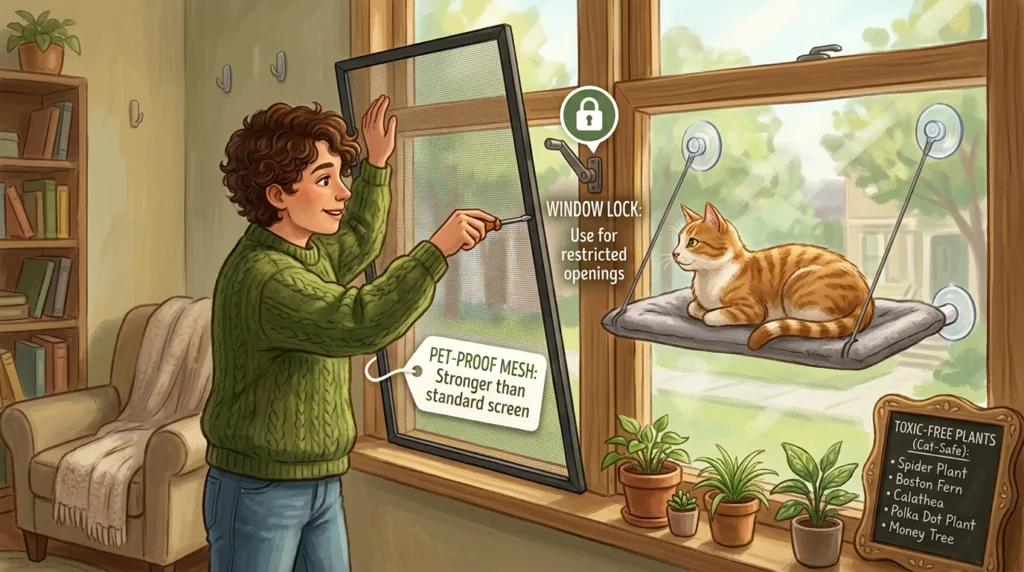
Windows can be some of the most valuable places in an apartment for an indoor cat. They provide daylight, changing sounds and a view of birds, people and outdoor activity, while elevated perches also make better use of limited indoor space. Balconies can seem to offer an even richer version of that experience because the cat is closer to fresh air and the outdoor environment.
The safety question begins when observation becomes physical access. An open window depends on the strength and security of whatever separates the cat from the outside. A balcony adds railings, gaps, ledges and furniture that may create routes a renter did not initially notice. Since cats climb, jump and react quickly to movement, evaluating these spaces based only on how cautious the cat has been in the past leaves too much to chance.
The ASPCA explains that cats can accidentally fall from windows, terraces and fire escapes when they become focused on birds or other activity and lose their balance. Preventing that risk does not require eliminating window enrichment from apartment life. It requires making sure the physical boundary is actually capable of keeping the cat inside.
Inspect the window as a system, not just a pane of glass
A closed, latched window presents a different situation from an open window supported by a screen, and the details of that screen matter. A frame that appears normal from across the room may be loose at one corner, poorly seated in its track or weakened after years of use.
The ASPCA recommends snug, sturdy screens on open windows and specifically advises checking adjustable screens to make sure they are tightly secured in the frame. Before allowing a cat regular access to an open window, press and inspect the screen from inside rather than assuming that its presence alone is enough.
Look at the edges as carefully as the center. Gaps can develop where the screen meets the frame, while bent tracks or damaged mesh may create an opening large enough for a determined cat to exploit. If the screen shifts when lightly pressed or is visibly damaged, keeping that window closed until the problem is repaired is more sensible than testing whether the cat will leave it alone.

The way the window opens also changes the risk. Sliding, double-hung, casement and other designs create different openings and may interact differently with screens or limiting hardware. As a renter, you do not necessarily need to redesign the window; you do need to understand which component is preventing the cat from reaching the exterior when the window is open.
This is particularly important if a cat uses the sill as an established perch. Windows are a legitimate part of creating a useful indoor environment for a cat in an apartment, but the perch and the safety barrier should be evaluated separately. A good view does not make a weak screen stronger.
Child window guards and pet barriers solve different problems
Apartment windows sometimes already contain guards, stops or limiting devices installed for building-safety reasons. It is tempting to see any metal barrier across an opening and assume that it also solves the cat-safety problem.
That assumption can be wrong.
The ASPCA specifically warns that cats can slip through childproof window guards and that these devices should not be relied upon as pet protection. Meanwhile, building codes and local rules may govern those guards for an entirely different purpose.
New York City illustrates the distinction clearly. The city’s Department of Health explains that approved window guards or limiting devices are required in certain apartments for child fall prevention and that tenants should not alter or remove required guards. Those are New York City rules, not national rental requirements, and they are designed around child safety rather than cat containment.
For a renter, the practical lesson is not to modify existing building safety equipment casually. If a landlord-installed guard leaves spaces a cat could pass through, adding a pet-safe solution may require coordination with property management rather than replacing or drilling into the existing device yourself.
This is where the lease becomes relevant even though the problem is primarily physical safety. If securing a window requires new hardware, drilling, replacing a screen frame or attaching something permanently, review the rental’s rules before making alterations. A protective measure should not create a lease or property-damage issue because it was installed without considering the building itself.
A balcony needs more than a quick look at the railing
Balconies create several possible routes to the exterior at once. A cat may fit through railing gaps, climb onto the railing, reach a neighboring space or use furniture to gain access to a higher edge. Consequently, assessing the balcony means looking at the entire path the cat could take rather than measuring the height of the railing alone.
Veterinary guidance summarized by PetMD recommends examining balconies for openings and escape routes, moving furniture away from edges and using secure screened enclosures when cats are allowed outdoor balcony access. Even after precautions are added, supervision remains important because a loose section, unexpected object or change in the environment can create a route that did not exist before.
Furniture deserves particular attention because it changes the usable geometry of the space. A chair positioned against the railing may effectively lower the effort required to reach the top. A storage box can serve as a step, while a narrow ledge may become more attractive once a cat has an easy route to it. Rearranging ordinary furniture can therefore eliminate an access path without modifying the rental at all.
Railings themselves also vary considerably. Solid balcony walls, widely spaced vertical rails, horizontal elements and decorative openings create different hazards. Netting or enclosure products can sometimes reduce access, but the installation has to be secure and appropriate for the structure; a barrier with gaps, loose attachment points or material the cat can easily push aside may provide little meaningful protection.
A fully enclosed outdoor space, often called a catio, is another possibility where the property permits it. The Feline Veterinary Medical Association notes that controlled outdoor access through secure enclosures can provide stimulation while reducing many of the risks associated with unrestricted outdoor access. In a rental, however, a permanent catio attached to the building is a different proposition from a freestanding enclosure, so permission and installation constraints still matter.
Do not let the indoor layout create an accidental launch point
Window and balcony safety is partly determined several feet away from the opening.
A tall bookcase beside a window may give the cat direct access to the upper portion of the frame. A cat tree can turn a previously unreachable opening into an easy destination, while a chair beside a balcony railing may have the same effect outdoors. These pieces of furniture are not inherently unsafe; their position changes what the cat can reach.
This creates an interesting tradeoff because cats benefit from vertical space. Feline Veterinary Medical Association guidance emphasizes elevated resting places and vertical territory as important components of the indoor environment. The answer is therefore not to remove every tall surface from an apartment.
Instead, provide height where the boundary beyond it is safe. A sturdy perch beside a securely closed or properly screened window can offer useful enrichment. By contrast, positioning the tallest cat tree beside a window with an unreliable screen unnecessarily connects two otherwise separate features.
Curtains and blinds deserve a similar review, particularly when cords or fabric create climbing opportunities near an opening. The main concern in this article is falling and escape, but anything that changes how easily the cat reaches the window should be considered part of the route.
This kind of inspection is especially useful after rearranging the apartment. Moving furniture may improve the room for people while giving the cat access to something that was previously out of reach. A quick reassessment after major layout changes is simpler than assuming the original safety plan still works.
Supervision is useful, but it should not compensate for a weak barrier
Watching a cat on a balcony can reduce risk because the renter can respond when the animal approaches an unsafe edge, climbs furniture or becomes intensely focused on something outside. PetMD’s veterinary guidance recommends supervision even when other balcony precautions have been taken.
Supervision, however, should sit on top of a reasonably secure setup rather than replace one. A cat can move quickly, particularly when startled or when a bird passes close to the building. Relying on the assumption that you will always react before the cat does makes the safety plan dependent on perfect attention.
The same distinction applies to open windows. Sitting in the room with a cat does not strengthen a loose screen. If the physical barrier is unreliable, close the window or address the barrier rather than treating human presence as its structural reinforcement.
Harness use can provide controlled outdoor exposure for some cats, but it is a separate skill rather than an immediate substitute for balcony containment. A cat should be appropriately accustomed to a well-fitting harness before relying on it, and attaching a leash does not justify leaving the animal unattended on a balcony.
The broader principle is that each layer should do its own job. The screen or enclosure provides a physical boundary, furniture placement reduces easy access to vulnerable edges, and supervision gives the renter an opportunity to notice behavior or conditions that the physical setup did not anticipate.
Rental-friendly safety means knowing what you may change
The safest technical solution is not necessarily the one a renter is free to install.
Replacing a screen, attaching mesh to a railing, drilling a window stop into the frame or constructing an enclosure can affect building components. Some properties may permit particular modifications; others may require management or maintenance staff to perform them.
When you identify a weak screen or damaged window component that belongs to the property, report it rather than silently rebuilding it. Existing defects should also be documented, particularly at move-in, so the condition is not confused later with damage caused during the tenancy.
Temporary or freestanding solutions can reduce some modification concerns, although “removable” should not be interpreted as automatically harmless. Fasteners, adhesives and pressure-mounted products can still affect paint, finishes, window frames or railings depending on how they are installed.
If management offers a repair or approved solution, confirm what will actually be changed. A replacement insect screen may fix damaged mesh, for example, but the renter should still check that it is securely seated before treating the window as a regular cat perch.
There is also no reason to open every window merely because one cannot be made safe for cat access. In many apartments, the simplest answer for a particular opening is to keep it closed while using another secure window for ventilation and observation.
If a fall happens, treat it as an emergency even when the cat gets up
Prevention is the focus, but the response to a fall is worth knowing because cats do not always display the full extent of an injury immediately.
The ASPCA advises that a cat that falls from a window or other height should be located promptly and taken for veterinary care. High-rise falls can cause fractures and internal injuries, and the fact that a cat is conscious or able to move does not establish that it escaped injury.
Do not attempt to use the outcome of a previous fall as evidence that the balcony or window is safe. Cats can survive serious falls, but that does not make repetition predictable.
For renters, the more useful strategy remains prevention: inspect the actual openings, keep barriers secure, account for the ways furniture changes access and involve property management when the solution affects the building. Those steps preserve the benefits of windows and, where appropriate, controlled balcony access without depending on the cat to recognize a hazard that the apartment itself has left available.

Alex is the content editor at PetzNews, covering pet care guidance and pet-friendly housing topics for renters and property owners across the United States