
Apartment maintenance is one of the few routine events that can change who controls your front door, which rooms stay open and what appears on the floor within a matter of minutes.
A leaking sink may bring one technician who enters once and leaves twenty minutes later. An appliance replacement can mean repeated trips through the hallway. A window repair may temporarily remove a screen. Flooring work can turn the room that normally keeps a pet away from visitors into the exact room workers need to enter.
For a renter with a dog, cat or other free-moving pet, those differences matter more than the word “maintenance” on the notice. The useful question is not simply where to put the animal while someone works. It is whether that location will remain secure after the repair actually begins.
That makes the maintenance notice the first part of the pet-safety plan.
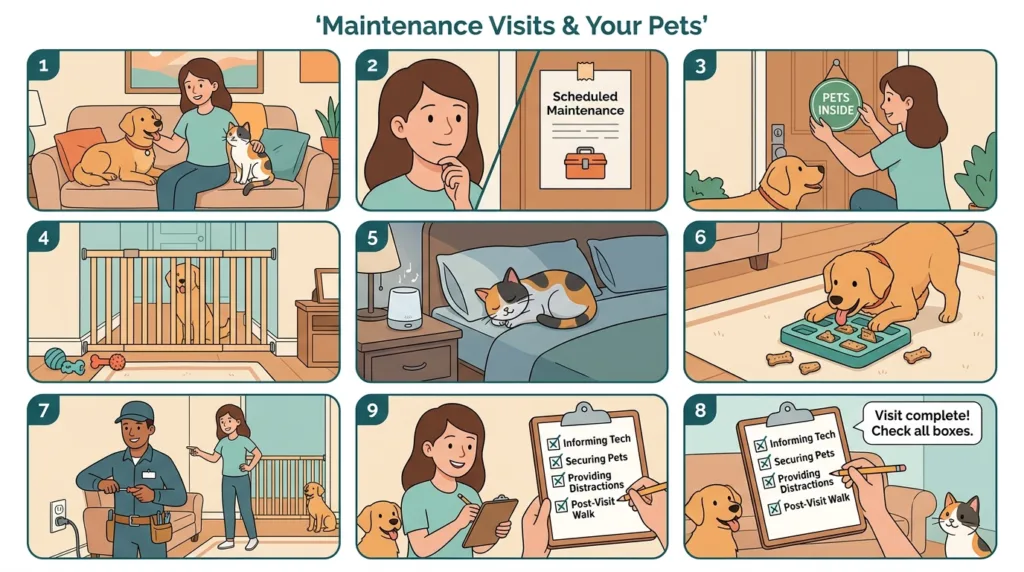
Read the work order as a map of doors and rooms
Start with the area maintenance needs to reach.
If the repair is under the kitchen sink, a closed bedroom may create a straightforward separation between the pet and the work. If the request involves a bedroom window, that same room cannot serve as the retreat. An HVAC inspection may require access to several areas, while a dishwasher repair could keep most of the apartment untouched.

The location of the problem therefore determines which doors can realistically stay closed.
It also helps to know whether the worker is likely to make repeated trips outside. VCA Animal Hospitals identifies worker traffic and pet escape as two of the practical hazards created by home-repair activity. Someone carrying tools, parts or equipment may open the apartment door far more often than the renter normally would.
That changes the risk even for an animal that does not usually try to escape.
A cat that normally watches the hallway from several feet away may react differently to unfamiliar people, noise and repeated door movement. FelineVMA guidance notes that unfamiliar visitors and increased traffic can disrupt a cat’s routine and recommends providing a separate retreat with basic resources such as water, a litter box and a familiar resting place.
For a dog, the question is less about creating a generic “safe room” and more about choosing a separation method the individual dog already understands. A familiar room behind a closed door may work well. A crate can be useful for a dog that is already comfortable resting there, but a scheduled maintenance visit is a poor time to introduce prolonged confinement for the first time.
The same applies to cats and carriers. A carrier may solve a short transfer problem, but it should not automatically become the holding area for a long repair simply because it has a door.
Think instead about how long the visit may last, what the pet normally does in that space and what resources it will need while separated.
If maintenance may enter while you are away, the plan needs to work without you standing beside the front door.
That usually means eliminating ambiguity. The animal should not be loose with a note asking the worker to “watch for the cat.” The worker should not have to decide whether a friendly dog can remain in the room. A closed space is more reliable when management also knows that the door is intentionally closed because an animal is inside.
A short work-order note can be enough:
Cat secured in bedroom. Please do not open that door. If bedroom access becomes necessary, please contact me before entering.
That message does three useful things. It identifies the animal’s location, gives the worker a clear boundary and explains what to do if the repair changes.
The third point matters because repairs do change.
A technician investigating a leak may discover that access is needed from the other side of a wall. A worker assigned to one window may be asked to inspect another. A repair expected to take twenty minutes can become a larger job.
The containment plan should be able to survive that change, or there should be a clear way to stop and revise it.
Property procedures for maintenance access vary by lease and jurisdiction, so this is not the place to invent a nationwide notice rule. If your building has specific instructions for pets during service calls or entry while residents are absent, read those together with the lease and community rules. Our guide to reviewing pet rules before signing a lease explains why property documents sometimes need to be read as one package rather than as isolated clauses.
A closed room is useful only while everything inside it remains safe
Separating the animal from the worker handles the doorway problem. It does not automatically handle the repair itself.
Maintenance changes the apartment temporarily.
A cabinet that normally stays shut may be open. A window may be without its screen. An access panel can expose wiring or wall cavities. Nails, screws, wire pieces, packaging and tools may move through areas the pet normally investigates without concern.
The ASPCA Animal Poison Control Center has received calls involving substances commonly used in home repairs, including caulk, spackle, floor adhesive, insulation and paint. Its more recent home-repair guidance also warns about nails, screws and wires that can cause injury or serious problems if swallowed. Those hazards are relevant to apartment maintenance even when the renter is not personally doing the work.
This changes how you choose the pet’s temporary location.
Imagine a cat has been placed in the bathroom because the maintenance request concerns the living-room window. Halfway through the visit, the worker needs to shut off water through an access point inside that bathroom. The room is no longer separated from the job.
The problem is not that the original decision was unreasonable. The repair route changed.
When a maintenance notice describes work that may spread through several rooms, ask enough about the job to understand whether a genuinely isolated area exists. You do not need an inventory of every tool and product. You do need to know whether the space holding the animal is likely to become part of the work zone.
Some visits are easier to manage by taking the pet elsewhere.
A major flooring repair, repeated contractor traffic or work involving several rooms can make a friend’s home, appropriate daycare arrangement or another familiar location more practical than continually moving the animal inside the apartment. Whether that is necessary depends on the animal and the job; a twenty-minute faucet repair does not deserve the same response as a day of window replacement.
Noise creates a separate problem because a closed door does not stop sound.
Drilling, hammering, alarms, vacuums and unfamiliar voices can still reach the pet. Cats often prefer familiar spaces and hiding opportunities when confronted with unfamiliar sights, sounds and smells, while dogs can react to hallway or visitor noise in very different ways.
The animal’s existing pattern matters here.
A dog that already barks intensely at people approaching the apartment door may respond differently to a contractor making several trips through the entrance. If hallway and visitor sounds are already a known trigger, our guide to reducing barking problems in an apartment focuses on identifying that pattern rather than assuming every bark has the same cause.
Likewise, a dog that becomes distressed when left alone presents a different situation if maintenance will enter while the renter is away. The stranger entering is only one part of the event; the absence itself may already be difficult for the dog. That issue is treated separately in our guide to leaving a dog home alone in an apartment.
Do not solve those problems by asking maintenance staff to manage the behavior.
A technician should not have to hold a leash, prevent a cat from crossing the threshold or judge whether a barking dog is safe to approach. Even a social animal can get underfoot while equipment is being moved. VCA specifically identifies pets interfering with workers as a construction-site safety concern.
The renter’s job is to create a boundary that lets both sides ignore each other.
That boundary may also need to remain in place after the actual repair is finished.
Paint, caulk, adhesives or cleaning products can still be wet. A repaired window may need to remain partially open. Furniture may have been moved away from a wall, revealing cables or gaps the pet could not previously reach.
The scheduled end of the maintenance appointment and the moment the apartment is ready for normal pet access are not always the same thing.
Treat the worker leaving as a handoff, not the end of the plan
Before releasing the pet, walk the route the worker used.
Start with the apartment’s boundaries. Check that the front door is fully secured and that any windows, balcony doors or screens affected by the repair are back in their intended condition. If a cabinet, utility panel or wall opening was accessed, confirm that it is closed or otherwise inaccessible before the animal returns.
Then look at the floor and the work surface.
A screw beside a baseboard or a short piece of wire can be nearly invisible during an ordinary walkthrough. The ASPCA recommends checking repair areas for items such as nails, screws and wires before pets regain access.
If the job involved a wet product, do not use the worker’s departure as the only signal that the area is ready. Follow the relevant product or professional instructions about drying, curing, ventilation and re-entry where applicable.
Food and water areas deserve a quick look if work occurred nearby. Dust, debris or a displaced bowl are simple problems to correct before the pet returns.
The final check is the rental itself.
Sometimes the repair changes the condition of a surface in a way unrelated to the pet. A screen may be damaged during removal, a wall may remain open for a follow-up visit, or flooring may be marked when equipment is moved. Photographing a meaningful new condition can preserve the sequence while the visit is still recent.
That is different from deciding immediately who caused what or who is financially responsible. Our guide to documenting pet damage and other property changes uses the same principle: record observable condition first, then keep the communications that explain what happened.
Only after those checks does the apartment return to its normal layout.
The animal may not return to normal just as quickly.
A cat that spent the visit hiding may remain cautious after the voices and tools disappear. A dog that listened to repeated door movement from another room may be unusually alert when released. Giving the pet a quiet transition back into the apartment is usually more useful than immediately turning the end of the visit into another burst of activity.
Repeated maintenance deserves one additional thought.
A containment plan that works once for twenty minutes may become much harder on an animal if workers return every morning for a week. Plumbing projects, inspections, window replacement or building-wide repairs can turn an occasional disruption into a temporary routine.
At that point, consistency becomes useful: the same secure location when practical, the same instruction to maintenance and the same basic resources for the pet. If the repair repeatedly needs access to that room, or if the animal is struggling with the ongoing disruption, the plan itself needs to change rather than being repeated simply because it worked on the first day.
A maintenance visit does not require a renter to predict everything a worker might discover behind a wall.
It requires a smaller kind of preparation: know which doors are likely to move, keep the animal out of the work route, and check that the apartment has actually returned to a pet-safe state before giving the space back.

Alex is the content editor at PetzNews, covering pet care guidance and pet-friendly housing topics for renters and property owners across the United States