
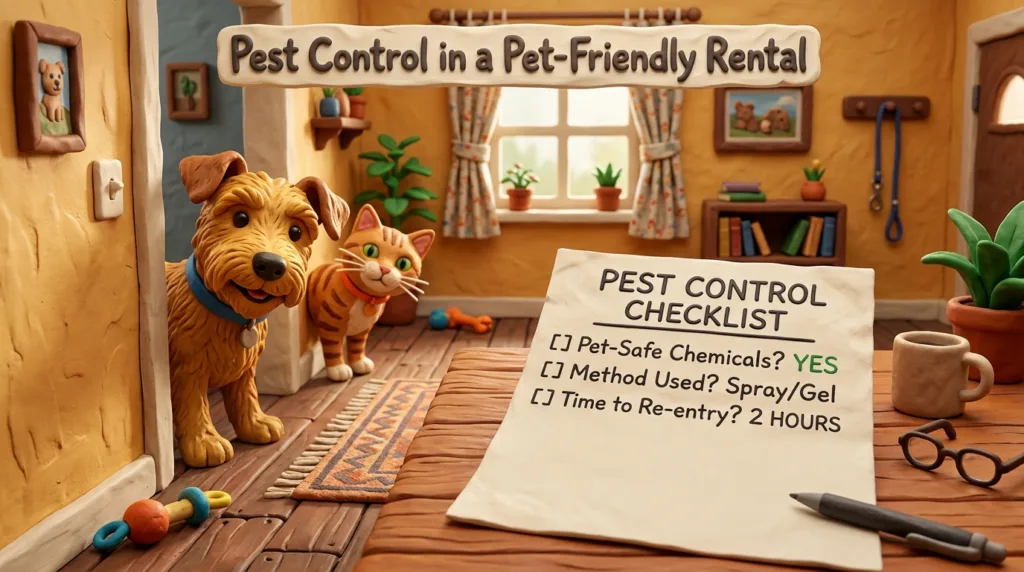
A pest-control notice can tell you that someone is coming Tuesday between 9 a.m. and noon and still leave out the information you need most as a pet owner.
Where will the product be applied? Will the technician spray, place bait, treat cracks and crevices, work outdoors or use another method? What product will be used? Does your dog need to leave the apartment, or only the treated room? What happens to a fish tank, bird cage or cat’s food bowls? When can the animal safely return?
Those details cannot always be answered by the phrase “pet-friendly treatment.”
For a renter, the useful goal before treatment day is to turn a general notice into a specific description of what will happen inside and around the home. Once the product, method, location and re-entry instructions are clear, deciding what to do with the pet becomes much less speculative.
Turn the notice into a treatment description
The date and appointment window are only the beginning.
Ask what pest is being treated, where the technician expects to apply the product and what form of treatment is planned. If a pesticide will be used, ask for the product name and, when available, its EPA Registration Number.



That number is useful because the U.S. Environmental Protection Agency maintains a Pesticide Product and Label System that can be searched by EPA Registration Number or product name. The label provides the directions and precautions associated with that particular product rather than with pesticides as a category.
EPA specifically recommends reading the pesticide label before use and following its precautions for pets. Depending on the product, the label can include instructions about where it may be applied, ventilation, personal precautions, keeping people or animals away from treated areas, storage and first aid.
That is more useful than asking only:
“Is this safe for pets?”
The word safe can flatten several different questions into one. A product might be registered for indoor residential use and still require pets to remain away from treated surfaces for a period of time. A bait may create little airborne exposure but still be a problem if a dog can reach and eat it. A treatment that can remain in one room may require a completely different pet plan from one distributed throughout the apartment.
Ask for the treatment as it will actually be performed.
If the pest-control company will choose the final product only after inspecting the unit, find out how you will receive the product information before or at the time of application. You do not need to become a pesticide specialist. You need enough information to follow the instructions attached to the treatment that will really occur.
The same applies when management has arranged treatment for several apartments at once. A building-wide notice may describe the program broadly while the technician uses different methods in different units.
Your pet plan should follow the treatment in your apartment, not the most general sentence in the email.
A spray, a bait and a fogger do not create the same apartment
The treatment method changes what your pet can reach.
The National Pesticide Information Center recommends removing pets, toys, chew items, bedding, food and water bowls from areas that will be treated. For indoor applications, NPIC advises either removing animals from the home or keeping them in untreated areas, depending on the treatment and its instructions.
That distinction is particularly useful in a rental.
Suppose the technician is making a limited application along baseboards in the kitchen and living room while a bedroom will remain untreated. Depending on the product label and the pest-control professional’s instructions, keeping a pet securely separated in that untreated room may be possible.
Now change the treatment.
If a fogger or total-release product is being used, NPIC advises removing all animals from the home. Fish tanks require additional consideration because fine airborne material can reach tank water and equipment; NPIC recommends precautions such as covering tanks and, for fogger applications, addressing pumps according to the guidance.
The apartment did not change.
The exposure route did.
Baits create another pattern. They may not require the same drying period as a liquid spray, but NPIC warns that rodent and insect baits should be placed where pets cannot access them. That matters particularly with dogs and other animals inclined to investigate food-like objects on the floor.
A small bait station tucked behind an appliance may seem invisible to a person and remain highly interesting to a pet.
If management or the applicator plans to use bait inside your apartment, ask where it will be placed and whether the locations will remain inaccessible to your particular animal after treatment.
The same question applies to common areas.
An apartment dog may have to cross a treated courtyard, lawn or building perimeter during normal bathroom trips. NPIC notes that outdoor products can have their own re-entry requirements and that granular products may need time to dissolve and the treated area to dry. The relevant label and application instructions should determine the restriction rather than a universal number of hours.
That is why “they’re only treating outside” does not automatically make the treatment irrelevant to a renter with a pet.
The route from the apartment door to the pet-relief area is part of the animal’s environment.
Build the plan around how your pet actually uses the space
Species changes the practical problem.
A dog normally spends much of its time in contact with floors and may later lick its paws. A cat can reach windowsills, baseboards and spaces behind furniture that people rarely touch. A rabbit or guinea pig may have bedding, hay and an enclosure close to a wall targeted for pest treatment. Birds and fish introduce different concerns because airborne material and water contamination can matter even when the animal never walks on the treated surface.
This is why moving a pet “to the other side of the room” is not automatically meaningful separation.
Map the treatment against the places your animal actually uses.
If the kitchen baseboards are being treated, move nearby bowls and feeding equipment before the technician arrives. If treatment will occur beside a small-pet enclosure, ask whether the enclosure should be moved entirely rather than simply covered. If your cat normally hides under the exact cabinet the technician needs to access, plan another secure location before the apartment door opens.
The National Pesticide Information Center’s current pet guidance recommends removing toys, food bowls and bedding from treatment areas and discussing the pets in the household with the pest-control professional.
That conversation should include more than “I have pets.”
Tell the applicator what animals are present and where they will be during treatment.
A household with one dog is different from a home with a bird, aquarium and two cats. The technician cannot account for animals they do not know are there.
For renters, worker access adds another layer. Pest control may involve management or an outside contractor entering while the resident is away. If that applies to your property, the pet must be separated in a location that the technician does not need to enter.
Our guide to apartment maintenance visits when you have pets explains why a closed room works only when that room remains outside the worker’s route.
The same principle becomes more important with pesticide treatment because opening the wrong door may not merely create escape risk; it may place the animal inside the application area.
If there is no genuinely untreated area that fits the label and professional instructions, plan for the animal to be elsewhere.
That might mean taking the dog with you, arranging an appropriate temporary location or moving smaller animals in a way that is safe for the species. The right answer depends on the treatment and the animal rather than on a rule that every pet must always leave every pest-control appointment.
“Come back in two hours” is not a universal re-entry rule
One of the easiest mistakes is remembering a number from a previous treatment and applying it to the next one.
Two hours. Four hours. Until evening.
There is no single re-entry time that can replace the instructions for the product and application involved.
NPIC recommends keeping pets away for the period stated on the pesticide label or, for sprayed products, until the application has dried completely if that takes longer. Its current guidance also recommends adequate ventilation during the drying process and notes that the label may contain more specific instructions.
EPA makes the same broader point: warnings and directions on the product label tell users how to use the product correctly and when people and pets should remain away from treated areas.
For a professionally treated rental, confirm the re-entry instruction before the applicator leaves—or before treatment day if management already has that information.
Ask a precise question:
What condition has to be met before my pet can enter this area again?
The answer may be a stated period of time, complete drying, ventilation or another product-specific instruction.
That is more dependable than asking only, “What time can I come home?”
The two questions are not always identical.
Imagine the technician finishes at 11 a.m. and says the product must be fully dry before pets re-enter. The estimated drying time may help you plan the day, but the actual condition of the treated surface still matters.
Likewise, if the label specifies a particular restriction, the renter should not shorten it because the apartment smells normal or the surface looks dry earlier.
Before giving the animal normal access again, confirm that treated surfaces satisfy the re-entry instructions, pet bowls and bedding are back only where appropriate, and bait or other pesticide products remain inaccessible.
Do not automatically scrub treated areas immediately after returning. Some applications are intended to remain in particular locations to control the target pest. Cleaning instructions should come from the product label or pest-control professional rather than from a general instinct to remove everything that was applied.
If something about the treatment differs from what you were told—another room was treated, an additional product was used or bait was placed somewhere unexpected—pause and get the updated instructions before releasing the pet.
The product label matters more than the marketing language
Terms such as green, natural, low-toxicity or pet-friendly can influence how a treatment is described to residents. They do not replace the directions for the actual product being used.
EPA states that using a pesticide inconsistently with its labeling violates federal law and emphasizes following label directions rather than increasing amounts or improvising application methods. The agency also notes that pesticide labels contain precautionary statements and directions for use. (epa.gov)
For a renter, this creates a practical hierarchy.
The property notice tells you that treatment is happening.
The applicator tells you how and where it will happen.
The product label tells you the precautions and directions associated with that pesticide.
All three can matter, but they do different jobs.
A reassuring phrase in an email should not overrule more specific instructions on the label. Conversely, reading alarming information about a completely different pesticide online does not tell you the risk of the treatment being used in your unit.
Identify the product first.
If you want to verify a registered pesticide label yourself, the EPA Registration Number is particularly useful because EPA describes it as a key identifier for tracking pesticide products and allows the number to be searched in its label system.
Keep the treatment notice and product information at least until the application is finished. If a question arises later, knowing the exact product is considerably more useful than remembering that “the building sprayed something for bugs.”
If you believe your pet may have been exposed to a pesticide, do not wait for internet symptoms to match perfectly. NPIC advises contacting a veterinarian or animal emergency resource promptly and following relevant first-aid information on the product label.
The National Pesticide Information Center can also answer pesticide-related questions at 1-800-858-7378.
A scheduled pest-control visit should not require guesswork about where your animal can be.
Before treatment day, you should be able to write down four facts:
the product, the application method, the treated area and the re-entry condition.
Those four facts turn “pest control Tuesday” into a plan you can actually use. If one of them is missing, that is the question to ask before the apartment is treated.

Alex Tex writes about pets, rental housing, and everyday life with animals in the United States. After living in multiple rental homes and apartments and spending years caring for pets, he focuses on the practical challenges renters face — from lease rules and apartment routines to behavior, safety, and property care.