
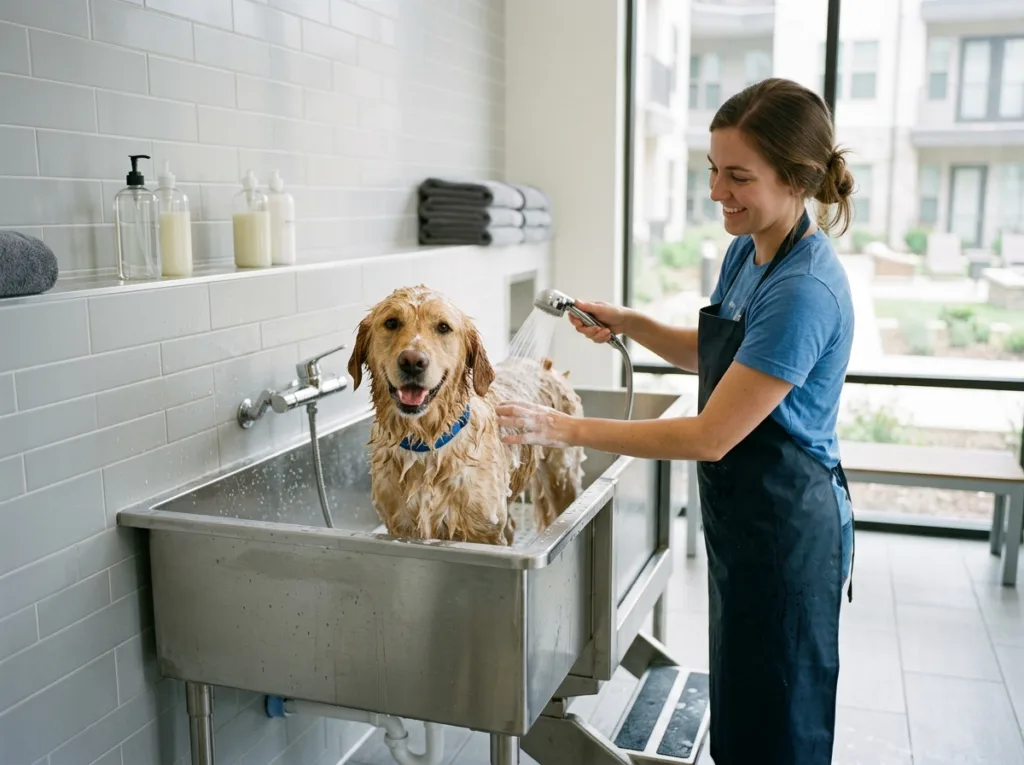
A dog park looks impressive in a leasing brochure. A pet spa sounds convenient. A package of “pet amenities” can even help a building charge more rent. But when you are a renter with limited cash, the useful question is not how many pet features the property advertises. It is whether one of them will make your daily life safer, cheaper, or easier enough to justify the rent and the rules attached to it.
For a household that cannot absorb another move, the wrong amenity can be expensive. You may pay extra for a wash station you never use, discover that the dog run is too crowded, find that the relief area is unsafe after dark, or learn that the “pet community” still restricts your animal’s size or breed. This guide helps renters judge apartment amenities by their real-life return, not by the photograph in the listing.
The market is selling convenience, but renters still pay for access
RentCafe’s October 2025 analysis of rental listings found that pet parks appeared in 58.44% of descriptions, while pet washing stations appeared in 11.95% and pet spas in 11.12%. The same analysis estimated average U.S. pet rent at $35.65 per month, with average pet deposits slightly above $300 and one-time pet fees around $315. These are proprietary listing figures, not a guaranteed price list for your city, but they show why an amenity should be evaluated together with the cost of keeping a pet in the building see RentCafe’s 2025 rental data and methodology.
Michelson Found Animals’ 2025 housing reports describe a similar mismatch: many properties call themselves pet-friendly, while far fewer meet a more demanding definition of pet-inclusive housing without breed or weight restrictions and excessive fees. That distinction matters to a renter who has a large dog, two cats, a senior animal, or very little move-in cash review the Pet-Inclusive Housing Initiative’s research library.
Judge the amenity by the problem it removes
| Feature | It can be genuinely useful when | It is mostly marketing when | Ask before signing |
|---|---|---|---|
| Dog run | It is close, secure, shaded, clean, and available during your schedule. | It is small, crowded, unlit, muddy, or closed frequently. | Who maintains the fence, surface, lighting, and waste bins? |
| Pet wash | It has drainage, ventilation, usable hours, and equipment you would otherwise pay for. | It requires a reservation, has unclear charges, or is often out of service. | Is it free, metered, reserved, or billed through an amenity fee? |
| Relief area | It reduces a long or unsafe nighttime route. | It is beside traffic, poorly lit, or inaccessible during maintenance. | Can a resident reach it safely at 6 a.m. and 11 p.m.? |
| Pet concierge | The operator, insurance, pricing, and emergency contact are named. | The brochure promises “services” without a provider or service terms. | Who is responsible if a visit is missed or a pet is injured? |
| Pet-friendly flooring | It gives animals and older residents traction and is easy to clean. | It is used to excuse poor maintenance or odor problems. | Who repairs damage and how quickly are spills or leaks handled? |
The scorecard is intentionally practical. A rooftop dog lounge may be valuable for some residents, but a secure door, a clean relief route, and a reliable elevator can prevent more daily problems. In a low-income household, the best amenity is often the one that prevents a recurring transportation, cleaning, grooming, or safety expense.
What changes from one U.S. city to another
Houston: affordability and housing stability
A 2024 study of 24 current, former, and aspiring pet owners in affordable housing in Houston documented high pet charges, policy confusion, breed and size restrictions, safety concerns, and housing insecurity. For a renter in Houston, a useful amenity is one that reduces daily exposure to heat, unsafe walking routes, or costly transportation. Ask about shade, drainage, gates, after-hours access, and what happens when a storm or power outage affects the building read the Houston tenant study.


Phoenix: heat changes the meaning of convenience
In Phoenix, a dog run without shade or a relief area made of heat-retaining material may look useful and still be unsafe during much of the day. A renter should inspect the feature at the time the dog would actually use it, ask about water access, and identify an indoor backup when temperatures make a walk impractical.
Chicago: winter access is part of the amenity
In Chicago, the value of a relief area depends on snow removal, lighting, traction, elevator reliability, and the distance from the unit. A pet wash may save money after muddy walks, but only if it remains open and reachable when the weather is worst. Ask who clears the route and how outages are communicated.
Los Angeles and California markets: policy transparency
California renters should not assume that a high-end amenity package answers questions about rent, fees, or lease protections. The California Attorney General explains that many tenants have state and local protections, but coverage and exemptions vary. The amenity tour should therefore include the pet addendum, fee schedule, and the rules that apply to your specific unit check the California Attorney General’s tenant guidance.
New York City: space, elevators, and time
In a small, expensive apartment, a “pet lounge” may be less useful than a quiet elevator, secure entry, nearby relief route, and a building that handles maintenance predictably. Count the minutes and stairs in the daily route. A feature is not convenient if reaching it requires crossing a lobby at the busiest time or waiting for an unreliable elevator.
These are renter scenarios, not uniform city laws. The point is to test the amenity against climate, density, transportation, building access, and your animal’s actual schedule. A feature that works in a suburban Texas complex may have little value in a high-rise in Manhattan.
Free, included, or extra: find the price behind the feature
Do not compare amenity lists. Compare the total housing trade.
Ask whether pet rent, an amenity fee, a pet deposit, required insurance, parking, utilities, waste fees, and service reservations are mandatory. Then ask what you would spend without the amenity: a groomer, a dog walker, a car trip to a park, a laundromat, or a replacement item after poor maintenance.
For example, a pet wash may save a renter occasional grooming costs, but it may not justify a recurring fee if the station is hard to reserve. A dog run may reduce transportation costs for a renter without a car, but not if the space is unsafe or unusable at the hours required by a work schedule. A concierge service may be helpful during a long shift, but the service needs a named provider, clear cancellation terms, and a responsible contact when something goes wrong.
Write the answer into your own budget. If the amenity costs $35 in monthly pet rent, it adds $420 over a year before deposits, utilities, or other charges. If it does not replace a real expense or solve a real problem, it is not free just because the brochure calls it included.
Dogs and cats do not use the same building in the same way
Dog-oriented properties often emphasize parks, wash stations, walking services, and outdoor events. Those may help an owner with a large dog or a long commute, but they can also create noise, traffic, and crowding near units. Ask whether the building separates high-traffic pet areas from quiet residential spaces and how staff respond to repeated complaints.
Cat owners should inspect different details: escape risk during maintenance, secure windows, quiet hallways, elevator noise, litter storage, reliable door latches, and whether the unit layout allows food, water, litter, and resting areas to be separated. A pet spa may have no value for a cat household if the apartment has unsafe windows or no practical place to keep litter away from food.
The same principle applies to rabbits, birds, fish, and other animals. “Pet-friendly” may be written around dogs and cats, while the lease defines allowed species, tank limits, noise expectations, or approval requirements. Ask for the policy rather than assuming the amenity package applies to your animal.
The amenity is only as good as the person responsible for it
During a tour, ask who owns the problem when something breaks. Is there a maintenance request category for a damaged gate, overflowing waste bin, broken lighting, standing water, or a pet-wash drain? How are closures communicated? Is the property manager, a vendor, or a resident responsible for cleaning?
Look for these signals
Strong signal: the leasing team gives you a written policy, a named maintenance channel, realistic hours, and a clear response process.
Weak signal: the tour guide points to a feature but cannot explain who maintains it, whether it is open, or what happens when the feature fails.
High-risk signal: the property charges for an amenity that is mandatory, unavailable, or governed by rules that were never disclosed before application.
This is also where recent pet-inclusive housing research becomes useful. The Pet-Inclusive Housing Initiative reports that incomplete policy information can force renters to pay application fees before understanding restrictions and charges. A property that discloses amenities but hides the pet addendum is not giving you enough information to make a safe decision see the initiative’s research on pet-policy transparency.
Do not mistake an amenity for a safety plan
A building may have a dog park and still fail basic safety questions. Check the condition of gates, latches, lighting, drains, stairs, balconies, elevators, and common-area doors. Ask how the property handles extreme heat, winter storms, flooding, pest treatment, construction, fire alarms, elevator outages, and evacuation.
Ask where a cat can be secured during maintenance. Ask whether a dog can reach a relief area if the primary elevator is unavailable. Ask how residents receive notice when a common area is closed. These questions affect both the animal and the renter’s ability to keep the lease without missing work or paying for emergency alternatives.
For assistance animals, do not treat the amenity package as a substitute for a housing accommodation process. HUD explains that an assistance animal is not an ordinary pet, but the details of a reasonable-accommodation request depend on the situation review HUD’s fair-housing information.
Use a resident-cost audit before you sign
If the feature is important to your daily routine, ask four questions:
- Will I use it at least often enough to justify the cost?
- Can I use it safely at the time and in the weather conditions that matter?
- Is someone clearly responsible for maintenance and access?
- Would I still choose this apartment if the feature disappeared next month?
If the answer to the last question is no, confirm the service in writing and ask what happens when it is unavailable. If the amenity is a deciding factor, include its failure in your risk calculation. A renter should not pay a premium for a promise that has no operating hours, no maintenance owner, and no remedy.
For a broader money-and-policy review, use PetzNews’s guide to hidden rental costs, lease-renewal review, apartment-hunting questions, and renter’s inspection guide. The best amenity is not the one that looks most impressive online. It is the one that reduces a real expense, removes a real safety risk, and still works on the ordinary day when you are tired, late, short on cash, or carrying a pet through a broken elevator route.

Alex Tex writes about pets, rental housing, and everyday life with animals in the United States. After living in multiple rental homes and apartments and spending years caring for pets, he focuses on the practical challenges renters face — from lease rules and apartment routines to behavior, safety, and property care.