
“It’s only for the weekend.”
That sounds like an obvious distinction when a friend asks you to watch a dog, cat or other pet. The animal is not yours, you are not adopting it, and it may be gone again by Sunday night.
Your rental documents may care about a different fact: an animal that has not been approved will be staying in the unit.
Some pet policies focus on animals a tenant owns. Others use broader language involving pets that are kept, harbored, hosted, brought onto the property or allowed to stay in the apartment. Some explicitly address visiting pets. A property may also require notification or approval whenever another animal is added temporarily, even though the renter never becomes its owner.
So before agreeing to pet-sit, do not start by asking whether two nights “really counts” as having another pet.
Start with the words your rental uses.

The weekend label is not necessarily the lease definition
Rental rules do not use one national definition of a temporary pet.
That makes the exact paperwork more useful than a general rule found online.
Georgia’s current Landlord-Tenant Handbook, for example, advises that a lease should address house rules such as pets, guests, noise and the consequences of violating those rules. That is Georgia guidance rather than a nationwide pet-sitting rule, but it illustrates why a visiting animal can sit at the intersection of more than one section of a rental agreement.
Your own documents might regulate:
- pets generally;
- additional pets;
- unauthorized animals;
- visiting or guest pets;
- animals kept or harbored on the premises;
- overnight guests and animals accompanying them;
- prior approval;
- pet registration;
- community or common-area rules.
Do not assume those phrases are interchangeable.
Suppose your pet addendum identifies one approved dog by name. That approval clearly establishes that your dog can live in the unit under the conditions stated in the agreement. It does not necessarily say anything about a second dog staying there for three days.
The reverse can happen too. A lease may allow pets generally but contain a separate community rule requiring management approval before any additional animal stays in the apartment.
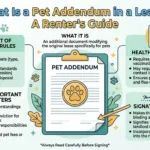
This is why a pet addendum should be read together with the main lease and property rules, rather than treated as the only place where an animal restriction can appear.
The rental-housing industry itself recognizes visiting pets as a separate policy issue. In an article developed with animal-welfare housing experts from the ASPCA and Michelson Found Animals Foundation, the National Apartment Association recommends that pet policies make expectations clear for both resident pets and visiting pets, including situations in which residents sit or host another animal.
That does not mean every apartment community follows the same model. It means “the dog belongs to my friend” is not a safe substitute for reading the policy.
Pay attention to the verbs
A heading that says Pets may be less informative than the sentence underneath it.
Compare:
Tenant may not own more than one pet.
with:
No animal may be kept or harbored in the premises unless approved by management.
The first sentence focuses on ownership. The second reaches much more directly toward presence in the home.
Likewise:
Only the animal identified in the Pet Addendum is authorized.
raises a different question from:
Residents may have up to two pets.
A renter should not rewrite ambiguous language in the direction they prefer. If the wording does not make clear whether temporary care is permitted, that uncertainty is useful information: it tells you what to ask management before the animal arrives.
The same principle applies if your property is pet-friendly.
“Pets allowed” answers only a broad eligibility question. It does not tell you whether your current approval covers another dog, whether temporary animals must be registered or whether the pet-number limit counts a guest animal.
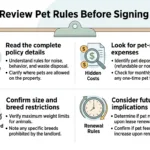
Our broader guide to reviewing pet rules before signing a lease explains how cross-referenced documents can change what a short pet clause actually means. For pet-sitting, however, the narrower task is to find the language that controls an animal that is present but not permanently part of your household.
Temporary approval should match the actual stay
If the documents clearly prohibit visiting animals, you have an answer to discuss with management before agreeing to the arrangement.
If they clearly permit them under stated conditions, follow those conditions.
The more common difficulty is a policy that says nothing specific enough to make you comfortable relying on it.
In that situation, a narrow written question is more useful than a long explanation.
For example:
I am considering watching my friend’s dog from Friday evening through Sunday afternoon. The dog would stay in my unit during those dates and would not become a permanent household pet. Does the lease or property pet policy require temporary approval, registration, an addendum or any other steps before the dog stays here?
The usefulness of that message is its scope.
It gives management the animal situation and dates, then asks which property rule applies. It does not ask for permanent pet approval when none is intended, and it does not rely on a vague conversation such as “A friend might bring a dog over sometime.”
If management approves the arrangement, keep the response.
Also read what was actually approved.
Permission for one dog to stay from October 4 through October 6 does not necessarily establish permission for you to pet-sit the same animal every weekend. Likewise, permission for a friend’s dog does not automatically cover a second animal later.
If the property requires a temporary registration or pet addendum, clarify whether it applies only to that stay. Some housing providers structure visiting-pet rules separately from permanent pet approval, while others may run temporary animals through much of the same process.
Do not assume that a charge, deposit or document is valid or invalid nationwide simply because the animal is temporary. Pet-fee and deposit rules vary by jurisdiction, and the exact nature of the payment matters. If management requests money for the arrangement and you are uncertain about it, identify exactly what the payment is called, whether it is refundable and what provision authorizes it before deciding what to do.
The same restraint matters in the opposite direction. A weekend stay does not automatically mean that fees, registration or approval requirements disappear.
Duration is one fact.
It is not always the fact the policy is built around.
Pet-sitting can create responsibilities even when it does not create a permanent pet
Suppose management says the visit is allowed.
The rental question is not completely finished.
The animal can still affect the apartment and the people around it during those two or three days. A dog unfamiliar with the building may bark at elevator sounds. A cat in a new environment may hide in a place that is difficult to reach. A house-trained dog can still have an accident when its routine changes. Another animal may interact poorly with the pet already living in the unit.
Those are not arguments against pet-sitting. They are reasons to treat temporary care as actual animal care rather than as a harmless technicality.
Before the owner leaves, understand the routine you are taking over:
feeding times, bathroom schedule, medication if applicable, walking equipment, emergency contact, veterinarian information and any known behavior that affects the apartment or common areas.
Also think through the property itself.
Where will the animal sleep?
How will you prevent escape through the apartment or building entrance?
Does the dog know how to use an elevator?
Are there community areas where pets are restricted?
If you already have an animal, can they safely share the same space, or does the apartment need a separation plan?
A temporary animal can also cause permanent damage.
California’s current landlord-tenant guide, for example, states that tenants there are responsible for damage beyond normal wear and tear caused by people or animals for whom they are responsible, including guests and pets. That is a California rule, not a statement of every state’s landlord-tenant law, but it demonstrates why “it was my friend’s dog” does not necessarily make property damage irrelevant to the renter.
From a practical recordkeeping standpoint, document a meaningful incident the same way you would if your own animal were involved. If the visiting dog damages a door, for example, photograph what happened and check the lease before making a permanent repair yourself. Our guide to documenting pet-related rental damage explains why recording the condition before assigning blame or legal responsibility creates a more useful timeline.
Noise and waste matter for the same reason.
The animal may be temporary, but the neighbor hearing repeated barking at midnight does not experience the noise as temporary. Nor does management necessarily treat waste left in a common area differently because the dog belongs to someone else.
The renter hosting the animal is the person with control over what happens inside the unit during the stay.
That makes the practical standard simple: if you cannot manage the animal safely within your apartment and property rules, getting permission to host it does not solve the underlying problem.
Repeated weekends are worth a new question
One successful stay can make the next invitation feel automatic.
Your friend travels again two weeks later. Then another weekend comes up. Soon the dog has a bed in your closet and knows which elevator reaches the pet-relief area.
Nothing about that sequence automatically establishes a particular legal threshold. Rental agreements and applicable law vary too much to invent a universal number of nights after which a visiting pet becomes a resident pet.
But the situation has plainly changed from a one-time favor.
If your written approval was limited to specific dates, ask again before assuming it continues indefinitely. If the property has a pet-number rule or requires each animal to be identified, repeated stays make those provisions more important rather than less.
Open-ended fostering deserves the same caution.
Agreeing to care for a rescue animal “until a permanent home is found” may sound temporary, yet the actual stay could last weeks or months. At that point, obtaining clear written guidance from management before the animal arrives is considerably safer than trying to decide later whether the arrangement still qualifies as a visit.
This is also where the difference between ownership and occupancy becomes especially useful.
You may never own the animal.
The property may still care that the animal is repeatedly living in the unit.
Pet-sitting works best when that distinction is resolved before your friend arrives with the leash, carrier and food bag. Read the language that actually controls animals in your rental, ask about the stay you really intend to provide, and keep the answer that management gives you.
Then the weekend can be about caring for the animal rather than discovering midway through it that everyone involved was using a different definition of “temporary.”

Alex Tex writes about pets, rental housing, and everyday life with animals in the United States. After living in multiple rental homes and apartments and spending years caring for pets, he focuses on the practical challenges renters face — from lease rules and apartment routines to behavior, safety, and property care.