
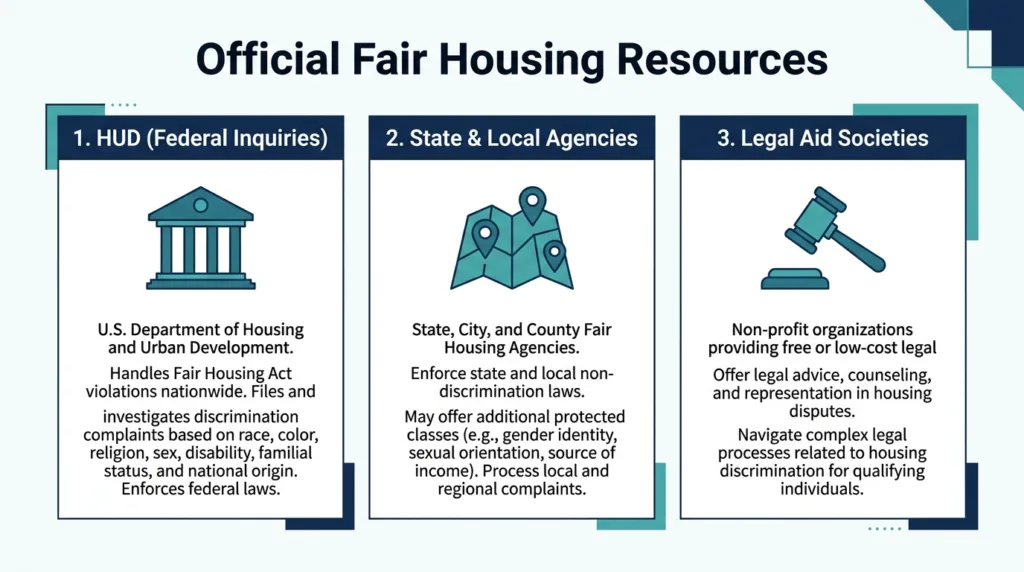
Searching for help with an assistance-animal problem can produce an awkward mix of government pages, advocacy groups, law firms, commercial registration websites and articles written for completely different legal settings.
The difficulty is not always finding information. It is knowing which source is supposed to answer which question.
A renter trying to understand whether a no-pets rule can be adjusted needs a different resource from someone who is ready to report housing discrimination. A person looking for a local fair-housing agency may need another route entirely. Starting in the right place can save a great deal of circular reading.
For assistance-animal issues in U.S. housing, the federal system can be navigated through a few distinct doors.
Need to understand the basic federal housing rule? Start with HUD.
Think a reasonable-accommodation request was unlawfully denied? Look at HUD’s Fair Housing and Equal Opportunity complaint process.



Want a state or local government agency? Look for a HUD Fair Housing Assistance Program partner.
Need a fair-housing organization that may help investigate or communicate with a housing provider? Check HUD’s FHIP directory.
The resources overlap, but they do not perform the same job.
Start with the resource that matches what you are trying to solve
You are still trying to understand whether the situation involves an assistance animal.
HUD’s current Assistance Animals page is the most useful federal starting point.
It explains that an assistance animal can work, perform tasks, provide assistance or provide emotional support that alleviates one or more identified effects of a disability. It also states that an assistance animal is not treated as a pet within the Fair Housing accommodation framework.
More importantly, the page connects that definition to housing.
HUD explains that a person with a disability may request a reasonable accommodation to a housing provider’s pet restrictions and gives two straightforward examples: asking to live with an assistance animal where a no-pets policy applies, or asking for a pet deposit, fee or other pet rule to be waived for the assistance animal.
This page is useful when the question is still basic:
Does this issue belong in the ordinary pet-policy system, or does it raise a disability-related accommodation question?
If you need more context before dealing with a dispute, our beginner’s guide to assistance animals in rental housing organizes that framework from the renter’s perspective.
HUD also links to the joint HUD/Department of Justice statement on reasonable accommodations. The HUD/DOJ Joint Statement goes deeper into questions such as how an accommodation can be requested, when disability-related information may be relevant, what makes an accommodation unreasonable and how alternatives can sometimes be discussed.
The two resources serve different reading needs. HUD’s assistance-animal page is a compact entry point; the joint statement is more useful when the dispute concerns the mechanics of reasonable accommodation.
You believe the housing provider may have violated Fair Housing requirements.
The route changes at that point.
HUD’s Office of Fair Housing and Equal Opportunity, commonly called FHEO, receives reports of housing discrimination. HUD’s Report Housing Discrimination page currently allows people to report possible discrimination online, by telephone or by mail.
The national FHEO intake number listed by HUD is 1-800-669-9777.
HUD asks people reporting discrimination to provide information such as who was involved, the housing location, what happened and the relevant dates. The complaint system covers disability discrimination under the Fair Housing Act along with the Act’s other protected characteristics.
An assistance-animal disagreement does not automatically prove discrimination, so the complaint route should not be understood as an automatic appeal that reverses a housing provider’s decision. FHEO first determines how the allegation fits within the laws it enforces and may then investigate or refer the matter as appropriate.
HUD’s current FHEO investigation-process page explains that the agency may interview the person reporting discrimination, prepare a formal allegation where appropriate, notify the parties and investigate or refer the allegation to another qualified agency. HUD also attempts to resolve allegations through agreements during the process.
For renters who have already received a rejection, our guide to an assistance-animal request that has been denied explains how to organize the request, reason for denial and supporting records before deciding what to do next.
You want a government resource closer to where the rental is located.
Federal Fair Housing law is not the only layer of the system.
HUD’s Fair Housing Assistance Program, or FHAP, includes state and local government agencies that enforce fair-housing laws HUD has determined to provide rights and remedies substantially equivalent to the federal Fair Housing Act.
HUD maintains a current directory of FHAP agencies by state and locality.
For example, depending on where the housing is located, the relevant agency may be a state civil-rights department, attorney general office, human-rights commission or local equal-opportunity office.
That local connection can matter because state or municipal fair-housing law may interact with the federal framework, and FHAP partners may handle allegations referred by HUD. Their procedures are not necessarily identical from one jurisdiction to another.
The key is to search according to where the housing is located, not simply where the renter happens to be when looking for help.
You want practical help from a fair-housing organization rather than beginning with a government complaint.
HUD also supports a different network called the Fair Housing Initiatives Program, or FHIP.
FHIP organizations are not the same thing as FHAP government agencies.
HUD’s current FHIP organization directory lists participating organizations by state. According to HUD, these organizations may be able to provide fair-housing information, communicate with a housing provider on someone’s behalf or investigate possible discrimination, including through testing in appropriate cases.
Some listed organizations are fair-housing centers; others are legal-aid or nonprofit organizations with fair-housing programs. The services available vary by organization.
That makes FHIP particularly useful when a renter is not sure whether the problem is ready for a formal complaint and wants to speak with an organization familiar with housing discrimination in the area.
The similarity between the acronyms causes unnecessary confusion:
FHAP usually points to a participating state or local government enforcement agency.
FHIP points to HUD-funded private fair-housing organizations and related nonprofits that may provide education, investigation or assistance.
Knowing which one you are looking for makes HUD’s directories much easier to use.
Use federal enforcement pages to understand the process, not to diagnose your own case

The Department of Justice is another federal source renters will encounter when researching Fair Housing disputes.
DOJ and HUD share federal Fair Housing enforcement responsibilities, but that does not mean an individual renter normally begins by asking DOJ to decide an assistance-animal request.
The DOJ Civil Rights Division’s page on individual housing-discrimination claims directs individuals who believe they experienced housing discrimination toward the HUD complaint process. HUD investigates complaints and, when a matter reaches later enforcement stages under the Fair Housing Act, the Department of Justice can become involved in certain circumstances.
DOJ pages are nevertheless valuable for another reason: they show what federal enforcement looks like in practice.
Reading settlements, complaints and consent orders can help a renter understand the types of Fair Housing issues the federal government has addressed. They can illustrate disputes involving reasonable accommodations, assistance animals, disability discrimination or discriminatory housing policies.
They should not be used as a substitute for evaluating the facts of an individual situation.
A settlement involving one landlord does not automatically establish what another housing provider must do under different facts. Likewise, an enforcement complaint contains allegations unless and until those allegations are established through the applicable legal process.
Official enforcement material is strongest when used for what it actually provides: examples of how federal agencies have interpreted and enforced Fair Housing obligations in documented cases.
For the underlying rule, return to the statute, HUD’s current public guidance and the HUD/DOJ reasonable-accommodation materials.
This distinction also helps renters avoid a common research trap. Search results may surface an old HUD memo, a law-firm interpretation or a decades-old enforcement case before they surface the current HUD page. Older material can still provide historical or legal context, but the fact that a PDF remains accessible online does not necessarily mean HUD currently treats it as operative guidance.
That became particularly important in 2025, when HUD formally withdrew several older FHEO guidance documents, including earlier assistance-animal guidance. Current HUD resources should therefore be checked before relying on an older document simply because it ranks highly in search results.
Deadlines and urgency change where “help” begins
A general question can be researched slowly. A discrimination allegation cannot always be.
HUD currently states that a Fair Housing Act allegation generally must be filed with FHEO within one year of the last date of the alleged discrimination. HUD recommends reporting possible discrimination as soon as possible rather than waiting for the end of that period.
The HUD/DOJ Joint Statement also explains that a private Fair Housing Act action in federal court generally has a two-year filing period for an alleged denial of a reasonable accommodation. Legal deadlines can involve facts and rules beyond a simple calendar count, so someone considering litigation should not treat a general article as a deadline calculation for an individual case.
The practical point is simpler: do not postpone finding the correct resource because you are still collecting the perfect file.
HUD’s complaint page asks for the people or organizations involved, the housing, a description of what happened and relevant dates. Additional information can become important as the matter develops, but remembering the dates and preserving the original communications is already useful.
HUD also states that retaliation for reporting discriminatory housing practices or participating in the Fair Housing complaint process is illegal. If a new adverse action occurs after an accommodation request or discrimination report, preserve that information with the rest of the chronology rather than assuming it has no connection to the housing dispute.
If you need to communicate directly with HUD rather than rely only on the national intake route, HUD maintains a directory of regional FHEO offices covering every state and U.S. region. HUD also says people can request disability-related assistance when contacting FHEO, including reasonable accommodations and auxiliary aids or services.
At that point the resource map becomes fairly simple.
Need the federal assistance-animal starting point? HUD Assistance Animals.
Need to understand the reasonable-accommodation framework in more detail? HUD/DOJ Joint Statement.
Need to report possible housing discrimination? HUD FHEO.
Need a participating state or local enforcement agency? FHAP.
Need a fair-housing organization that may provide local assistance or investigation? FHIP.
Need to understand how federal housing-discrimination enforcement can proceed? HUD and the DOJ Civil Rights Division.
The value of official help is not that every agency or organization will give the same answer to every dispute. It is that each one has a defined role. Once the renter identifies whether the immediate need is information, local assistance, investigation or formal reporting, the search becomes much narrower—and far less dependent on whichever website happens to appear first in Google.

Alex is the content editor at PetzNews, covering pet care guidance and pet-friendly housing topics for renters and property owners across the United States