

“We reviewed your request and cannot approve the animal. Our property does not permit dogs over 25 pounds. Please make other arrangements.”
A renter receiving a message like that may see only one thing: denied.
Yet the message contains several separate pieces of information. Management has made a decision, given a reason for it and possibly created a deadline or consequence that requires attention. Whether the denial is consistent with Fair Housing requirements depends on more than the word at the top of the email.
The most useful first response is therefore not necessarily a longer argument. It is to identify exactly what the housing provider decided, what information it relied on and whether the reason given actually addresses the disability-related accommodation that was requested.
Federal Fair Housing rules do allow reasonable-accommodation requests to be denied in some circumstances. They also prohibit refusing an accommodation simply because a provider does not want to make an exception that may be necessary because of disability. The difference lies in the facts and the reason for the decision.
Read the reason before reacting to the result
A denial that says “we do not allow pets” raises a different problem from one that says “we need additional information about the disability-related need.”
A breed or weight restriction raises another issue. So does a claim involving direct threat, property damage, financial burden or the absence of a disability-related connection.

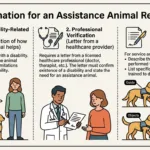

These reasons should not be treated as interchangeable.
The HUD/Department of Justice Joint Statement on reasonable accommodations explains that a request may be denied when it was not made by or for a person with a disability, when there is no disability-related need for the accommodation, or when the requested accommodation is not reasonable because it would create an undue financial and administrative burden or fundamentally alter the provider’s operations. It also explains that whether an accommodation creates an undue burden requires a case-by-case evaluation rather than a generic conclusion.
That means a denial can be legitimate without making every stated reason sufficient.
If management responds only that the building has a no-pets policy, compare that explanation with the accommodation actually requested. A no-pet rule can be the policy for which an exception is being sought; repeating the policy does not necessarily evaluate the request.
If management says the file lacks disability-related information, identify what was already provided and what fact management says remains unresolved. As discussed in what information may be relevant to an assistance-animal request, the appropriate inquiry depends on what is already apparent or known. An information gap is not the same thing as a request for unrestricted medical disclosure.
A denial based on breed or weight requires still another reading. Breed and weight restrictions for assistance animals explains why an ordinary pet category and concerns involving a particular assistance animal should not automatically be treated as the same analysis.
Sometimes the reason is less clear because the provider simply writes “request denied” without meaningful explanation. Federal law does not create one universal form that every private housing provider must use for denials. Still, asking management to identify the reason in writing can be useful because it clarifies what, if anything, can be addressed and creates a record if the disagreement continues.
The aim at this stage is not to predict who would win a legal dispute. It is to turn a vague rejection into a decision that can actually be examined.
Some denials reveal a gap that can still be addressed
Not every disagreement has reached the same endpoint.
Suppose management says it cannot evaluate the request because the disability-related need for the animal has not been established. If that information may appropriately be requested and the renter has reliable information that addresses the missing connection, providing that focused information can be more productive than resubmitting the entire file unchanged.
The reverse is also important. If the provider already knows both the disability and the disability-related need, continually sending more medical information may add sensitivity without resolving the actual disagreement.
Another possibility arises when the housing provider believes the precise accommodation requested would create an undue financial or administrative burden or fundamentally alter its operations.
The HUD/DOJ Joint Statement says that when the requested accommodation cannot reasonably be provided for those reasons, the provider should discuss whether another reasonable accommodation could effectively meet the person’s disability-related need. An interactive discussion can therefore remain useful even after the first proposed solution encounters a legitimate problem.
That does not mean the renter must accept an ineffective alternative. The same federal guidance recognizes that when the accommodation originally requested is reasonable, a person with a disability is not required to accept a provider’s preferred alternative merely because management likes it better.
This distinction changes how a renter may respond to a denial.
A response to “we need information connecting the animal to the accommodation” might address that missing connection.
A response to “we cannot provide this particular arrangement because of a specific operational problem” might ask whether an effective alternative is available.
A response to “we never allow assistance animals” presents a fundamentally different issue.
Before sending another document, identify which conversation is actually taking place.
Build the record while the sequence is still easy to remember
A housing disagreement can quickly produce more documents than expected: texts, emails, lease notices, medical or other supporting information, portal messages and phone conversations.
The useful record is not necessarily the thickest one. It is the one that makes the sequence understandable.
A simple chronology might look like this:
April 4 — Request sent asking for an exception to the no-pets policy because of a disability-related need.
April 7 — Management asks for information supporting the relationship between the disability and the requested accommodation.
April 10 — Supporting information provided.
April 18 — Management sends a denial based on the property’s dog weight limit.
Those four lines already answer questions that a folder full of disconnected screenshots may not: what was requested, what management asked for, what the renter supplied and what reason ultimately produced the denial.
Keep the original request rather than only the final version you wish you had sent. Preserve management’s responses in their original form. If an important conversation occurs by phone or in person, a contemporaneous note recording the date, participants and substance of the conversation can make the later chronology easier to understand.
Lease provisions and notices belong in the same record because they show which property rule was actually being applied.
If the provider proposes an alternative accommodation, preserve that proposal and the renter’s response as well. The history of the discussion can matter when the disagreement concerns whether an effective accommodation was available.
Do not alter screenshots, rebuild emails from memory or discard communications merely because they appear unfavorable. A reliable chronology is more useful than a curated story.
The same principle applies when a denial is followed by an “unauthorized pet” notice, demand to remove the animal or other enforcement communication. Record both events rather than treating the second notice as a separate problem with no history behind it.
If the dispute moves outside the property, deadlines start to matter
A renter who believes a reasonable accommodation was unlawfully denied can report housing discrimination to HUD’s Office of Fair Housing and Equal Opportunity.
HUD’s current reporting page says that people who believe their housing rights may have been violated can report housing discrimination online, by telephone or by mail. HUD asks for information such as the parties involved, the housing location, a short description of what happened and the dates of the alleged violation.
Under the Fair Housing Act, a HUD allegation generally must be filed within one year of the last date of the alleged discriminatory act. HUD recommends reporting discrimination as soon as possible rather than waiting for the deadline. Its current FHEO process page explains that HUD or a substantially equivalent state or local agency may investigate the allegation, attempt to resolve it and pursue further enforcement when warranted.
A private Fair Housing Act lawsuit can involve a different deadline. The HUD/DOJ Joint Statement describes a federal court action generally being available within two years of the alleged denial, although calculation of legal deadlines can depend on the circumstances and should not be reduced to a do-it-yourself countdown when litigation is being considered.
State and local law can add another layer. HUD works with state and local Fair Housing Assistance Program agencies that enforce laws HUD has determined to be substantially equivalent to the federal Fair Housing Act. Those jurisdictions may also provide additional rights or procedures. (hud.gov)
Renters do not have to navigate every option alone. HUD maintains a directory of Fair Housing Initiatives Program organizations, some of which may provide information, assist with complaints, communicate with housing providers or investigate potential discrimination.
The final article in this category, where to find official help about assistance animals and Fair Housing, organizes these federal, state/local and fair-housing resources in one place.
Urgency changes the practical response. HUD specifically tells people who believe they may lose their housing because of discrimination to inform their HUD investigator as soon as possible. If an eviction notice, court case or another immediate housing consequence is already involved, obtaining local legal assistance can also be important because the appropriate response depends on the jurisdiction and the specific proceeding.
There is another protection renters should know about: retaliation. HUD’s current complaint page states that retaliation is illegal when someone reports discriminatory housing practices or participates in the Fair Housing complaint process. A new threat, penalty or other adverse action following a Fair Housing request or complaint should therefore be documented rather than assumed to be irrelevant to the dispute.
A denial is a decision to examine, not a result to classify in advance
It is tempting to divide accommodation denials into two simple categories: landlords who are wrong and renters who failed to qualify.
Real disputes can be less tidy.
A housing provider may have a legitimate reason for denying a particular accommodation but fail to discuss an effective alternative. A renter may have a valid disability-related need but submit information that leaves the connection unclear. Management may rely on an ordinary pet restriction where a different accommodation analysis is required. In other circumstances, the evidence concerning a particular animal or the requested accommodation may support the provider’s decision.
That is why the record matters more than the emotional force of the word denied.
The request establishes what the renter asked for. Supporting information shows what was available to management. The denial identifies—or should help reveal—the reason the request was not granted. Later correspondence shows whether the problem was clarified, reconsidered or left unresolved.
Once those pieces are placed in sequence, the renter is in a much better position to decide whether the next move is additional information, further discussion, fair-housing assistance or a formal complaint.
A vague “no” is difficult to evaluate. A documented decision with a stated reason can be compared with the facts, the requested accommodation and the Fair Housing rules that apply to it.

Alex is the content editor at PetzNews, covering pet care guidance and pet-friendly housing topics for renters and property owners across the United States