
Dogs must weigh 25 pounds or less.
Restricted breeds are not permitted.
Our insurance does not allow that kind of dog.
A renter with an ordinary pet may encounter any of those statements while searching for housing. They can affect which dogs a property accepts under its regular pet program and may be important enough to rule out an apartment before an application is submitted.
An assistance-animal request raises a different question. When a person with a disability asks for an animal-related exception as a reasonable accommodation, an existing pet restriction does not necessarily provide the complete answer. The housing provider still has to consider the disability-related accommodation under the Fair Housing framework and the circumstances that apply to the request.
HUD’s current assistance-animal page says that individuals with disabilities may request reasonable accommodations to a housing provider’s pet restrictions. It also identifies specific circumstances that can affect whether an accommodation must be granted, including undue financial and administrative burden, fundamental alteration, and concerns involving a particular animal that presents a direct threat or significant physical-damage risk that cannot be sufficiently reduced through another reasonable accommodation.



The practical difference is therefore not that breed and weight suddenly become meaningless. It is that a rule created for ordinary pets should not automatically replace the accommodation analysis.
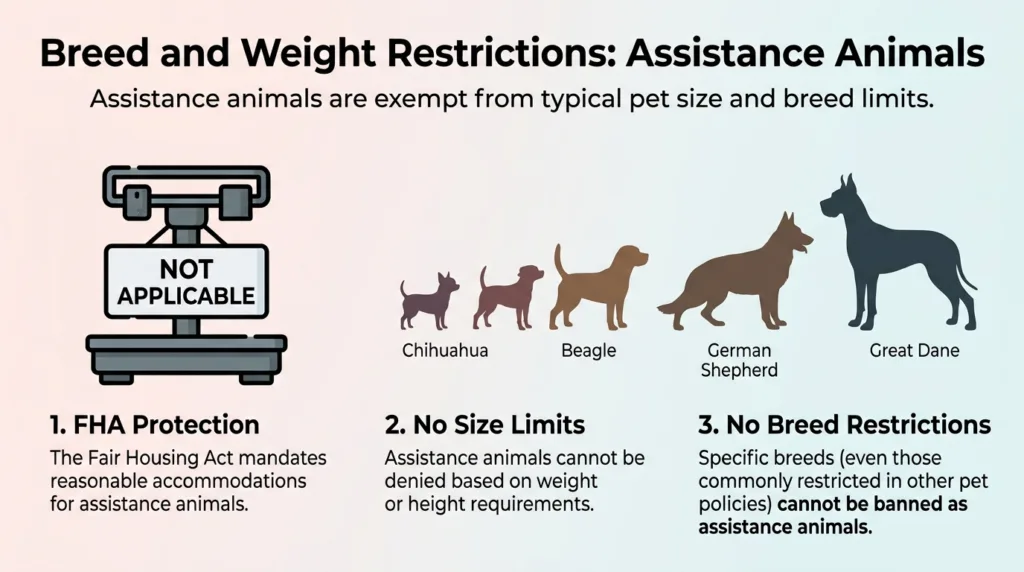
“25 pounds maximum” may describe the pet policy without resolving the assistance-animal request
Weight limits are easy for a property to administer. A lease can state one number, and management can apply it to every ordinary dog entering the pet program.
That administrative simplicity is exactly why a renter should first identify which system management is using.
If the dog is being considered as an ordinary pet, the property’s weight restriction may be part of the normal pet rules. Our guide to why rentals use breed and weight restrictions looks at those ordinary policies separately.
If the renter is instead requesting a disability-related accommodation for an assistance animal, the relevant question becomes whether an exception to that pet restriction is reasonably necessary.
A recent federal case provides a concrete example. In United States v. Nourse, the Department of Justice alleged that managers and owners of an Idaho RV park violated the Fair Housing Act by refusing to allow a tenant’s assistance dog because the dog exceeded a 15-pound limit. The DOJ also alleged that the property charged the renter a pet fee and made statements that assistance animals over fifteen pounds would not be allowed. The case ended in a January 2026 settlement requiring $20,000 in damages, fair-housing training and adoption of a new reasonable-accommodation policy.
That settlement should not be read as a judicial ruling that establishes a universal rule for every weight dispute. It does, however, show why a renter should be cautious when management responds to an assistance-animal request with nothing more than “the dog is over our pet limit.”
A more precise conversation identifies the rule first.
Is the 25-pound maximum an ordinary pet restriction?
Has the renter actually made a disability-related reasonable-accommodation request?
If so, is management evaluating that request, or merely routing the assistance animal through the same approval system used for ordinary pets?
Those questions matter more than arguing over whether twenty-five, thirty-five or seventy-five pounds is the correct threshold. The Fair Housing issue concerns the requested accommodation, not the mathematical generosity of the pet policy.
That does not guarantee that every request involving a larger animal must be granted. HUD’s current public guidance recognizes circumstances in which a provider can demonstrate that an accommodation would impose an undue financial and administrative burden, fundamentally alter operations, or involve a specific animal presenting certain safety or property risks.
The distinction is one we established in what a reasonable accommodation for an assistance animal actually means: the renter is asking for a particular rule to be adjusted because of a disability-related need. The existence of the rule is the beginning of that analysis, not necessarily its conclusion.
A breed list describes a category; direct-threat concerns focus on circumstances
Breed restrictions feel different from weight limits because they are often presented as safety rules.
A policy might prohibit pit bull-type dogs, Rottweilers, Dobermans or another list of breeds regardless of an individual dog’s history. For an ordinary pet program, renters need to understand whatever restrictions appear in the lease and confirm how management applies them.
The Fair Housing analysis introduces another layer because federal disability-accommodation rules recognize direct threat as a distinct concept.
HUD’s current assistance-animal page frames that concern around the specific assistance animal in question. It states that a housing provider can consider whether the particular animal would pose a direct threat to the health or safety of others despite other reasonable accommodations that could eliminate or reduce the threat.
That wording is important. It points toward the circumstances involving the animal rather than simply toward the name of a breed.
The broader HUD/DOJ reasonable-accommodation guidance uses the same individualized logic when discussing direct threats in housing. It explains that a direct-threat determination cannot rest on fear, speculation or stereotypes and instead calls for an individualized assessment using reliable, objective evidence.
In practical terms, these are different statements:
“We do not approve this breed.”
and
“We have a documented concern involving this particular animal and are evaluating whether that concern can be sufficiently reduced.”
The second statement presents facts that can be examined. The first primarily identifies a category.
Federal enforcement has addressed this distinction before. In United States v. Hammett, the DOJ alleged that the owner and manager of a Minnesota mobile-home park violated the Fair Housing Act by rejecting a rental application because the prospective tenants’ two assistance animals were pit bulls. A federal court entered a consent order in 2020 requiring a reasonable-accommodation policy, fair-housing training and $6,500 in damages.
Again, that consent order belongs to a specific case and should not be presented as a universal court ruling on every breed policy. Its usefulness for renters is more practical: federal enforcement has treated the refusal of an assistance-animal accommodation based on breed as a Fair Housing issue rather than assuming that an ordinary restricted-breed list ended the inquiry.
The same distinction helps avoid the opposite mistake.
A renter should not translate individualized assessment into “management is never allowed to care about safety.” Current HUD materials specifically retain direct-threat and significant-property-damage considerations. What matters is the difference between a generalized prediction and a concern supported by circumstances involving the particular animal.
Suppose two dogs belong to the same breed listed in a property’s pet restriction. One has no known history creating a safety concern; the other has recently displayed behavior that management believes creates a serious risk to residents.
Treating both situations as identical because the breed name is the same would ignore the individual circumstances. But ignoring credible evidence involving the second animal simply because it is an assistance animal would make the opposite error.
There can also be room to consider whether another reasonable accommodation would eliminate or sufficiently reduce a legitimate concern. A management plan, control measure or other practical change may matter depending on the facts; in other circumstances, no effective alternative may exist.
That is why the most useful vocabulary here is not allowed breed versus banned breed.
It is category rule versus individualized concern.
“Our insurance won’t allow it” needs more information than the sentence provides
Insurance creates a harder conversation because it introduces a third party into the housing decision.
A property manager may say that the building’s insurer restricts certain dogs. From the renter’s perspective, that can sound like a final answer: management is not making the rule, so management cannot change it.
Federal reasonable-accommodation law does recognize that an accommodation does not have to be granted when it would impose an undue financial and administrative burden on the housing provider. The HUD/DOJ Joint Statement says that this determination is case-specific and may involve the cost of the accommodation, the provider’s financial resources, the benefit to the requester and the availability of effective alternatives.
Insurance consequences can therefore raise a genuine financial question. What they should not become is a substitute for understanding what the claimed consequence actually is.
There is a material difference between:
“Our ordinary pet policy uses the same restricted-breed list as our insurer.”
and
“Allowing this particular accommodation would have a specific effect on our insurance coverage or cost.”
The second claim gives both sides something concrete to address. The first may leave unanswered whether the property is merely repeating an ordinary pet restriction.
This point requires additional care because older HUD materials discussed insurance restrictions much more specifically. HUD withdrew several FHEO guidance documents in September 2025, including its 2020 Assistance Animals Notice, and instructed stakeholders not to rely on the withdrawn documents as authoritative current guidance. Renters should therefore be cautious with websites that quote older HUD animal guidance as though every sentence remains current agency policy.
What does remain available on current federal pages is the broader reasonable-accommodation framework: a provider may raise an actual undue financial and administrative burden, but that determination is not merely a label. HUD and DOJ describe it as a case-by-case evaluation, and the current HUD assistance-animal page continues to identify undue financial and administrative burden as one of the circumstances relevant to an assistance-animal request.
If insurance is cited, a renter does not need to become an insurance-law expert to make the issue clearer. Asking management what specific restriction or consequence it is relying on can separate a real coverage problem from an ordinary breed policy that has simply been described as “insurance.”
If a reasonable-accommodation request is ultimately denied, preserving that explanation can also matter. Keep the request, management’s response and any explanation of the restriction rather than relying later on a memory of a verbal conversation. Our guide to what renters can do when an assistance-animal request is denied addresses the next stage of that process.
The three statements from the beginning of this article can now be read differently.
“25 pounds maximum” raises the question of whether an ordinary pet weight rule is being applied to an accommodation request.
“Restricted breeds are not permitted” raises the question of whether management is relying only on a category or has a concern involving the particular animal.
“Our insurance doesn’t allow it” raises the question of what insurance consequence management says would actually result and how that fits into the reasonable-accommodation analysis.
None of those questions guarantees a particular outcome.
They do something more useful: they turn a broad rejection into an issue that can actually be examined.

Alex is the content editor at PetzNews, covering pet care guidance and pet-friendly housing topics for renters and property owners across the United States