
The difference between a service animal and an emotional support animal seems straightforward until housing enters the conversation.
In a restaurant, store or other public setting covered by the Americans with Disabilities Act, the definition of a service animal is relatively narrow. In rental housing, however, the Fair Housing Act uses a broader reasonable-accommodation framework that can protect a person who needs an animal because of a disability even when that animal does not meet the ADA definition of a service animal.
As a result, two statements can both be true: an emotional support animal is not a service animal under the ADA, and an emotional support animal may still be relevant to a reasonable-accommodation request in housing.
That distinction is the key to understanding the subject without treating every disability-related animal as the same thing.
The quickest comparison starts with the law being applied
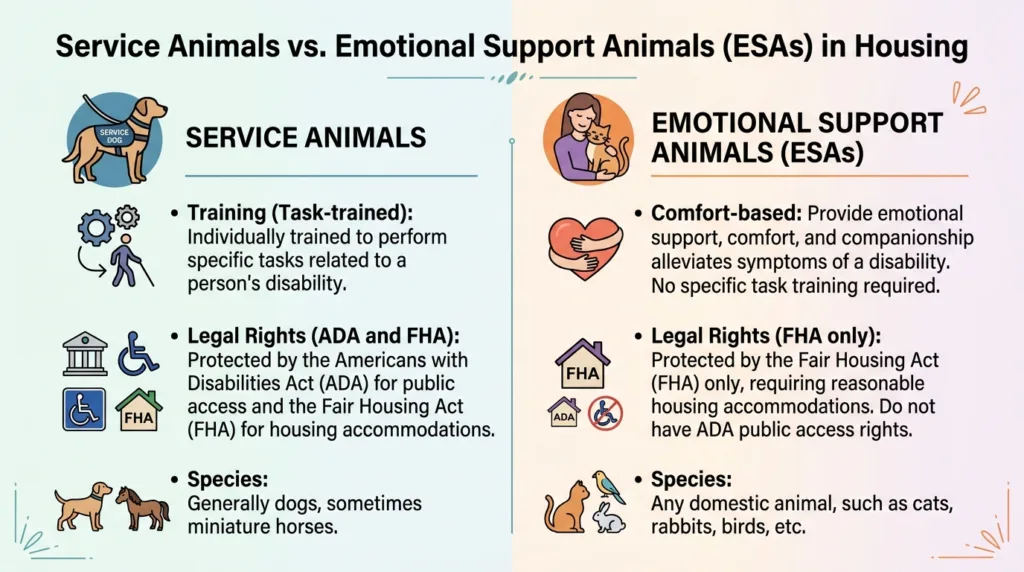
The U.S. Department of Justice defines a service animal under the ADA as a dog that has been individually trained to do work or perform tasks for a person with a disability. The work or task must be related to the person’s disability.
HUD’s housing framework is broader. Its current assistance-animal guidance explains that an assistance animal can include a service animal as well as another animal that works, performs tasks, provides assistance or provides therapeutic emotional support related to a disability.



That means the comparison below is not between two completely separate legal systems. A service dog can also be an assistance animal in housing. The main difference is that Fair Housing protections are not limited to animals that satisfy the ADA’s narrower service-animal definition.
| Question | Service animal under the ADA | Emotional support / other support animal in housing |
|---|---|---|
| Must the animal perform a trained task? | Yes. The dog must be individually trained to perform disability-related work or tasks. | Not necessarily. Disability-related emotional support can be relevant under the Fair Housing framework even without task training. |
| Is comfort alone enough under the ADA? | No. Comfort or emotional support by presence alone does not satisfy the ADA service-animal definition. | It can be relevant if the support alleviates one or more effects of a disability and the Fair Housing requirements are otherwise met. |
| Is the animal treated as an ordinary pet? | A qualifying service animal is not treated as an ordinary pet under the applicable disability-access rules. | HUD states that qualifying assistance animals are not pets for Fair Housing accommodation purposes. |
| Can the definition extend beyond a trained service dog in housing? | The ADA service-animal definition generally concerns dogs, with separate ADA provisions for trained miniature horses. | Yes. HUD’s housing guidance can encompass other assistance or support animals under the Fair Housing framework. |
| Can disability-related information become relevant? | Public-access inquiries under the ADA are tightly limited when the service is not obvious. | In housing, reliable disability-related information may sometimes be requested when the disability or disability-related need is not observable or already known. |
| Does the label alone decide the housing request? | No. The actual ADA requirements matter. | No. The Fair Housing analysis focuses on disability, disability-related need and the requested accommodation. |
The table is useful precisely because it separates concepts that are frequently collapsed into one label. A renter does not gain or lose housing rights simply because someone uses the initials “ESA” or calls an animal a “service pet.” The actual function of the animal and the legal framework matter more than informal terminology.
Training is the clearest dividing line under the ADA
Under the ADA, providing emotional comfort is not enough by itself to make an animal a service animal.
The Department of Justice explains that emotional support, therapy, comfort and companion animals do not qualify as service animals under the ADA when their function is simply to provide comfort through their presence. A service dog must instead be trained to take a specific action or perform work related to the person’s disability.
That distinction becomes easier to see with psychiatric disabilities.
Suppose a dog has been trained to recognize an impending anxiety episode and take a specific action, such as interrupting a behavior or guiding the person to a safer environment. The DOJ explains that a dog trained to take disability-related action can qualify as a psychiatric service animal under the ADA.
By contrast, if the dog’s presence makes the person feel calmer but the dog has not been trained to perform a disability-related task, that emotional benefit alone does not convert the dog into an ADA service animal.
The difference is therefore not whether the disability is physical or psychiatric. It is whether the dog has been trained to perform disability-related work or tasks.
Professional training is not required. The DOJ specifically states that people with disabilities may train their own service dogs and are not required to use a professional service-dog program. What matters under the ADA definition is the training and task, not who provided the training.
Housing adds another layer because a support animal does not necessarily need that type of task training to be considered within HUD’s Fair Housing assistance-animal framework.
Emotional support in housing is connected to disability, not ordinary companionship
Most pets provide companionship, comfort or emotional benefits to their owners. That fact alone does not make every pet an emotional support animal for Fair Housing purposes.
HUD’s framework is tied to disability and disability-related need. Its Assistance Animals Notice describes support animals as animals that may provide therapeutic emotional support for an individual with a disability. The support has to be relevant to the Fair Housing accommodation analysis, rather than simply reflecting the ordinary emotional bond many people have with pets.
This is why asking whether an animal “makes someone feel better” is too imprecise. The housing question concerns whether a person with a disability needs the animal as an accommodation in order to have an equal opportunity to use and enjoy the dwelling.
The broader concept is explained in our beginner’s guide to assistance animals in rental housing. The important point here is that an emotional support animal does not need to be converted into an ADA service animal before a housing accommodation can be considered.
It also follows that buying an online certificate or registration does not create the disability-related need on its own. HUD’s guidance focuses on reliable information relevant to the person’s disability and need for the animal when such information can appropriately be requested.
The label is therefore secondary to the underlying accommodation question.
Housing and public access are not the same privilege
A common misunderstanding runs in both directions.
Someone may learn that an emotional support animal can be considered in housing and conclude that the animal can therefore accompany the person into restaurants, stores and other public places under the ADA. That does not follow.
The ADA’s public-access rules use the service-animal definition described earlier. An emotional support animal whose function is comfort through its presence does not gain ADA public-access rights merely because it may qualify as an assistance animal for housing purposes.
The reverse error happens as well. A housing provider may correctly recognize that an emotional support animal is not an ADA service animal and then treat that conclusion as proof that no Fair Housing accommodation is possible.
HUD has specifically distinguished the two frameworks. Its guidance explains that the unique nature of housing can require consideration of assistance or support animals that are not individually trained service animals.
This distinction becomes especially important in properties containing spaces that serve different functions. A residential complex may include the tenant’s dwelling, common residential areas and spaces that are also open to the general public. Which law applies to a particular access question can therefore depend on the setting and the facts.
For most renters, there is no need to memorize every overlap. The safer conceptual rule is simply to stop treating “allowed in housing” and “allowed everywhere under the ADA” as equivalent statements.
The questions a housing provider can ask are not copied directly from ADA public-access rules
Another source of confusion comes from the well-known ADA rule about service-animal questions.
When it is not obvious that a dog is a service animal, ADA-covered staff in public-access situations may generally ask only two questions: whether the dog is required because of a disability and what work or task the dog has been trained to perform. The DOJ also states that covered entities cannot demand service-animal certification, require the dog to demonstrate the task or ask for details about the person’s disability in that ADA inquiry.
Housing accommodation requests can involve a different information process.
Under HUD’s Fair Housing guidance, if both the disability and disability-related need for the animal are readily apparent or already known, additional disability-related information may not be necessary. When one or both are not observable or known, however, reliable information supporting the disability or disability-related need may become relevant.
That does not give a housing provider unlimited access to a renter’s medical history. Nor does it mean that every person requesting an assistance animal must provide exactly the same letter, diagnosis or form.
The issue is sufficiently important that what information may be relevant to an assistance-animal request is treated separately in this series.
For this comparison, the essential distinction is simpler:
ADA public access and Fair Housing accommodation requests do not use the same inquiry process.
Applying the ADA’s two-question public-access rule mechanically to every housing request would leave out part of the Fair Housing framework. Applying broad housing documentation expectations to a restaurant’s ADA service-animal inquiry would make the opposite mistake.
Neither category should be reduced to a vest, certificate or website registration
Visual signals can be persuasive even when they have little legal significance.
A service dog may wear a vest because the handler finds it useful, but the ADA does not require a specific vest, identification card or certification. Likewise, the absence of a vest does not by itself prevent a properly trained service dog from satisfying the ADA definition.
Housing presents a similar problem with emotional support animals. Websites may sell registrations, identification cards or certificates, but those products are not substitutes for the disability-related facts that the Fair Housing analysis actually concerns.
HUD’s 2020 guidance specifically addresses documentation obtained from internet-based services and distinguishes reliable disability-related information from documentation that merely results from answering a short online questionnaire or purchasing a document without a meaningful connection to the person’s disability-related need.
That does not mean information delivered through telehealth or online communication is inherently invalid. HUD recognizes that legitimate healthcare professionals can provide services remotely. The relevant question is the reliability of the information and whether the provider has personal knowledge relevant to the individual, not whether paper changed hands in a physical office.
For renters, this distinction is useful because it moves the focus away from branding. An animal does not become legally meaningful because its owner purchased the most official-looking badge available online.
In housing, both can lead to a reasonable-accommodation request
Despite their differences, service animals and emotional support animals can converge at one important point: a renter may seek a reasonable accommodation in housing because of the animal.
A tenant with a trained service dog might request an exception to a no-pets policy. A tenant with a disability-related emotional support animal might make a similar request under the Fair Housing framework. The legal reasoning is not that the two animals are identical; it is that each situation can involve an accommodation necessary because of disability.
HUD and DOJ define a reasonable accommodation as a change, exception or adjustment to a rule, policy, practice or service that may be necessary to allow a person with a disability an equal opportunity to use and enjoy housing.
The specific accommodation could involve more than permission to keep the animal. Pet fees, deposits, animal restrictions or other rules may also become relevant depending on the circumstances. Those questions have their own limits and should not be resolved merely by deciding whether someone uses the term “service animal” or “ESA.”
The next step is understanding what a reasonable accommodation for an assistance animal actually means, because that mechanism is what connects the disability-related need to the housing rule being changed.
The most useful distinction to carry forward is therefore not “service animals are real and ESAs are not,” nor the equally inaccurate idea that the terms are interchangeable. Under the ADA, task training is central to the service-animal definition. Under the Fair Housing framework, disability-related assistance can extend beyond that narrower category and can include qualifying emotional support. Housing questions become clearer once the correct framework is identified before the label is interpreted.

Alex is the content editor at PetzNews, covering pet care guidance and pet-friendly housing topics for renters and property owners across the United States