
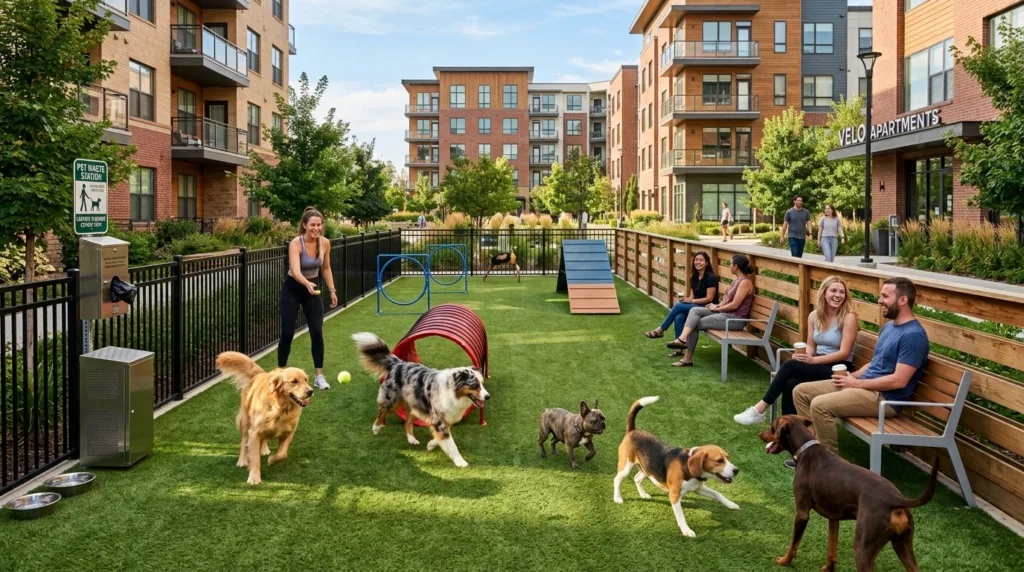
A fenced dog area can make an apartment community look significantly more convenient for a renter with a dog. It may reduce the distance required for some outdoor breaks, provide an off-leash option close to home and create a place where residents regularly meet other dog owners. Those advantages are real, but the phrase “on-site dog park” in a rental listing tells you surprisingly little about how useful the space will be once you live there.
One property may have a well-maintained area with secure gates, enough room for dogs to move comfortably and clear rules that residents generally follow. Another may technically offer the same amenity while providing a small patch of worn ground that becomes crowded at predictable times. More importantly, even an excellent dog park is not automatically a good environment for every dog.
When comparing rentals, it therefore helps to evaluate the shared pet space as part of the dog’s actual routine rather than treating it as a box to check on an amenities list. If you are already comparing pet-friendly apartments beyond the monthly rent, the condition and usability of shared pet facilities can be one of the practical differences worth examining in person.
What the listing says and what you actually need to know
Apartment listings tend to describe amenities in broad terms: dog park, pet area, dog run, pet relief station. Before giving that feature much weight in your housing decision, translate the marketing language into questions about how the space operates.
| The listing tells you | What is more useful to verify |
|---|---|
| “On-site dog park” | Is it actually large enough for the number of dogs using it? |
| “Fenced pet area” | Is the fencing secure, and how are the gates designed? |
| “Pet-friendly community” | Which parts of the property are dogs allowed to use? |
| “Dog amenities” | Are they included in rent or connected to an additional fee? |
| “Convenient pet relief area” | Is it clean, accessible and practical at the times you will use it? |
| “Space for socializing” | Does your dog actually enjoy interacting with unfamiliar dogs? |
Seeing the area during a tour is better than relying solely on photos. If possible, look at it around the time you would normally expect to use it. A dog run that feels spacious at 11 a.m. on a weekday may function very differently at 6 p.m., when many residents return from work.
While you are there, notice the ordinary details. Are gates closing correctly? Is there waste on the ground? Are trash receptacles available and maintained? Does the space turn into deep mud after rain? Can dogs waiting outside the gate create a bottleneck with dogs trying to leave?


The American Kennel Club recommends visiting a dog park without your dog first and evaluating factors such as secure fencing, double-gate entrances, crowding, cleanliness and whether owners are actively supervising their animals. Although a private apartment dog run may differ from a municipal dog park, those observations are equally useful when deciding whether a shared space is well managed.
Convenience does not make the dog park necessary
For some renters, an on-site dog area genuinely improves the daily routine. A quick trip downstairs may be useful during bad weather or before work, and residents without a private yard may appreciate having an off-leash space available without driving elsewhere.
Still, access to a dog park should not be confused with meeting all of a dog’s activity needs. The space may complement walks, training, enrichment and other forms of exercise, but its usefulness depends on the individual animal and on how the area is being used at that moment.
This distinction becomes important when comparing two rentals. Imagine one property has a dog run but poor pedestrian access outside the complex, while another has no private dog park but sits beside a comfortable network of sidewalks and walking routes. A renter whose dog dislikes group play may get much more everyday value from the second property.
The same reasoning applies to dogs that simply prefer walking and exploring. As discussed in our guide to building an exercise routine for an apartment dog, a sustainable routine can combine physical activity, sniffing, mental engagement and rest in different ways. There is no requirement that shared off-leash play be part of that formula.
In other words, judge the amenity by the problem it solves for your household. If you would rarely use it, its presence should not outweigh factors that influence every day, such as outdoor access, the building layout or the surrounding neighborhood.
The right question is whether the space suits your dog
A dog park brings unfamiliar dogs into relatively close interaction, often without leashes. Some dogs enjoy that environment and navigate it comfortably. Others find crowded or unpredictable social situations stressful, and forcing participation simply because the amenity is available can create unnecessary problems.
The AKC advises that shy or nervous dogs may find dog parks overstimulating, while dogs with significant reactivity, aggression or certain forms of resource guarding may not be good candidates for that type of group environment. The organization also recommends that dogs using off-leash parks have enough basic training that the owner can regain their attention in a distracting setting.
Those considerations are more useful than judging suitability by breed or size alone. A sociable small dog and an uncomfortable small dog do not have the same needs merely because both fit into the same designated section. Likewise, a dog that interacts well with familiar animals may not enjoy being approached by several unfamiliar dogs at once.
Observe your own dog before deciding that regular dog-park use should become part of apartment life. Does the dog voluntarily engage and then disengage from play? Can you call the dog away when necessary? Does the animal remain comfortable when new dogs enter, or does arousal continually increase?
You should also feel free to leave. Shared amenities sometimes create subtle social pressure because residents see one another frequently, but staying in an increasingly uncomfortable situation is not a requirement of being a good neighbor. If the area becomes too crowded or another dog’s behavior makes the interaction feel unsafe, another walk or a later visit can be the better option.
Entry and exit deserve almost as much attention as the space itself
Many awkward dog-park interactions happen near the gate, where dogs entering and leaving have little room to create distance. A secure double-gate arrangement helps because one gate can close before the next opens, reducing the chance that a loose dog slips out as another resident enters.
The AKC specifically identifies secure fencing and double-gated entrances as desirable features when evaluating a dog park. In an apartment community, the surrounding layout matters as well. A narrow path immediately outside the enclosure may create congestion if residents wait there with leashed dogs, whereas a more open approach gives people room to pause before entering.
This is also where the rest of the building connects with the amenity. A renter may still need to move through a lobby, elevator or hallway before reaching the dog area, which means the convenience of having a park on site does not eliminate the challenges of shared access. If those transitions are difficult for your dog, elevators, stairs and hallways remain part of the apartment routine even when the destination downstairs is designed specifically for pets.
Before entering, take a few seconds to look at what is happening inside rather than opening the gate automatically. A calm space with two dogs may become a very different environment when a larger group is playing intensely near the entrance. Timing the visit around your dog’s comfort can make the amenity far more useful.
Cleanliness is more than a cosmetic issue
Shared pet areas concentrate dogs in the same relatively small space. As a result, waste management and basic hygiene deserve more attention than they might in a large open neighborhood.
The CDC explains that dog feces can carry germs that make people and animals sick and recommends picking up dog waste promptly and disposing of it properly. In an apartment dog run, one resident failing to clean up does not affect only the appearance of the property; it affects a space that many dogs may use repeatedly throughout the day.
A consistently dirty area can also reveal something about management and resident behavior. During a property tour, one overlooked pile of waste does not necessarily indicate a chronic problem, but overflowing receptacles, widespread waste or broken cleanup stations deserve more attention.
Water requires judgment too. Shared bowls may look convenient, yet they are used by multiple animals. The AKC recommends bringing your own portable water bowl rather than relying on communal dog-park bowls. A source of fresh water on the property can still be useful; using an individual bowl simply gives the renter more control over what the dog drinks from.
Health status matters as well. A shared dog area is not an appropriate place to bring an animal that is currently ill or potentially contagious. The CDC advises, for example, that dogs with diarrhea or Giardia infection should have their access to communal outdoor areas such as dog parks limited while they are ill or undergoing treatment.
That does not require renters to approach every shared space as a disease hazard. It does support a basic principle of communal use: cleaning up waste, keeping sick animals out of group areas and using reasonable hygiene protects more than your own dog.
Read the rules before assuming how the area can be used
A private apartment dog park is part of the rental property, so the housing provider may establish rules that differ from those at a public park. There may be designated hours, registration requirements, limits on the number of dogs a resident can bring at once or rules covering toys, food, supervision and cleanup.
Do not assume that “off-leash area” means dogs can be off leash anywhere between the apartment and the enclosure. The dog may still need to remain leashed in hallways, elevators, landscaped areas or other common spaces. Likewise, a pet relief station and a recreational dog run are not necessarily interchangeable; the property may expect residents to use particular areas for particular purposes.
Review the lease, pet addendum and community policies rather than relying only on signs posted near the amenity. Pet rules in a rental can be distributed across several documents, and understanding those boundaries early is easier than discovering them after a complaint.
If something about the shared area matters significantly to your decision to rent, ask specific questions before signing. Is use restricted to registered pets? Who should residents contact when the gate or fence is damaged? How often is the area maintained? Are there hours when access is unavailable?
The answers may not determine whether the property is good or bad, but they tell you whether the amenity is being operated as part of the community or merely advertised as one.
A pet amenity should make daily life easier, not decide the rental by itself
An apartment dog park is most valuable when three things align: the area is reasonably well managed, your dog is comfortable using it, and it fits naturally into a broader routine that already includes appropriate exercise and outdoor access. If any one of those elements is missing, the amenity may still be pleasant to have, but its practical value drops.
Before giving a property extra credit for its shared pet facilities, consider how often you would genuinely use them, what the space looks like during normal resident hours and whether your dog benefits from that type of environment. Then compare those answers with features that affect every outing: the path outside, nearby walking options, building traffic and the rental’s actual pet rules.
A dog park can be a meaningful advantage. It can also be an amenity you rarely enter. Evaluating the difference before signing the lease gives you a much more realistic picture of what “pet-friendly” will mean after you move in.

Alex is the content editor at PetzNews, covering pet care guidance and pet-friendly housing topics for renters and property owners across the United States