
A dog does not need a separate room to have a place of its own.
In a small apartment, that would often be impossible anyway.
What matters more is whether the space makes sense. Can the dog rest somewhere without being interrupted constantly? Is there a predictable place for food and water? Can you reach the leash without searching for it every morning? Does the dog spend the afternoon staring through a window that triggers barking every five minutes?
Small apartments work better when every useful area has a purpose.
That does not mean dividing the home into rigid pet zones or filling it with dog furniture. A bed in one corner, bowls placed thoughtfully and a basket near the door may be enough to create structure.
The CDC recommends considering a dog’s temperament, size and activity level together with the home environment when deciding whether the living arrangement is appropriate. In a rental apartment, good organization helps that environment function without requiring permanent modifications.


Think in zones, not rooms
A studio apartment may have one main room.
The dog can still experience several different spaces within it.
One corner can mean rest.
Another can be associated with meals.
A mat near the living area might become the place where the dog settles while people eat or answer the door.
The entryway can hold walking supplies and provide a predictable transition between indoors and outside.
These functions do not need walls between them. They need enough consistency that the dog and renter are not improvising everything each day.
The ASPCA recommends creating a dedicated quiet, safe area such as a bed, crate or other comfortable space when preparing a home for a dog.
That principle becomes particularly useful in a small apartment because space has to serve more than one purpose.
Your desk area can still be your dog’s resting area during work hours. The important question is whether that arrangement actually allows rest.
If the bed sits beside the front door and the dog jumps up every time someone passes in the hallway, moving it six feet may accomplish more than buying a more expensive bed.
Start by watching where your dog naturally settles.
Then ask whether that location helps the dog relax or repeatedly exposes the animal to activity.
Give rest a place that actually feels restful
A resting area should be comfortable, but location often matters just as much as the bed itself.
The ASPCA’s general dog-care guidance says dogs should have access to a warm, quiet and comfortable place to rest.
“Quiet” is relative in an apartment.
You may hear neighbors, elevators, traffic and plumbing regardless of where the bed goes. Still, some parts of the unit are calmer than others.
A dog that reacts strongly to hallway sounds may settle better away from the entrance.
One that becomes excited by people walking past the window may rest more successfully in a part of the room with less visual exposure.
The bed also should not create a traffic problem for the household.
Placing it in the middle of the only route between the kitchen and bathroom may mean the dog is repeatedly stepped around or asked to move. A protected corner can provide more consistency without consuming much usable floor area.
What about a crate?
A crate can be useful for some dogs, but it should not automatically become the solution to limited apartment space.
The ASPCA explains that some dogs learn to experience a crate as a safe place, while dogs showing distress during confinement may become more anxious and may need a different setup.
Watch the dog rather than assuming that a crate is calming because it is enclosed.
If the dog relaxes there voluntarily, the crate may function as a resting area.
If confinement produces frantic escape attempts, persistent vocalization or other signs of distress, making the crate more attractive visually does not solve the underlying problem.
A bed, mat or gated portion of a room may work better for some dogs.
Keep feeding simple and separate from human food preparation
Food and water require surprisingly little space.
Their location deserves some thought nonetheless.
A bowl placed in a busy walkway may be kicked regularly. Water beside a sensitive floor can create repeated moisture problems. Food stored wherever there happens to be room can end up beside human ingredients or in an area the dog can access independently.
Choose a location that is:
- easy to clean;
- away from the busiest walking route;
- stable enough for the bowls;
- practical for refilling;
- appropriate for the flooring underneath.
A removable mat can help contain water and food debris, particularly if the dog is enthusiastic while drinking.
There is also a hygiene reason to separate pet-food handling from human food preparation. The CDC advises keeping pet food and supplies out of areas where human food is prepared or eaten and storing pet food separately from food intended for people.
In a tiny apartment kitchen, perfect separation may require a little creativity.
A sealed container in a nearby closet or storage cabinet can be more practical than leaving an open bag beside the counter.
The arrangement does not need to look like a pet store.
It needs to be easy enough that you will maintain it.
Use storage to make the routine smaller
A small apartment feels more crowded when pet supplies migrate into every room.
One leash hangs from a chair.
Waste bags sit on the kitchen counter.
Treats are in three cabinets.
Towels used after rainy walks never seem to reach the same place twice.
None of these objects is large, yet collectively they make the dog’s routine occupy more visual and functional space than necessary.
Centralizing high-frequency items helps.
Near the exit, you might keep:
- leash and harness;
- waste bags;
- paw towel;
- collapsible water bowl if regularly used;
- other walking essentials.
Less frequently used supplies can live elsewhere.
The principle is simple: store an item near the place where it enters the routine.
That reduces unnecessary movement through a small home.
It also makes departures calmer. Searching for a leash while an excited dog waits beside the door can create more chaos than the lack of square footage itself.
If the entrance becomes a high-energy area, organization can also help separate “we are getting ready to leave” from constant access to walking equipment.
Be careful with the most interesting window in the apartment
A window can be excellent enrichment.
It can also become the dog’s full-time surveillance post.
Some dogs calmly watch people pass. Others respond to every dog, delivery truck or pedestrian.
If your dog repeatedly barks at outdoor activity, the best view in the apartment may not be the best place for the main bed.
The ASPCA’s barking guidance suggests reducing a dog’s access to visual triggers when territorial or alarm barking is repeatedly prompted by people or animals visible outside.
This does not mean covering every window.
Observe what actually happens.
A dog that watches quietly may have no problem at all.
If the same window produces dozens of barking episodes each day, changing furniture placement or controlling the view during busy periods can alter the environment without any permanent modification.
That connection between layout and behavior is why reducing dog barking problems in an apartment is partly a question of space, not only training.
Leave enough open space for ordinary movement
Small apartments sometimes become less dog-friendly because people try too hard to make them dog-friendly.
A large bed, toy basket, feeding station, crate and storage unit can consume more usable space than the dog needs.
Your dog still needs to move through the apartment.
Watch the paths between:
resting area → water → front door → main living area
Those routes should not require navigating an obstacle course.
For a dog that moves quickly indoors, traction can matter too. A strategically placed runner may help on a slippery path without covering the entire floor.
Likewise, avoid placing fragile renter-owned or landlord-owned items in locations where tails, paws or excited turns repeatedly reach them.
The goal is not maximum dog equipment.
It is maximum usability of the space you already have.
That distinction also helps protect the rental. As discussed in our guide to protecting rental floors and doors from dog damage, repeated contact in a few predictable locations often matters more than the total amount of floor the dog can access.
Activity does not require sacrificing the entire living room
A small apartment cannot provide unlimited indoor exercise, nor should it have to.
The larger activity routine should include appropriate outdoor movement and enrichment based on the individual dog’s needs. Our guide to building an exercise routine for an apartment dog covers that balance separately.
Inside, choose activities that match the available space.
A short training session needs almost none.
Food puzzles can occupy a dog without requiring a clear running lane.
Scent games can use a portion of the room temporarily and disappear when the activity ends.
The ASPCA notes that regular exercise and supervised play can help dogs avoid boredom and provide appropriate outlets for behaviors such as chewing, retrieving and chasing.
You do not need to leave every enrichment activity accessible all day.
Rotating a few appropriate items can reduce clutter and help preserve interest.
The apartment remains a human home as well as a dog’s environment.
A setup that makes the renter miserable will not be sustainable.
Let the layout change when the dog changes
A puppy and an adult dog may use the same apartment very differently.
So might a dog that has just moved in and the same dog six months later.
Initially, a new dog may benefit from a smaller, predictable area while learning the household routine. The ASPCA recommends starting pets in a defined “home base” when settling into a new home and expanding access gradually as they become comfortable.
Later, the resting spot may move.
The dog may stop reacting to the hallway.
A crate may become unnecessary.
A feeding arrangement may need to change.
An older dog could eventually require easier access, better traction or a bed in a different location.
The apartment is not a finished pet setup once the bowls are placed.
Watch how the dog actually uses it.
If everyone constantly walks around the same oversized bed, move it.
If the dog never touches an expensive piece of pet furniture, question whether it needs to occupy valuable space.
If a quiet corner becomes the dog’s preferred resting area, support that pattern.
Small apartments are often easier to improve precisely because each adjustment has an obvious effect.
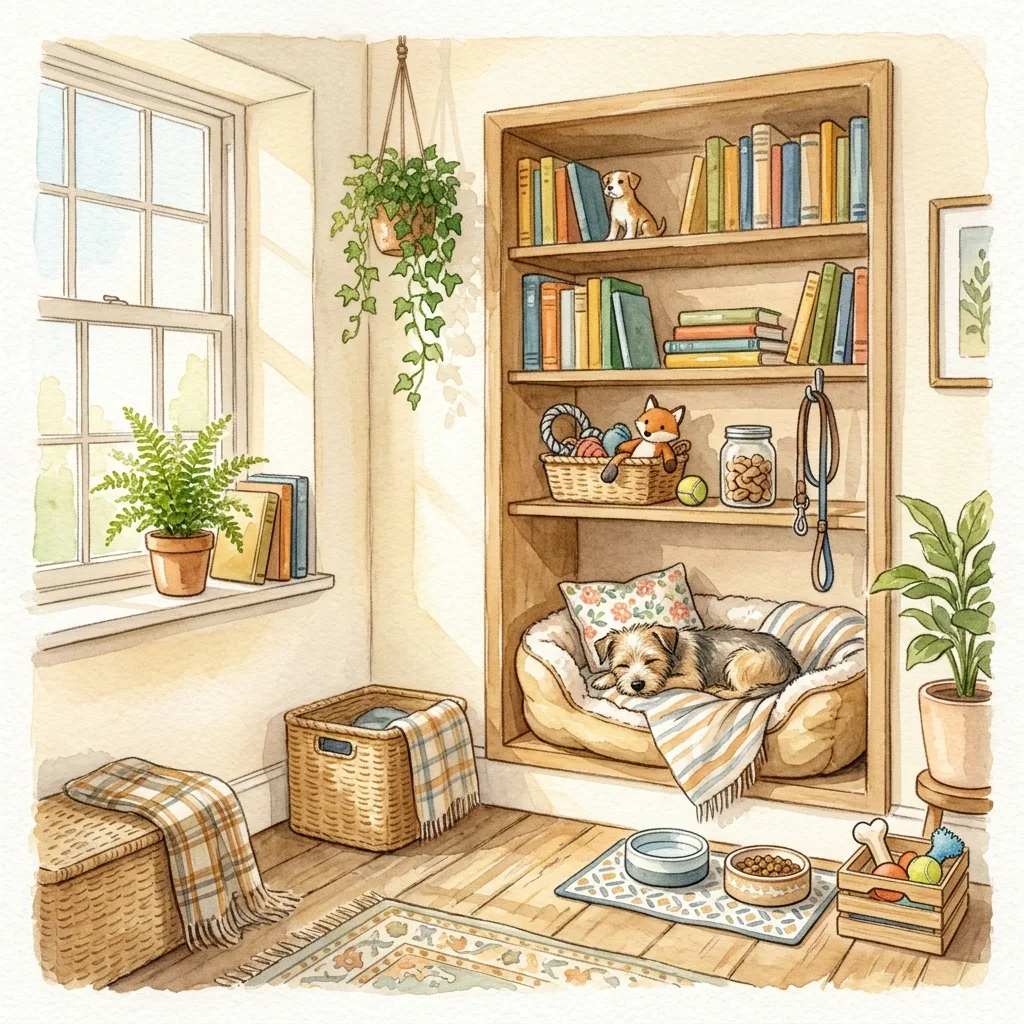
A dog-friendly apartment should still look like your home
It is easy to approach a small apartment as a storage problem:
Where can another pet product fit?
A better question is what the dog genuinely needs from the space.
A reliable place to rest.
Access to water.
A workable feeding location.
Room to move.
Safe storage of supplies.
A routine that gets the dog outside.
An environment that does not constantly trigger stress or overexcitement.
Once those needs are covered, extra equipment is optional.
A successful small-space setup is not the apartment with the most visible evidence of dog ownership.
It is the one where the dog’s needs fit naturally into everyday life without making the renter feel that the animal has taken over every square foot.

Alex is the content editor at PetzNews, covering pet care guidance and pet-friendly housing topics for renters and property owners across the United States