
Most dog-related rental damage does not begin as a dramatic event.
It starts with repetition.
The same paws turn sharply on the same section of flooring. Wet feet cross the entryway after every rainy walk. A dog waits at the front door and scratches when someone leaves. Water splashes beside the bowl several times a day. A puppy discovers that one corner of the trim is satisfying to chew.
Weeks later, the repeated contact is more visible than any single incident.
That is useful for renters because repetition can often be interrupted before the condition becomes expensive. You do not have to cover an entire apartment in protective material. Instead, identify where your dog’s movement, moisture and behavior repeatedly meet surfaces you do not own.
Look for pressure points, not just expensive surfaces
Walk through the apartment and notice where the dog repeatedly starts, stops, turns or waits.



Those places may include the path between the bed and front door, the area around food and water bowls, a favorite window, the entrance after walks, or the section of flooring where an excited dog changes direction.
A beautiful hardwood floor that your dog rarely crosses may be less vulnerable than an inexpensive surface used fifty times a day.
The same is true of doors.
A bedroom door is not automatically at risk because a dog lives in the apartment. A front door where the dog waits anxiously every morning may be different.
This is why prevention works better when it is specific.
Rather than asking:
How do I dog-proof the whole apartment?
ask:
Where does my dog repeatedly make contact with the rental?
Once those areas are visible, protection can be much more targeted.
If you are still arranging the unit, creating a dog-friendly space in a small apartment can reduce some of these pressure points by giving rest, feeding and activity their own workable locations.
Floors can be damaged in more than one way
“Protect the floor” sounds like one problem. In practice, renters may be dealing with scratching, slipping, moisture, dirt or repeated impact—and each calls for a different response.
Scratches and nail contact
Hard flooring can show marks where a dog runs, pivots or repeatedly pushes off.
Regular nail care can help for reasons that go beyond the rental itself. The American Kennel Club notes that overgrown nails can affect a dog’s gait, cause discomfort and increase the risk of broken nails.
Keeping nails appropriately maintained may also reduce unnecessary contact between long nails and hard flooring, although no nail-care routine can guarantee a scratch-free floor.
Some dogs naturally create more friction than others because of their movement and activity level.
In high-traffic locations, a removable runner or area rug can create a buffer between paws and the rental surface. It can also provide additional traction on slick flooring.
Placement matters more than quantity.
A runner along the route where your dog repeatedly accelerates may be more useful than carpeting an entire room the dog barely uses.
Make sure anything placed on the floor is stable enough that it does not create a new slipping hazard.
Water, mud and everyday mess
Sometimes the greater risk is not claws.
It is moisture.
A water bowl on wood or laminate can create repeated splashes in the same location. Rainy walks bring wet paws into the entryway. Snow, mud or other outdoor debris can remain on flooring if the normal routine has no place to deal with it.
The practical solution is to intercept the mess where it occurs.
A renter might place an appropriate removable mat beneath food and water bowls and create a small entry routine for wet paws.
That does not require turning the doorway into a cleaning station. A towel stored nearby may be enough to prevent dozens of wet trips across the room over the course of a season.
The important word is repeated.
One splash is rarely the same problem as moisture reaching the same seam in the flooring day after day.
Accidents need prompt attention
Urine, vomit or other accidents create a different kind of risk because both staining and odor can become harder to address if the material absorbs them.
Clean accidents promptly using a method appropriate for the surface.
Avoid assuming that a stronger chemical is automatically better. Flooring materials differ, and a product that works on tile may not be appropriate for wood, carpet or another finish.
If the lease or property provides cleaning guidance, follow it. When you are unsure whether a product can alter the surface, check the manufacturer’s instructions rather than experimenting on a visible area.
For renters, the goal is to solve the original problem without creating a second one through aggressive cleaning.
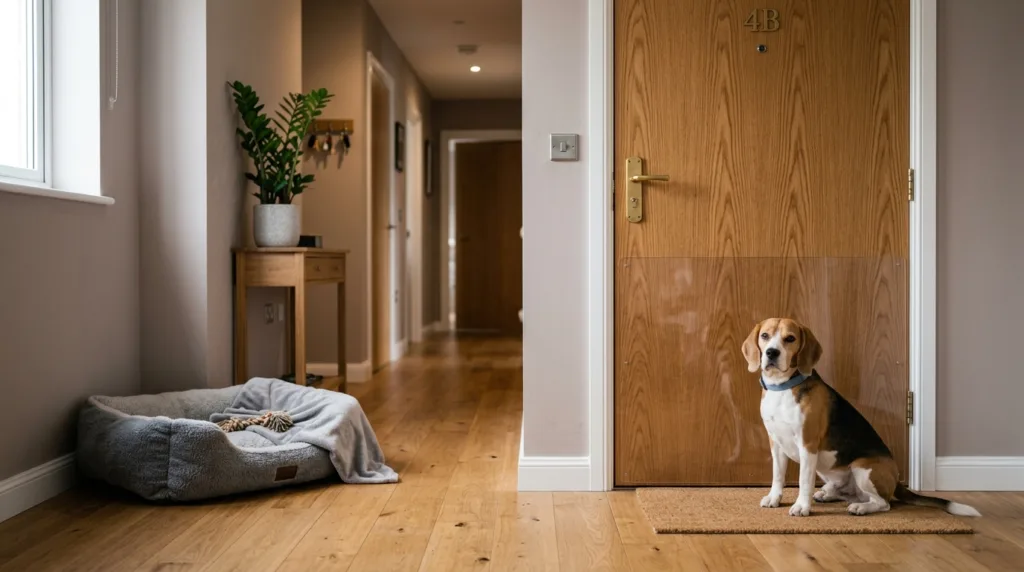
Doors often reveal a behavior before they reveal a maintenance problem
A scratched or chewed door is easy to classify as property damage.
What caused it can be more important.
A puppy may chew trim while exploring. A dog may scratch a door because it has learned that scratching gets it opened. Another may repeatedly target the exit only after the renter leaves.
Those situations should not automatically receive the same response.
The ASPCA explains that dogs experiencing separation anxiety can chew door frames or window sills, dig at doors and attempt to escape when left alone. When that destruction is part of a broader pattern of distress during absence, placing a protector over the door may preserve the surface without addressing what is happening to the dog.
Look at timing.
If the marks appear while you are home and the dog wants access to another room, the pattern is different from damage that occurs only after departure.
If the door is targeted mainly when someone knocks or walks down the hallway, environmental arousal may be involved instead.
The physical mark is evidence of contact.
It is not, by itself, a behavioral diagnosis.
For renters who see destruction concentrated around departures, planning for leaving a dog home alone in an apartment becomes more relevant than simply adding another layer of material to the door.
Persistent barking around the same trigger may also provide useful context; our apartment barking guide explains how to look for those patterns without assuming every vocalization has the same cause.
Prefer protection you can remove without creating another repair
Renters face a limitation homeowners do not: the surface belongs to someone else.
That changes which protective ideas are sensible.
A permanent wall panel, screwed-in guard, adhesive product or flooring alteration may solve one problem while creating another if the lease prohibits modifications or the product damages the finish when removed.
Before attaching anything substantial, check the lease and property rules.
In general, renter-friendly prevention favors solutions that:
- can be removed cleanly;
- do not penetrate doors, walls or flooring without permission;
- suit the actual surface underneath;
- remain stable during normal use;
- can be cleaned or replaced without altering the property.
A freestanding mat under a water bowl is very different from permanently coating a rental floor.
A removable runner is different from installing new flooring.
Even products advertised as removable deserve caution. Adhesives can react differently with paint, varnish, laminate and other finishes, particularly after months of contact.
When possible, test a product according to the manufacturer’s instructions and avoid treating the word renter-friendly on packaging as a guarantee that it is compatible with your particular apartment.
Protecting a door should not trap the dog in distress
There is another practical boundary.
Suppose a dog is damaging an exit door while desperately trying to get out whenever the renter leaves.
Installing a stronger barrier might protect the door. It can also leave the underlying distress untouched.
The ASPCA notes that escape attempts associated with separation anxiety can be extreme enough to cause broken teeth, injured paws and damaged nails.
At that point, protecting the property is no longer the only consideration.
A dog repeatedly injuring itself, showing severe distress or engaging in intense escape behavior deserves appropriate veterinary or qualified behavioral guidance.
Rental protection matters.
The animal’s safety matters more.
Catch the change while it is still small
Prevention is easiest when you know what the surface looked like before the pattern began.
Suppose the flooring near the balcony starts showing new marks.
You can compare the area with your move-in photographs.
Perhaps the marks were already present. Perhaps they are new and correspond with your dog repeatedly running to the balcony door.
Either way, you now know more than you would from memory alone.
This is where property care and documentation intersect.
Our guide to pet damage in a rental and what renters should document explains how to create that record without photographing every ordinary moment of the tenancy.
If damage does occur, check the lease before making permanent repairs. Painting trim, refinishing flooring or replacing part of a door without permission may violate rules governing alterations even when your intention is to correct the problem.
Document the condition, determine what caused it if you reasonably can, stop the repeated source of damage, and find out what the property allows you to do next.
That sequence is usually more useful than trying to make the evidence disappear.
The best protection often changes the routine, not the apartment
A rug can protect a floor.
A mat can catch water.
A door guard can create a physical barrier.
But the most durable solution often sits one step earlier.
Why is the dog making repeated contact with that surface?
Perhaps the water bowl needs a better location. The dog may need traction where it turns toward the front door. A puppy needs appropriate chewing outlets. A resting spot beside the entryway may be exposing a reactive dog to every hallway sound.
Move the bowl.
Change the route.
Create traction where it is needed.
Reconsider the resting area.
Address the behavior instead of only covering its result.
The official New York City pet-inclusive housing guide encourages renters to incorporate consistent routines, appropriate enrichment and responsible property care into everyday life with pets.
That combination is useful because rental protection is rarely about one product.
It is about noticing how the dog uses the home.
Once you understand that pattern, you can protect the few places that actually need attention instead of trying to wrap the entire apartment in armor.

Alex is the content editor at PetzNews, covering pet care guidance and pet-friendly housing topics for renters and property owners across the United States