
Imagine that the move-in sheet for an apartment shows four separate amounts:
Security deposit: $1,800
Pet deposit: $300
Monthly pet rent: $40
Regular monthly rent: $1,650
For a renter moving in with an ordinary pet, all four lines may be relevant, subject to the lease and applicable state or local law. For a renter whose animal qualifies as an assistance animal under the Fair Housing framework, however, the animal-specific lines should not simply be carried over from the property’s pet program.



The distinction is not based on whether a charge sounds large or small. It depends on what the charge is actually for.
HUD’s assistance-animal guidance treats qualifying assistance animals differently from ordinary pets and identifies waiver of a pet deposit or fee as an example of a reasonable accommodation. That same framework also preserves an important boundary: waiving pet-specific charges does not give the renter immunity from ordinary rent, a generally applicable security deposit or responsibility for actual damage.
Follow the charge back to its purpose
Rental paperwork uses several terms that can sound interchangeable even though they describe different costs.
A pet deposit is generally an upfront amount connected specifically to keeping a pet. A pet fee may also be charged because the property permits an ordinary pet, although unlike a refundable deposit it may be structured as a nonrefundable charge where allowed. Pet rent is typically a recurring amount added to the monthly housing cost because an ordinary pet occupies the unit.
If those distinctions are unfamiliar, our guide to pet deposits, pet fees and pet rent explains the ordinary rental side in more detail.
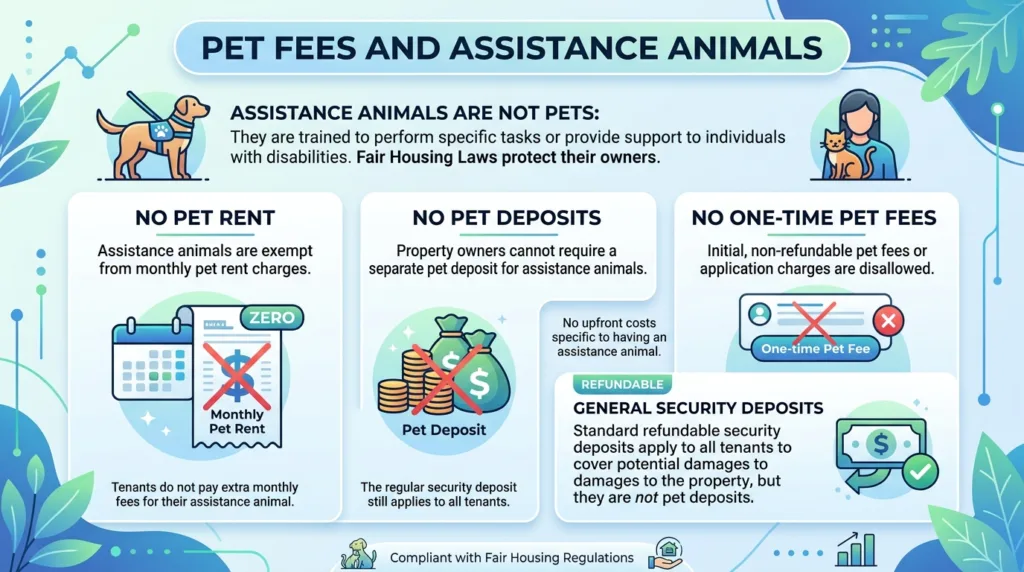
Assistance animals enter a different framework. HUD states that assistance animals are not treated as pets for Fair Housing accommodation purposes and that housing providers may not impose a pet deposit, fee or surcharge for a qualifying assistance animal.
That principle reaches the reason for the charge rather than the label printed on the ledger.
Suppose a property calls a $250 payment an “animal administrative fee.” If every renter with an ordinary dog pays it because management processes the animal through its pet program, changing the name does not necessarily change what the fee is doing. The relevant question is whether the renter is being required to pay an animal-specific charge as a condition of receiving the disability-related accommodation.
The same reasoning applies to a recurring charge. A monthly amount imposed because an ordinary pet lives in the unit does not become fundamentally different simply because the lease calls it “animal rent” rather than “pet rent.”
Federal HUD materials for public and voucher housing are explicit that assistance animals are exempt from pet deposits and monthly pet fees. HUD’s broader Fair Housing guidance similarly states that a housing provider may not charge a deposit, fee or surcharge for an assistance animal.
That does not mean ordinary pet charges are unlawful in general. The distinction exists because a qualifying assistance animal is being considered through a disability-related accommodation rather than through the property’s voluntary pet program.
The conceptual difference is developed further in why assistance animals are not treated the same as pets in housing.
A regular security deposit is a different line on the ledger
Now return to the hypothetical move-in sheet.
The $300 pet deposit exists because of the animal.
The $1,800 security deposit, by contrast, may be required from every tenant regardless of whether an animal lives in the unit.
Those charges should not automatically be treated as the same thing.
HUD guidance distinguishes an additional deposit imposed for an assistance animal from a standard security deposit imposed on tenants generally. A housing provider does not have to waive every ordinary financial obligation of the tenancy merely because a reasonable accommodation has been granted.
That distinction becomes especially important when a property uses the word deposit for several different payments.
If management says, “This is our normal security deposit for every apartment,” the relevant inquiry is different from “We require an extra $300 because you have an animal.” The first may be a generally applicable tenancy charge. The second is specifically tied to the animal.
A reasonable accommodation is usually targeted at the rule creating the disability-related barrier. Our guide to reasonable accommodations for assistance animals explains why granting one accommodation does not automatically rewrite unrelated lease obligations.
This also helps avoid an overly broad statement sometimes found online: “People with assistance animals do not pay deposits.”
That is too imprecise.
The more useful statement is that a housing provider generally should not require an additional pet-specific deposit, fee or surcharge for the qualifying assistance animal. A standard security deposit imposed under the property’s normal tenancy rules is a separate matter, subject to the lease and applicable state or local law.
The distinction may seem technical when someone is signing paperwork, but it becomes important later because the standard security deposit can also interact with actual property damage.
Actual damage begins a different financial question
Suppose the assistance animal lives in the unit for two years without any pet deposit or monthly pet fee. Near move-out, management documents significant damage to a door caused by the animal.
The absence of pet fees does not automatically require the housing provider to absorb that repair.
HUD’s assistance-animal guidance states that a provider may charge a tenant for damage caused by an assistance animal when it is the provider’s usual practice to charge tenants for damage they cause. Where a standard security deposit applies to tenants generally, the guidance also recognizes that qualifying damage may be deducted from that deposit in accordance with the usual process.
The sequence matters:
Before damage occurs: the provider is not supposed to collect an animal-specific deposit merely because the renter has a qualifying assistance animal.
After actual damage occurs: the renter may still be responsible for the cost when tenants are ordinarily held responsible for damage they cause.
Those are not contradictory rules. They address different events.
An upfront pet deposit assumes a charge because the animal will be present. A damage charge addresses a condition that actually occurred.
This is why “no pet deposit” should never be translated into “no responsibility for damage.”
A renter can make that distinction easier to manage by documenting the condition of the unit when moving in, keeping records when property problems appear and separating pre-existing wear from later animal-related damage. Our guide to documenting pet-related rental damage explains that process from the property-condition side.
Cleaning charges require the same kind of attention to purpose.
A routine cleaning charge imposed on every tenant under lawful lease terms is not automatically transformed into a pet fee simply because the renter has an assistance animal. On the other hand, adding a separate “pet cleaning charge” solely because the assistance animal lives in the apartment raises the same basic question as another animal-specific fee: is the renter being charged for actual work or damage, or being required to pay simply for having the assistance animal?
Those facts can matter considerably. State security-deposit and damage laws also vary, so federal Fair Housing guidance should not be treated as a substitute for checking the rules governing deductions and deposits where the property is located.
A charge can become easier to understand when the paperwork is separated
Disputes become confusing when every amount associated with an animal is discussed simply as “the fee.”
A renter looking at a lease, addendum or account statement can separate the entries instead.
What is the ordinary monthly rent?
What security deposit does the property require from comparable tenants generally?
Which amounts appear only because an animal is present?
Is management charging for damage that has already occurred, or asking for money in advance as a condition of allowing the assistance animal?
That exercise can expose the real disagreement quickly.
Consider a renter who previously paid $40 each month as ordinary pet rent and later receives a qualifying reasonable accommodation for the same animal. The issue is no longer merely whether “pet rent exists in the lease.” The renter and housing provider need to identify how the accommodation affects a pet-specific recurring charge going forward and, if there is a dispute about amounts previously paid, what law and facts govern that separate issue.
Federal enforcement shows why that distinction matters in practice. In United States v. Nourse, the Department of Justice alleged that housing providers violated the Fair Housing Act by refusing an accommodation involving an assistance dog because the dog exceeded a 15-pound limit and by charging the renter a “pet fee.” The case ended in a January 2026 settlement that included damages, fair-housing training and a new reasonable-accommodation policy.
That settlement illustrates enforcement of the broader accommodation principle, but it should not be turned into a universal formula for resolving every billing dispute. Questions involving refunds, past payments, security-deposit deductions or damages can depend on additional facts and on state or local law.
A renter who believes an animal-specific charge should be waived can make the issue clearer by identifying the exact line item rather than simply asking management to “remove all fees.” If the property has already recognized the animal as part of a reasonable accommodation, the renter can ask how the particular pet-specific charge fits with that accommodation and keep the response with the lease records.
The same discipline helps housing providers. A ledger that clearly separates ordinary rent, generally applicable deposits, assistance-animal accommodations and charges for documented damage is easier to explain than one in which every animal-related amount is automatically processed through the ordinary pet system.
By the time the numbers are separated, the central rule becomes much less abstract. A qualifying assistance animal is not supposed to carry the admission price of an ordinary pet. The renter, meanwhile, remains a tenant with the ordinary financial responsibilities that still apply—including responsibility for actual damage when the generally applicable rules support that charge.
The useful question is therefore rarely “Does an assistance animal cost nothing?”
It is: What exactly is this particular charge paying for?

Alex is the content editor at PetzNews, covering pet care guidance and pet-friendly housing topics for renters and property owners across the United States