
A rental can allow dogs and still reject your dog.
It can accept cats but limit the household to one. Another property may welcome pets below a certain weight, require registration before move-in, exclude particular types of animals or impose rules on where pets can go inside the community.
In other words, “pets allowed” is usually the beginning of the policy, not the entire policy.
For renters, this distinction matters early in the housing search. An apartment can look pet-friendly in an advertisement while having a restriction that makes it unsuitable for the animal already living in your household.
Rather than treating pet acceptance as a simple yes-or-no question, look at the individual restrictions that sit underneath it.
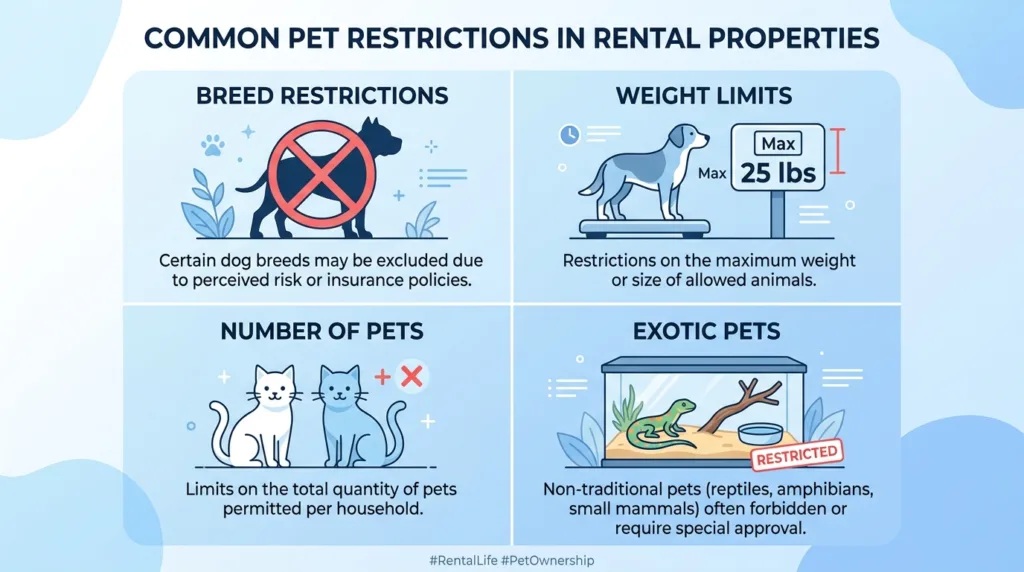
Pet restrictions can take several different forms
There is no single pet policy used across rental properties in the United States.

Rules can differ by landlord, property, housing program and location. Some are primarily about the animal itself. Others regulate behavior or how the pet can use the property.
Common areas of restriction include:
- number of pets;
- species or type of animal;
- dog weight or size;
- particular breeds or breed types;
- registration and approval;
- vaccination or licensing;
- use of common areas;
- noise and nuisance behavior;
- waste cleanup;
- unauthorized additional animals.
Not every rental uses all of these restrictions.
Indeed, two buildings across the street from each other may have very different policies. That is why renters should review the pet rules before signing a lease instead of assuming that a pet-friendly label describes the whole arrangement.
Some properties limit how many pets can live in one unit
A rental may accept pets while limiting the household to one or two animals.
For someone with one cat, that rule might have little practical effect. For a renter moving with two dogs and a cat, however, the same property may not be an option at all.
Number limits can also be more specific than they first appear.
A policy might say:
Maximum of two pets per apartment
Another could say:
One dog or one cat
Those rules produce different outcomes.
The New York City Housing Authority provides a concrete example from public housing: NYCHA’s current pet policy generally permits a household to have either one registered dog or one registered cat, while also allowing reasonable quantities of certain small caged or aquarium pets.
That is NYCHA policy, not a national rule for private apartments.
Its value as an example is that it demonstrates how a single property system can distinguish between dogs, cats and smaller household animals rather than applying one numerical limit to every species.
If multiple animals are part of your household, confirm the details rather than asking only, “Do you allow pets?”
The upcoming guide on pet number limits in rental properties examines this issue in more depth.
Weight restrictions usually matter most to dog owners
Another common screening rule is a maximum dog weight.
A property might accept dogs under a specified adult weight while declining larger dogs. Occasionally, the rule refers to current weight; elsewhere, the policy may focus on expected full-grown weight.
That distinction matters for puppies.
A ten-pound puppy does not necessarily satisfy a policy with a 25-pound adult-weight limit if the dog is expected to grow substantially beyond it.
Again, actual policies show how specific these rules can become. NYCHA currently states that dogs registered under its applicable policy generally cannot exceed 25 pounds in adulthood.
A renter in an ordinary privately owned apartment should not take that number and treat it as a common legal maximum. There is no 25-pound nationwide rule.
Instead, use examples like this as a reminder to check exactly how your property defines its limit.
If the policy lists a weight restriction, find out whether it refers to:
- current weight;
- expected adult weight;
- a veterinary record;
- management’s own documentation requirement.
This can be particularly important when choosing a rental with a young dog.
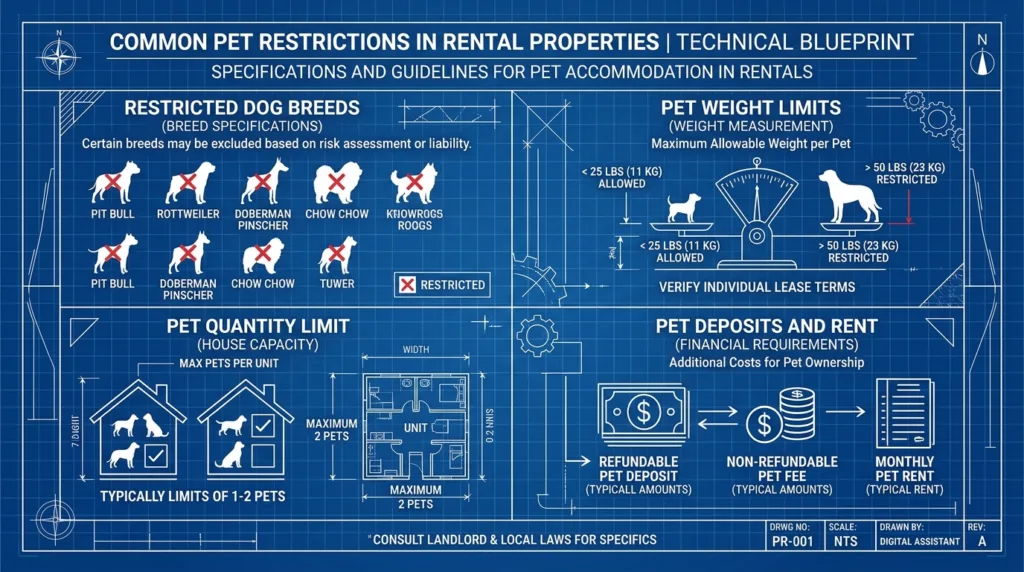
Breed restrictions are separate from weight restrictions
A small dog can still fall under a breed restriction, while a large dog may satisfy a policy that has no prohibited-breed list.
The two rules should therefore be checked separately.
A property with breed-related restrictions may identify specific breeds or may use broader language involving mixed breeds or dogs believed to contain certain breed characteristics.
Because wording can differ, the exact written policy matters.
Once again, this is an example from a particular public housing authority—not evidence that those three breeds are prohibited in rentals throughout New York or the United States.
In fact, this is one of the areas where a renter should resist shortcuts. Searching online for “restricted dog breeds” and finding a generic list does not tell you what your property permits.
The relevant questions are narrower:
What does this property’s written policy say?
Does state or local law affect that restriction?
Does the rule apply to this particular animal and housing situation?
Because the subject has enough complexity to stand on its own, breed and weight restrictions in rentals are covered separately in the next article of this series.
Species restrictions can be easy to miss
Dogs and cats receive most of the attention in rental advertising. Yet renters with other animals may face a different problem: the lease may never clearly say whether their pet is permitted.
A landlord might allow dogs and cats but prohibit reptiles. Another property might permit fish and small caged animals while requiring approval for rabbits. Elsewhere, local law itself may restrict certain animals regardless of the landlord’s preference.
Therefore, “no dog restrictions” does not necessarily mean “all pets accepted.”
This becomes particularly relevant for renters with:
- rabbits;
- guinea pigs;
- hamsters;
- birds;
- reptiles;
- other less common household animals.
NYCHA again illustrates how detailed such distinctions can become: its current policy permits reasonable numbers of small domestic animals such as hamsters, small birds and fish under specified conditions, while separately prohibiting various unconventional or dangerous animals.
Private rental policies can be different, of course.
If you have a smaller or less common animal, our guide to small-pet restrictions in rental leases will help you examine the issue without assuming that rules written for dogs automatically apply.
Approval and registration can be restrictions too
Not every restriction says no.
Sometimes the rule says yes, but only after approval.
A lease may require the renter to provide information about an animal before it moves in. Depending on the property and applicable rules, management might request items such as basic identifying information, proof of vaccination, licensing information or a completed pet registration form.
This means that a property can technically allow your type of pet while still requiring a process before the animal is authorized to live there.
Moving the pet in first and dealing with the paperwork later can therefore create an unnecessary lease problem.
Public housing policies provide a clear example of this distinction: NYCHA requires dogs and cats to be registered and requires specified vaccination and other documentation as part of its pet rules.
The broader lesson is not that every U.S. landlord can demand the same documents.
It is that permission and approval are not always the same thing.
When the lease says pets require prior approval, determine what that process involves before move-in.
A permitted pet can still be subject to behavior rules
Imagine that your dog meets every eligibility requirement:
The breed is accepted.
The weight is within the limit.
The animal is registered.
All required fees have been paid.
The rental can still regulate how that dog behaves on the property.
Common provisions address excessive noise, aggression, unsanitary conditions, pet waste or interference with other residents.
This shifts the question from “Can this pet live here?” to “What conditions apply while the pet lives here?”
The distinction is important because eligibility at move-in is not necessarily permanent permission to disregard the property’s conduct rules.
Those standards belong to that particular housing system, but similar categories of behavior can appear in private leases and community rules.
Dog owners in multifamily housing may therefore want to address recurring problems before they become rental conflicts. Persistent barking, for instance, is discussed separately in our guide to reducing dog barking problems in apartments.
Common-area rules may matter more than they seem
A pet policy can also regulate where an otherwise approved animal may go.
Rules can address elevators, hallways, courtyards, lawns, playgrounds, laundry areas or other shared spaces. Leashes may be required, and certain areas may be designated as pet-free.
These restrictions often look minor while reading a lease. Their practical impact depends heavily on the property.
Consider a dog owner in a large apartment complex.
If the designated pet exit is far from the unit, that route may be repeated several times a day. If pets cannot use a particular courtyard, the renter may need a different outdoor routine. Conversely, a restriction affecting an amenity you never use may make little difference.
Thus, restrictions should be evaluated not only by how strict they sound, but by how often they intersect with daily life.
This is one reason comparing rentals solely by price misses part of the picture. A slightly more expensive property with a workable pet policy can be a better fit than a cheaper apartment whose rules clash with your routine.
Some rules come from outside the landlord’s pet policy
The lease is important, but it is not necessarily the only source of rules affecting an animal.
Depending on the location and housing situation, a renter may also encounter state or local requirements involving licensing, vaccination or types of animals that can legally be kept.
A property policy may incorporate those requirements instead of reproducing all of them.
That is another reason broad internet advice can become misleading.
The sentence:
“This type of pet is allowed in apartments.”
is incomplete without knowing where the apartment is located and what rules apply there.
Likewise:
“Landlords always prohibit this breed.”
is too broad without identifying the actual property policy and jurisdiction.
Good rental research moves from the general to the specific:
United States → state → locality → housing program, if applicable → property → lease → your particular pet
Each layer can matter.
Assistance animals should not be screened as ordinary pets
There is an important boundary to all of these ordinary pet restrictions.
A qualifying assistance animal may fall under fair housing protections rather than the property’s standard pet framework.
This means a housing provider cannot necessarily take an ordinary pet restriction—such as a breed, size or weight rule—and automatically apply it to an assistance animal in exactly the same way.
California’s Civil Rights Department, for example, states that service animals and emotional-support animals covered by fair housing protections are not subject to the breed, size or weight restrictions ordinarily applied to pets.
Federal housing rules also distinguish assistance animals from ordinary pets.
However, this does not mean every animal is exempt from every rule merely because a renter describes it as an assistance animal. Reasonable-accommodation requirements involve their own legal standards and factual circumstances.
For that reason, PetzNewz handles Assistance Animals & Rental Housing as a separate category rather than mixing those questions into routine pet-policy advice.
Read restrictions as a compatibility test
It is easy to view every restriction as an obstacle.
A more useful approach is to treat the policy as a compatibility test between three things:
your pet, your routine and the property.
Suppose the rental permits your dog but limits pets to one animal. That is workable if you have one dog and problematic if you plan to bring a second pet.
A 20-pound dog may fit a property’s weight rule but still be unsuitable if the owner cannot reasonably manage the building’s common-area requirements.
A cat may face no weight restriction at all, yet the lease could include other obligations that affect how the household functions.
Therefore, the goal is not to find a property with the fewest possible pet rules.
It is to find one whose written conditions you understand and can realistically follow.
“Pet-friendly” should survive a closer look
The label on a listing is useful for narrowing a search. It should never replace reading the actual policy.
Before you commit, identify which restrictions affect:
who your pet is — species, breed, size or number;
what you must do — registration, documentation or approval;
how the pet must behave — noise, safety and cleanliness;
where the pet can go — common areas and pet-free zones;
what happens if circumstances change — another animal, a growing puppy or a policy issue during the tenancy.
Some rentals will survive that closer look easily. Others will stop being a realistic option once the details are clear.
Finding that out before signing is not a setback. It is exactly what a careful pet-friendly rental search is supposed to accomplish.

Alex is the content editor at PetzNews, covering pet care guidance and pet-friendly housing topics for renters and property owners across the United States