
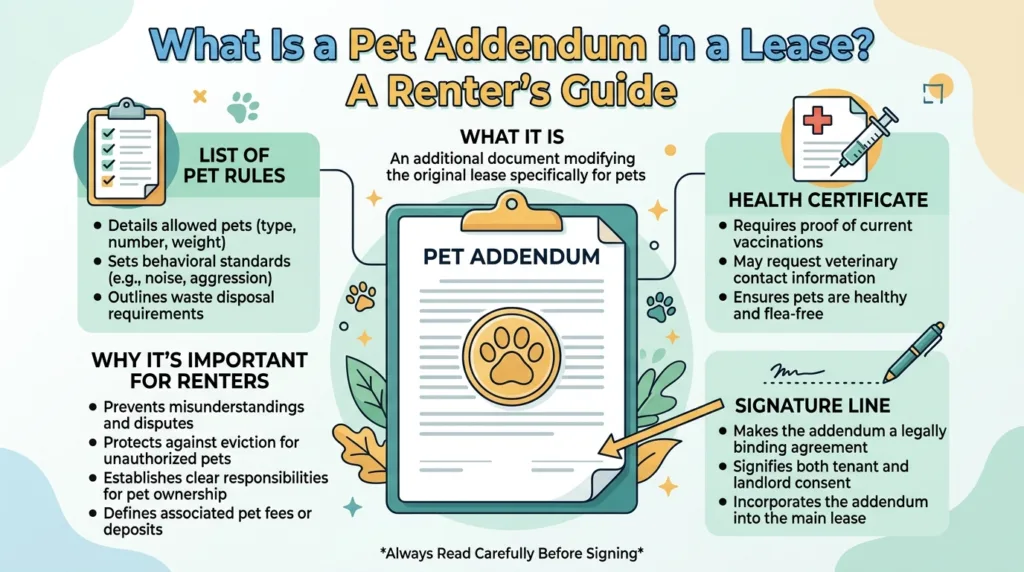
A lease may say that pets are allowed without explaining every condition that comes with that permission. The details can appear somewhere else: in a pet addendum attached to the rental agreement.
A pet addendum is generally an additional document that sets out specific terms for keeping an animal in a rental property. Once properly incorporated into the rental agreement, its provisions can become part of the renter’s contractual obligations.
That makes it more than a formality.
An addendum may identify the approved pet, establish property rules, describe pet-related charges, address damage or cleanup responsibilities, and explain what happens if the renter does not follow the agreed conditions.
For someone renting with an animal, understanding this document before signing is just as important as understanding the pet section of the main lease.
Why landlords use a separate pet addendum
A standard lease has to address many parts of the landlord-tenant relationship. Pet ownership, however, can involve enough additional details that a property chooses to place them in a separate document.


This allows the main lease to establish the general tenancy while the addendum deals specifically with the animal.
The practice is not unusual in housing documentation. In certain HUD-regulated housing programs, for example, official materials specifically contemplate incorporating pet rules into a lease or using a pet agreement or lease addendum to document those rules.
A pet addendum can therefore function as a bridge between a general statement such as “pets permitted with approval” and the actual conditions attached to that approval.
However, the existence of a separate document does not mean renters should read it in isolation.
The lease, addendum and any property pet policy should be reviewed together. If one document says pets are allowed while another imposes additional restrictions, the complete package determines what the renter is being asked to accept.
What information can appear in a pet addendum?
There is no single nationwide pet-addendum template that every U.S. rental property must use.
Consequently, the contents can vary substantially.
A document may include basic identification information such as:
- the pet’s name;
- species;
- breed or type;
- approximate weight;
- color or description;
- number of approved animals;
- vaccination or licensing information when applicable.
Other provisions may focus more heavily on conduct and property use.
For example, an addendum may address whether animals must be leashed in common areas, how waste must be handled, whether pets are permitted in particular shared spaces, or how noise complaints will be addressed.
Financial provisions can also appear there. If the property charges a deposit, fee or recurring amount, renters should understand the difference between pet deposits, pet fees and pet rent rather than assuming every pet-related payment serves the same purpose.
The key is not how many clauses the addendum contains. It is whether you understand the obligations that apply to your particular tenancy.
The approved pet should be clearly identifiable
One practical purpose of a pet addendum is documenting which animal or animals have actually been approved.
Suppose a property permits one dog, and the addendum identifies that dog. Bringing a second dog into the unit later may not automatically fall under the original approval.
Likewise, permission for a cat does not necessarily establish permission for another species.
Therefore, renters should compare the animal information in the addendum with the pet they actually intend to keep in the home.
Pay attention to wording involving:
- number of pets;
- species;
- breed or type;
- size or weight;
- age;
- replacement pets;
- additional pets.
The broader property policy may impose limits as well. For that reason, it is useful to read the rental’s entire pet policy before applying, not merely the page requiring your signature.
Read the money clauses particularly carefully
A pet addendum may contain financial terms that materially change the cost of the rental.
For instance, it may specify a one-time pet fee, a deposit or recurring pet rent. It may also explain whether an amount is charged per animal.
Those distinctions matter because a monthly charge that looks small can accumulate over a full lease term.
However, renters should also remember that state law can affect what a landlord may collect and how a payment is classified.
Massachusetts provides a useful example of why nationwide generalizations are risky. The state’s current landlord-tenant guidance says landlords may collect only certain specified payments at the beginning of a tenancy and states that upfront pet fees are not among the permitted charges. Massachusetts Guide to Landlord and Tenant Rights
That does not create a national rule against pet fees. Instead, it demonstrates why a clause that might be ordinary in one state can require a different analysis somewhere else.
Therefore, whenever a pet addendum creates a meaningful financial obligation, check the rules that apply where the property is located.
An addendum can establish behavior rules inside and outside the unit
Pet rules often extend beyond damage to the apartment itself.
A property may regulate animal behavior in:
- hallways;
- elevators;
- courtyards;
- dog areas;
- lobbies;
- landscaped spaces;
- other common areas.
There may also be rules about leashes, pet waste, unattended animals or nuisance behavior.
These conditions can matter considerably in multifamily housing because an animal’s behavior can affect neighbors as well as the renter’s own unit.
Noise is a common example.
A renter with a dog may comply with every financial requirement yet still encounter problems if persistent barking conflicts with lease rules. For people living in multifamily housing, planning how to reduce dog barking problems in an apartment can therefore be part of complying with the rental agreement, not simply a matter of convenience.
Still, do not assume that every property uses the same behavioral rules. Read what your documents actually require.
Property-damage language deserves more than a quick glance
Another common subject is damage caused by the approved animal.
An addendum may state that the renter remains responsible for certain pet-related damage even when a pet fee or deposit has already been paid.
That distinction matters.
An upfront pet payment should not automatically be interpreted as an unlimited damage waiver. Conversely, a clause assigning responsibility does not mean that every mark discovered at move-out was necessarily caused by the animal.
Documentation helps establish a clearer starting point.
Before settling into a new property with your pet, document the rental before moving in. Existing scratches, stains, damaged trim or worn flooring should not become mysteries months later.
California’s current official landlord-tenant guide, for example, discusses the importance of the rental agreement, security deposits and documenting property condition within the state’s particular legal framework. California Department of Real Estate — Landlord/Tenant Rights Guide
Although the legal rules differ elsewhere, preserving a record of the starting condition is a practical precaution for renters in any state.
Check what happens if a rule is violated
The consequences section of an addendum may be easy to overlook because renters naturally focus first on whether the pet is approved.
Yet it can be one of the most important parts.
A document may describe procedures or consequences associated with:
- unauthorized animals;
- repeated waste violations;
- excessive noise;
- aggressive behavior;
- damage;
- failure to follow common-area rules;
- failure to maintain required approvals or records.
In some housing programs, pet-rule violations are explicitly tied to notice procedures and, under certain circumstances, removal of the pet or tenancy consequences.
That does not mean every violation in every private rental automatically leads to eviction. The applicable lease, state law, local law and type of housing all matter.
The more accurate lesson is simpler: do not sign an addendum without understanding what the document says happens when its rules are not followed.
Can the landlord change the pet addendum later?
This question cannot be answered with a single nationwide yes or no.
Generally, a signed lease is a contract, and the ability to alter its terms depends on the agreement and applicable law.
For example, the New York Attorney General explains that a lease in force cannot simply be changed unless both parties agree, and that agreed changes should be documented appropriately. New York Attorney General — Residential Tenants’ Rights Guide
Texas provides similar practical guidance: the state Attorney General advises renters to read the lease carefully and, when landlord and tenant agree to alter a provision, put the change into the agreement rather than relying on an informal understanding. Texas Attorney General — Renter’s Rights
However, the rules affecting a particular renter may be different depending on lease type, renewal status, jurisdiction and housing program.
Therefore, if a property attempts to add a new material pet obligation during an existing lease term, do not assume either that it is automatically valid or automatically invalid. Review the actual contract and the applicable local rules.
A pet addendum should match what you were promised
Suppose a leasing agent tells you:
“Your dog is approved, and the only extra cost is a $250 pet fee.”
The addendum then says:
- $250 pet fee;
- $45 monthly pet rent;
- an additional deposit.
That discrepancy should be resolved before signing.
Likewise, if the listing says two pets are allowed but the addendum identifies only one, ask for clarification.
This is one reason asking the right questions before renting with a pet is useful. Verbal assurances are easier to misunderstand or dispute later than written terms that clearly match the agreement.
If something important is inconsistent, ask the landlord or property manager to explain it and, where appropriate, correct the document before you sign.
Assistance animals should not simply be inserted into ordinary pet rules
A pet addendum is designed around pets. Assistance animals can involve a different legal framework.
Under federal fair housing rules, qualifying assistance animals are not treated as ordinary pets. Consequently, standard pet fees, deposits or restrictions cannot simply be applied in the same manner when a reasonable accommodation is required.
HUD’s housing materials distinguish assistance animals from pets and address them through the reasonable-accommodation framework rather than ordinary pet ownership rules. HUD — Assistance Animals in Housing
A renter should therefore be cautious if a property tries to resolve an assistance-animal request merely by inserting the animal into its standard pet addendum and applying every ordinary pet provision unchanged.
At the same time, assistance-animal situations have requirements of their own. They should be evaluated under the relevant fair housing rules rather than treated as a way to bypass ordinary pet policies.
Keep a complete copy after signing
Once the lease and addendum are executed, retain the complete set of documents.
Do not save only the signature page.
Keep copies of:
- the main lease;
- pet addendum;
- pet policy;
- move-in inspection documentation;
- written pet approval;
- receipts for pet-related payments;
- relevant communications about changes or exceptions.
The reason is practical: months later, a dispute may involve a small clause that was easy to forget at move-in.
Moreover, the pet addendum may refer back to another section of the lease. Without the entire agreement, it can be difficult to understand how the provisions interact.
The signature is the last step, not the first
A pet addendum is useful because it puts expectations into writing. Nevertheless, that benefit disappears if the renter signs without understanding what the document actually adds to the lease.
Before signing, identify the approved animal, verify every charge, read the behavior and common-area rules, understand damage provisions, and check what the document says about violations.
Then compare those terms with the main lease and the property’s broader pet policy.
If the documents agree and you understand the obligations, the addendum provides clarity for both sides.
If they do not agree, the time to resolve that discrepancy is before your signature turns the paperwork into part of your rental relationship.

Alex is the content editor at PetzNews, covering pet care guidance and pet-friendly housing topics for renters and property owners across the United States