
Designing your cat’s environment is not about buying more toys; it’s about arranging opportunity. In a small apartment the right structure — not sheer square footage — restores agency, reduces stress, and channels natural behavior into satisfying outlets.
Thesis: Enrichment by Behavioral Environment Design
If a cat knocks a phone charger off a table, reaches repeatedly for a curtain edge, or stares at the same blank wall until she invents movement, those are not arbitrary misbehaviors. They are readable signals that the apartment is not offering the set of behavioral choices a cat needs. Behavioral environment design treats the home as a micro-ecosystem: rather than treating toys as the only intervention, it first maps the behaviors cats must express daily — climbing, hiding, scratching, hunting, choosing resting places — then creates affordances that allow those behaviors to occur safely and predictably.
This approach reframes enrichment away from accumulation (more toys, more gadgets) and toward opportunity (where and how the cat can choose). The sections below separate common categories — toys versus agency, vertical space, hunting sequence, rotation and novelty, and multi-cat dynamics — into practical, apartment-friendly strategies.
Toys vs. Agency: Why Objects Alone Don’t Solve Boredom
Toys are tools, not solutions. A feather wand or a battery mouse can spark interest for a moment, but they do not create long-term choice. Agency is the cat’s ability to decide: where to perch, when to hunt, where to retreat, when to approach you. Without agency, toys become background clutter; with agency, toys become meaningful options that a cat can select to meet behavioral needs.
Practical distinction:
– Toys: movable objects that simulate prey or provide tactile input.
– Agency: environmental structures and scheduling that let the cat make choices over time.
Examples that emphasize agency in a small apartment:
– Multiple perches at different heights and locations so the cat can choose vantage points.
– Several appropriately placed scratch surfaces that align with natural marking behavior.
– Mealtime devices and puzzle feeders that require decision-making and effort to access food.
– Predictable play and feeding routine so the cat can plan and feel in control.
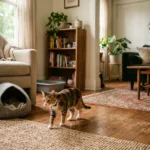


When you introduce a toy, pair it with an opportunity: use the wand at an elevated perch, or hide kibble in a puzzle feeder placed on a shelf. That coupling repeatedly creates a behavioral loop: choose — act — succeed — rest. The loop restores a cat’s sense of competence, which is at the core of welfare.
Vertical Space: The High Ground Is Non-Negotiable
Cats are vertical strategists. Height offers surveillance, escape, and control — all of which reduce baseline anxiety. In small apartments the vertical axis is the most efficient resource because it doesn’t require more floor area. Even modest investments yield large behavioral returns.
- Install at least one reliable elevated perch in each area the cat spends time in (living room, bedroom, kitchen doorway if safe).
- Mix perch types: a window-facing shelf, a soft high bed, a tall cat tree near a sunny window. Different textures and heights give different affordances (watching, napping, retreating).
- For rentals, use non-invasive options (freestanding trees, tension-mounted shelves) and check lease terms or landlord guidance before drilling. When in doubt consult your building’s policies; documentation or permissions may be required for permanent fixtures.
Authoritative sources emphasize vertical territory: the Ohio State University Indoor Pet Initiative and research summarized by the National Institutes of Health highlight elevated perches and vertical access as core welfare supports.
The Hunting Sequence: How Mealtime Rebuilds Predatory Behavior
Predation for cats is a sequence: orient → stalk → chase → pounce → catch → kill → eat → groom → sleep. Dry kibble delivered straight to a bowl collapses most of that sequence into “eat.” Puzzle feeders, food-dispensing toys, timed feeders, and play-before-meal routines reintroduce the missing phases, producing deep behavioral satisfaction with modest space requirements.
Practical options that fit studios:
– Slow feeders and modular puzzle feeders placed on a low shelf or under a small console.
– Scatter feeding in a controlled area (scatter a measured portion around a rug for 5–10 minutes).
– Short 3–5 minute wand-play immediately before mealtime to simulate a hunt, then bowl access as the “catch.”
Cornell University’s Feline Health Center underlines the safety and value of toys that engage predatory behaviors while recommending supervised use for toys with strings or small parts (Cornell Feline Health Center).
Rotation, Novelty, and the Role of Observation
Rotation is the simplest method to preserve novelty without buying more items. Cats habituate quickly; an out-of-sight cookie jar returns to value when it reappears. Rotate toys weekly, change the location of a scratcher fortnightly, and periodically reconfigure perches to create new sightlines. Importantly, rotate in a way that preserves predictability for the cat around core resources (food, litter, primary bed).
Observation is the human skill that ties design to effect. Build brief, regular checks into your week:
– Spend five minutes each evening observing where your cat chooses to be and what she does (watching, grooming, patrolling).
– Note any changes in where she sleeps, whether she avoids particular rooms, and how she uses perches and scratching posts.
These observations will tell you which affordances are working and where competition or avoidance is emerging.
Multi-Cat Apartments: Resource Distribution and Competition
When more than one cat shares limited space, the distribution of resources becomes the primary behavioral lever. Competition is often subtle: a dominant cat may occupy the best window perch and the other cat may restrict its movements, creating chronic low-level stress. The principle is simple and evidence-based: provide N+1 of each critical resource where N is the number of cats.
- Feeding: separate feeding stations; consider micro-schedules to give each cat private access.
- Litter: minimum number of boxes = number of cats + 1, placed in different locations and levels if possible.
- Perches: at least as many quality elevated options as cats, spread across rooms.
- Hiding spaces: multiple enclosed choices (boxes, covered beds) placed where cats already feel comfortable.
Observation here is essential: watch the interactions around resources, and if one cat consistently blocks access, add duplicate or higher-quality alternatives in new locations. If stress behaviors persist, a veterinary behaviorist consultation is the cautious next step.
Apartment-Friendly Decision Matrix
Use this quick matrix to match a behavioral need to apartment-scale solutions and a suggested frequency for maintenance or rotation.
| Behavioral Need | Apartment Solutions | Where to Place | Rotation / Maintenance |
|---|---|---|---|
| Climbing / Surveillance | Window perch, wall-mounted shelf, compact cat tree | Near windows or room entrances; distribute across rooms | Inspect monthly; reposition seasonally |
| Hiding / Safe Retreat | Covered bed, box with small entrance, under-furniture refuge | Edges of room or higher shelves; quiet corners | Clean bedding weekly; rotate covered options every 2–4 weeks |
| Scratching / Marking | Tall vertical scratcher, horizontal scratch pad | Next to sofas, near doors, beside windows where cat marks | Replace when worn; rotate orientation monthly |
| Hunting / Foraging | Puzzle feeders, scatter feeding, wand-play | Feeding area, elevated shelf for puzzle feeders | Daily feeding play; clean feeders weekly |
Enrichment Schedule: A Practical Weekly Plan
Consistency is as important as variety. Below is a schedule you can adapt to your routine. Times are illustrative; the key is regular repetition and short, rewarding interactions rather than long, irregular pushes.
| Time | Activity | Goal |
|---|---|---|
| Morning (5–10 minutes) | Quick wand/play session or puzzle feeder breakfast | Start the day with predatory sequence and exercise |
| Midday (5 minutes) | Scatter a small portion of kibble / rotate a toy | Break up long rest periods; add novel choice |
| Evening (10–15 minutes) | Interactive play followed by meal or puzzle food | Replicate hunt-to-eat; wind-down activity |
| Weekly | Rotate toys, swap scratcher location, add a temporary box | Maintain novelty and test new affordances |
| Monthly | Deep-clean beds and feeders; inspect perches for stability | Safety and continued usability |
Observation Checklist: Quick Behavioral Audit
Spend two minutes each day checking these items. They guide small corrections before issues escalate.
- Where did the cat spend most time today? (shelves, floor, windowsill)
- Any new avoidance (avoiding a room or perch) or increased startle responses?
- Is scratching concentrated on one piece of furniture? Add an aligned alternative nearby.
- Did play sessions end with the cat eating or resting? (good closing sequence)
- For multi-cat homes: Did any cat block another from a resource repeatedly?
Links for Practical Next Steps
If you’re moving or negotiating with a landlord about modifications, review the moving-day checklist for renters with pets. For apartment hunting or evaluating amenity trade-offs that affect enrichment (window orientation, balcony safety, in-unit storage for perches), see the pet-friendly apartment amenities guide. To refine your reading of feline behavior while you observe, the cat body language guide is a practical companion.
Note: If your cat’s behavior includes severe aggression, sustained withdrawal, elimination outside the litter box, or marked changes in appetite, consult a veterinarian. This article gives behavioral-environmental strategies, not medical diagnoses. For landlord/lease changes, proceed cautiously and seek written permission for permanent fixtures.
Frequently Asked Questions
1. My apartment is tiny — how much vertical space do I realistically need?
You don’t need to cover every wall. Aim for one stable elevated vantage point in each main area where your cat spends time (living area, sleeping area). Combine a window perch with a compact cat tree or tension-mounted shelf for maximum benefit with minimal footprint.
2. How do I introduce a new perch or scratcher so a cautious cat accepts it?
Place the new item at the edge of a familiar area rather than directly in the center of a room. Add an item that carries their scent (a blanket) and pair the introduction with a positive routine — a short play session or a small food reward nearby. Rotate old and new items so novelty is preserved.
3. My two cats seem fine but one is monopolizing the window. Should I worry?
Monopolization can create chronic stress for the other cat. Add a second elevated option at a similar quality level in a different location and observe interactions. If avoidance or stress signs continue, separating key resources (feeding areas, litter boxes) and consulting a behaviorist are reasonable next steps.
Authoritative references: NIH review of environmental enrichment for cats (PMCID), Cornell Feline Health Center guidance on safe toys and enrichment (Cornell), and The Ohio State University Indoor Pet Initiative (OSU).

Alex is the content editor at PetzNews, covering pet care guidance and pet-friendly housing topics for renters and property owners across the United States